Showing posts with label Quentin Durward. Show all posts

Saturday, April 21, 2012

Orleans


‘21st April, 1644. I went about to view the city, which is well built of stone, on the side of the Loire. About the middle of the river is an island, full of walks and fair trees, with some houses. This is contiguous to the town by a stately stone bridge, reaching to the opposite suburbs, built likewise on the edge of a hill, from whence is a beautiful prospect. At one of the extremes of the bridge are strong towers, and about the middle, on one side, is the statue of the Virgin Mary, or Pieta, with the dead Christ in her lap, as big as the life. At one side of the cross, kneels Charles VII., armed, and at the other Joan d'Arc, armed also like a cavalier, with boots and spurs, her hair disheveled, as the deliveress of the town from our countrymen, when they besieged it. The figures are all cast in copper, with a pedestal full of inscriptions, as well as a fair column joining it, which is all adorned with fleurs-de-lis and a crucifix, with two saints proceeding (as it were) from two branches out of its capital.’

On April 21st, 1644, John Evelyn’ diary shows he was touring Orleans, and Jeanne D’Arc’s memorial statue.  Duke Louis of Orleans and Count de Dunois, the Bastard of Orleans,  appear in Walter Scott’s “Quentin Durward”.


‘Upon the arm of his relation Dunois, walking with a step so slow and
melancholy that he seemed to rest on his kinsman and supporter, came
Louis Duke of Orleans, the first prince of the Blood Royal (afterwards
King, by the name of Louis XII), and to whom the guards and attendants
rendered their homage as such. The jealously watched object of Louis's
suspicions, this Prince, who, failing the King's offspring, was heir to
the kingdom, was not suffered to absent himself from Court, and,
while residing there, was alike denied employment and countenance.
The dejection which his degraded and almost captive state naturally
impressed on the deportment of this unfortunate Prince, was at this
moment greatly increased by his consciousness that the King meditated,
with respect to him, one of the most cruel and unjust actions which a
tyrant could commit, by compelling him to give his hand to the Princess
Joan of France, the younger daughter of Louis, to whom he had been
contracted in infancy, but whose deformed person rendered the insisting
upon such an agreement an act of abominable rigour.
 
The exterior of this unhappy Prince was in no respect distinguished
by personal advantages; and in mind, he was of a gentle, mild and
beneficent disposition, qualities which were visible even through
the veil of extreme dejection with which his natural character was at
present obscured. Quentin observed that the Duke studiously avoided even
looking at the Royal Guards, and when he returned their salute, that he
kept his eyes bent on the ground, as if he feared the King's jealousy
might have construed the gesture of ordinary courtesy as arising from
the purpose of establishing a separate and personal interest among them…’

Tuesday, March 27, 2012

Mary of Burgundy


"Messires," said Crevecoeur, "the Duke ought in justice to have the
first of my wares, as the Seigneur takes his toll before open market
begins. But tell me, are your news of a sad or a pleasant complexion?"
 
The person whom he particularly addressed was a lively looking man,
with an eye of great vivacity, which was corrected by an expression
of reflection and gravity about the mouth and upper lip--the whole
physiognomy marking a man who saw and judged rapidly, but was sage and
slow in forming resolutions or in expressing opinions. This was the
famous Knight of Hainault, son of Collara, or Nicolas de l'Elite, known
in history, and amongst historians, by the venerable name of Philip de
Comines, at this time close to the person of Duke Charles the Bold, and
one of his most esteemed counsellors. He answered Crevecoeur's question
concerning the complexion of the news of which he and his companion, the
Baron D'Hymbercourt, were the depositaries.

[D'Hymbercourt, or Imbercourt, was put to death by the inhabitants
of Ghent, with the Chancellor of Burgundy, in the year 1477. Mary of
Burgundy, daughter of Charles the Bold, appeared in mourning in the
marketplace, and with tears besought the life of her servants from her
insurgent subjects, but in vain. S.]

Tearful Mary of Burgundy was the daughter of Charles the Bold, a major character in Walter Scott’s “Quentin Durward”, from which the text/note above come.  Mary married a Habsburg, Archduke Maximilian of Austria, but died five years later after a fall from a horse.  Mary was 25 when she died, on March 27th, 1482.

Wednesday, December 14, 2011

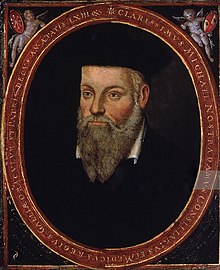
Nostradamus


The King then pulled forth a paper from his pocket, and, ere he gave
it to Martivalle, said, in a tone which resembled that of an apology,
"Learned Galeotti, be not surprised that, possessing in you an oracular
treasure, superior to that lodged in the breast of any now alive, not
excepting the great Nostradamus himself [a French astrologer of the
sixteenth century, author of a book of prophecies, which was condemned
by the papal court in 1781], I am desirous frequently to avail myself of
your skill in those doubts and difficulties which beset every Prince
who hath to contend with rebellion within his land, and with external
enemies, both powerful and inveterate."…

Michel de Nostradame needs no introduction.  Nostradamus was born in 1503, on December 14.  Sir Walter Scott mentions him in “Quentin Durward” (text above).

Sunday, April 17, 2011

A View of Calais

'...The Vice-Admiral dined with us, and in the afternoon my Lord called me to give him the commission for him, which I did, and he gave it him himself. A very pleasant afternoon, and I upon the deck all the day, it was so clear that my Lord’s glass shewed us Calais very plain, and the cliffs were as plain to be seen as Kent, and my Lord at first made me believe that it was Kent...'

On April 17, 1660, Samuel Pepys records (in his diary) enjoying the sight of Calais through a glass.  The telescope had been around for about 50 years at this time.  As Calais lies so close to England, it has seen its share of military action, as well as sight-seeing.  Walter Scott alludes to Calais' situation as a portal as part of the setting of "Quentin Durward":

'But the excitement of the moment presently gave way to the host of political considerations, which, at that conjuncture, rendered an open breach with Burgundy so peculiarly perilous. Edward IV, a brave and victorious king, who had in his own person fought thirty battles, was now established on the throne of England, was brother to the Duchess of Burgundy, and, it might well be supposed, waited but a rupture between his near connexion and Louis, to carry into France, through the ever open gate of Calais, those arms which had been triumphant in the English civil wars, and to obliterate the recollection of internal dissentions by that most popular of all occupations amongst the English, an invasion of France. To this consideration was added the uncertain faith of the Duke of Bretagne, and other weighty, subjects of reflection. So that, after a deep pause, when Louis again spoke, although in the same tone, it was with an altered spirit. "But God forbid," he said, "that aught less than necessity should make us, the Most Christian King, give cause to the effusion of Christian blood, if anything short of dishonour may avert such a calamity. We tender our subjects' safety dearer than the ruffle which our own dignity may receive from the rude breath of a malapert ambassador, who hath perhaps exceeded the errand with which he was charged. — Admit the envoy of Burgundy to our presence."...'

Friday, April 15, 2011

Madame de Pompadour

It's good to be the king, and it may be good to be the mistress as well.  Especially if you are the chief mistress, as Jeanne Antoinette Poisson, the Madame de Pompadour, became for Louis XV of France.  Jeanne filled a void in Louis' heart after his second chief mistress died, and she enjoyed a short life of favor, dying of tuberculosis on April 15, 1764.

We find Madame de Pompadour mentioned in the introduction to Walter Scott's "Quentin Durward", which was set in France.  Here the author discusses his meeting with a character called Marquis de Hautlieu.

'...Observing this peculiarity, I backed out of the candid confession which my vanity had meditated, and engaged the Marquis [de Hautlieu] in farther remarks on the mansion of his ancestors. "There," he said, " was the theatre where my father used to procure an order for the special attendance of some of the principal actors of the Comedie Francoise, when the King and Madame Pompadour more than once visited him at this place ; — yonder, more to the centre, was the Baron's hall, where his feudal jurisdiction was exercised when criminals were to be tried by the Seigneur or his bailiff; for we had, like your old Scottish nobles, the right of pit and gallows, or fossa cum furca, as the civilians term it; — beneath that lies the Question-chamber, or apartment for torture ; and truly, I am sorry a right so liable to abuse should have been lodged in the hands of any living creature. But," he added, with a feeling of dignity derived even from the atrocities which his ancestors had committed beneath the grated windows to which he pointed, "such is the effect of superstition, that, to this day, the peasants dare not approach the dungeons, in which, it is said, the wrath of my ancestors had perpetrated, in former times, much cruelty." As we approached the window, while I expressed some curiosity to see this abode of terror, there arose from its subterranean abyss a shrill shout of laughter, which we easily detected as produced by a group of playful children, who had made the neglected vaults a theatre, for a joyous romp at Colin Maillard....'

Thursday, January 6, 2011

Joan d'Arc

'...Among others who seemed of quality, the most remarkable was the Count de Dunois, the son of that celebrated Dunois, known by the name of the Bastard of Orleans, who, fighting under the banner of Jeanne d'Arc, acted such a distinguished part in liberating France from the English yoke...'

Joan d'Arc's birthdate is not known with certainty, but is often placed on January 6, 1412.  Scott included reference to her in his French-set Quentin Durward.  Joan of Arc fought in the Hundred Years War against England, as did Jean de Dunois, supporting the future Charles VII of France.

Friday, December 18, 2009

Saint Gatian


December 18 is the feast day of Saint Gatian, the first Bishop of Tours. Saint Gatian reached Gaul in the mid-third century. He proceeded to convert many of the Gauls to Christianity.


Scott includes the Church of St. Gatian - the Cathedral of Tours - in his Quentin Durward. This cathedral was erected between the 13th and 16th centuries.


"...The towers of the church of Saint Gatien were also visible, and the gloomy strength of the Castle, which was said to have been, in ancient times, the residence of the Emperor Valentinian..."

Monday, November 23, 2009

Louis, Duke of Orleans

On November 23, 1407, Louis, Duke of Orleans, was assassinated in Paris. The murder was undertaken at the behest of John the Fearless, Duke of Burgandy. The source of Louis and John's dispute was the guardianship of the children of Louis eldest brother, Charles the Mad.

Louis is included as a character in Scott's Quentin Durward:

"...Upon the arm of his relation Dunois, ...came Louis Prince of Orleans, the first prince of the Royal Blood (afterwards king, by the name of Louis XII)..."

Sunday, August 30, 2009

Louis XI

This day (August 30) in 1483 saw the death of France's Louis XI. According to Wikipedia, Louis was largely responsible for undermining the fuedal system. The changing structure of political life was a focus of Scott's Quentin Durward. From that novel:

"...Among those who were the first to ridicule and abandon the self-denying principals in which the young knight was instructed, and to which he was so carefully trained up, Louis XI was the chief. The sovereign was of a character so purely selfish - so guiltless of entertaining any purpose unconnected with his ambition, covetousness and desire of selfish enjoyment - that he seems almost an incarnation of the devil himself, permitted to do his utmost ot corrupt our ideas of honour at the very source."

Monday, August 24, 2009

St. Bartholomew's Day

August 24th is associated with the apostle St. Bartholomew, who was flayed alive while on mission in Armenia. The feast of St. Bartholomew's day appears in several of Scott's novel's, including Kenilworth, Peveril of the Peak, and Quentin Durward. St. Bartholomew's symbol is the knife, in remembrance of Bartholomew's horrible death. It is an ill portent, when the day appears in Scott's stories.

There was also the St. Bartholomew's Day Massacre, which began on 8/24/1572. The initial violence occurred in Paris, where Catholic (Queen Mother) Catherine de Medici's daughter Marguerite was to be married to Huguenot Prince Henry of Navarre. Thousands of Huguenots were killed (est. 8k - 20k) in the on-going slaughter, which persisted into September of that year.