Showing posts with label December 14. Show all posts

Wednesday, December 14, 2011

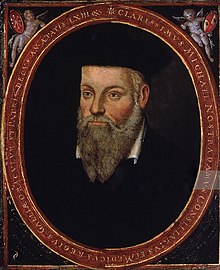
Nostradamus


The King then pulled forth a paper from his pocket, and, ere he gave
it to Martivalle, said, in a tone which resembled that of an apology,
"Learned Galeotti, be not surprised that, possessing in you an oracular
treasure, superior to that lodged in the breast of any now alive, not
excepting the great Nostradamus himself [a French astrologer of the
sixteenth century, author of a book of prophecies, which was condemned
by the papal court in 1781], I am desirous frequently to avail myself of
your skill in those doubts and difficulties which beset every Prince
who hath to contend with rebellion within his land, and with external
enemies, both powerful and inveterate."…

Michel de Nostradame needs no introduction.  Nostradamus was born in 1503, on December 14.  Sir Walter Scott mentions him in “Quentin Durward” (text above).

Tuesday, December 14, 2010

Critique by William Taylor

'...Chalmers writes in great transports about Scott's versions; but weightier encouragement came from Mr. Taylor of Norwich, himself the first translator of the Lenore.


[Footnote 130: Some extracts from this venerable person's unpublished Memoirs of his own Life have been kindly sent to me by his son, the well-known physician of Chelsea College, from which it appears that the reverend doctor, and, more particularly still, his wife, a lady of remarkable talent and humor, had formed a high notion of Scott's future eminence at a very early period of his life. Dr. S. survived to a great old age, preserving his faculties quite entire, and I have spent many pleasant hours under his hospitable roof in company with Sir Walter Scott. We heard him preach an excellent circuit sermon when he was upwards of eighty-two, and at the Judges' dinner afterwards he was among the gayest of the company.]
I need not tell you, sir [he writes], with how much eagerness I opened your volume--with how much glow I followed The Chase--or with how much alarm I came to William and Helen. Of the latter I will say nothing; praise might seem hypocrisy--criticism envy. The ghost nowhere makes his appearance so well as with you, or his exit so well as with Mr. Spenser. I like very much the recurrence of

"The scourge is red, the spur drops blood,
The flashing pebbles flee;"

but of William and Helen I had resolved to say nothing. Let me return to The Chase, of which the metric stanza style pleases me entirely; yet I think a few passages written in too elevated a strain for the general spirit of the poem. This age leans too much to the Darwin style. Mr. Percy's Lenore owes its coldness to the adoption of this; and it seems peculiarly incongruous in the ballad--where habit has taught us to expect simplicity. Among the passages too stately and pompous, I should reckon--


"The mountain echoes startling wake--
And for devotion's choral swell
Exchange the rude discordant noise--
Fell Famine marks the maddening throng
With cold Despair's averted eye,"--

On December 14, 1796, William Taylor of Norwich wrote a letter to Sir Walter Scott, with the comments above.  The text was found in John Gibson Lockhart's "Memoirs of the Life of Sir Walter Scott".

Taylor was six years senior to Walter Scott, and outlived him by five years as well (lived between 1765 and 1836).  Taylor contributed to the interest in German literature that swept England and Scotland in the late 18th century.  In fact, Taylor has been referred to as "the founder of the Anglo-German school in England" (by G. Borrow).  Taylor's translation of Gottfried Burger's "Lenore" was influential to Coleridge and Wordsworth, for example.  Taylor also published a "Historic Survey of German Poetry" (1830), which provided an overview of the development from Old and Middle High German to the 19th century.

Monday, December 14, 2009

James V of Scotland

James V died on December 14, 1542, soon after the Battle of Solway Moss. James did not join the field of battle, but was situated at Lochmaben. He retreated to Falkland Palace after his Scottish forces were routed by English forces under the command of Sir Thomas Wharton. James' troops were to have been led by Lord (Robert) Maxwell, but Maxwell fell ill, leaving command uncertain. Sir Oliver Sinclair de Pitcairns attempted to assume command, but allegiance was to Maxwell; the battle was lost. James died two weeks after Solway Moss, leaving his newborn daughter Mary as hier. James commented as death approached "It came wi' a lass, and it shall go wi' a lass".

Besides the English, James had difficulties with the powerful Douglas clan. Scott's most popular poem, "The Lady of the Lake", covers the feud between James V and James Douglas.