Showing posts with label Memoirs of the Life of Sir Walter Scott. Show all posts

Monday, August 13, 2012

Order of the Garter


‘Thursday 13 August 1663 

…Thence to Mrs. Hunt’s, where I left my wife, and I to walk a little in St. James’s Park, while Mrs. Harper might come home, with whom we came to speak about her kinswoman Jane Gentleman to come and live with us as a chamber mayde, and there met with Mr. Hoole my old acquaintance of Magdalen, and walked with him an hour in the Parke, discoursing chiefly of Sir Samuel Morland, whose lady is gone into France. It seems he buys ground and a farm in the country, and lays out money upon building, and God knows what! so that most of the money he sold his pension of 500l. per annum for, to Sir Arthur Slingsby, is believed is gone. It seems he hath very great promises from the King, and Hoole hath seen some of the King’s letters, under his own hand, to Morland, promising him great things (and among others, the order of the Garter, as Sir Samuel says); but his lady thought it below her to ask any thing at the King’s first coming, believing the King would do it of himself, when as Hoole do really think if he had asked to be Secretary of State at the King’s first coming, he might have had it. And the other day at her going into France, she did speak largely to the King herself, how her husband hath failed of what his Majesty had promised, and she was sure intended him; and the King did promise still, as he is a King and a gentleman, to be as good as his word in a little time, to a tittle: but I never believe it…’

Being appointed to The order of the Garter would have been quite an honor for Samuel Morland, or anyone.  Morland entered Charles II’s service due to his work in the field of espionage, and his development of cryptography.  Morland was an associate of Samuel Pepys, whose diary is the source of today's post (August 13th).

John Gibson Lockhart’s “Memoirs of the Life of Sir Walter Scott” includes the following story of Scott a member of this order, in 1813. 

‘Scott had been for some time under an engagement to meet the Marquis of Abercorn at Carlisle, in the first week of August, for the transaction of some business connected with his brother Thomas's late administration of that nobleman's Scottish affairs; and he had designed to pass from Drumlanrig to Carlisle for this purpose, without going back to Abbotsford. In consequence of these repeated harassments, however, he so far altered his plans as to cut short his stay at Drumlanrig, and turn homewards for two or three days, where James Ballantyne met him with such a statement as in some measure relieved his mind.

He then proceeded to fulfil his engagement with Lord Abercorn, whom he encountered travelling in a rather peculiar style between Carlisle and Longtown. The ladies of the family and the household occupied four or five carriages, all drawn by the Marquis's own horses, while the noble Lord himself brought up the rear, mounted on horseback, and decorated with the ribbon of the order of the Garter. On meeting the cavalcade, Scott turned with them, and he was not a little amused when they reached the village of Longtown, which he had ridden through an hour or two before, with the preparations which he found there made for the dinner of the party. The Marquis's major-domo and cook had arrived there at an early hour in the morning, and everything was now arranged for his reception in the paltry little public-house, as nearly as possible in the style usual in his own lordly mansions. The ducks and geese that had been dabbling three or four hours ago in the village-pond were now ready to make their appearance under numberless disguises as entrees; a regular bill-of-fare flanked the noble Marquis's allotted cover; every huckaback towel in the place had been pressed to do service as a napkin; and, that nothing might be wanting to the mimicry of splendour, the landlady's poor remnants of crockery and pewter had been furbished up, and mustered in solemn order on a crazy old beauffet, which was to represent a sideboard worthy of Lucullus. I think it worth while to preserve this anecdote, which Scott delighted in telling, as perhaps the last relic of a style of manners now passed away, and never likely to be revived among us...’

Friday, August 10, 2012

Vasa


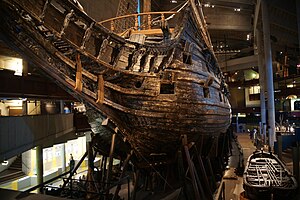
Gustavus Adolphus, who Walter Scott’s "A Legend of Montrose" character Major Dalgetty served during the Thirty Years’ War, built a navy to patrol the Baltic.  The Vasa was to serve at sea, joining land efforts of men such as Dalgetty in this same war.  Many know the story, of how this top-heavy vessel sank, minutes into its maiden voyage, on August 10, 1628.  

Thankfully, the Vasa was salvaged, in 1961.  For those of you who have not yet seen the Vasa Museum in Stockholm, it is well worth the trip (Link:  http://www.vasamuseet.se/en/The-Ship/ ).  

Vasa is a family name, a family of which Gustavus Adolphus (Gustavus II of Sweden) was a member.  Scott met Prince Gustav of Vasa, who is descended from a different line than Gustavus Adolphus, when that prince resided in Edinburgh, in 1820.  From John Gibson Lockhart’s “Memoirs of Sir Walter Scott”:

‘…In a letter, already quoted, there occurs some mention of the Prince Gustavus Vasa, who was spending this winter in Edinburgh, and his Royal Highness's accomplished attendant, the Baron Poller. I met them frequently in Castle Street, and remember as especially interesting the first evening that they dined there. The only portrait in Scott's Edinburgh dining-room was one of Charles XII. of Sweden, and he was struck, as indeed every one must have been, with the remarkable resemblance which the exiled Prince's air and features presented to the hero of his race. Young Gustavus, on his part, hung with keen and melancholy enthusiasm on Scott's anecdotes of the expedition of Charles Edward Stuart. — The Prince, accompanied by Scott and myself, witnessed the ceremonial of the proclamation of King George IV. on the 2d of February at the cross of Edinburgh, from a window over Mr Constable's shop in the High Street; and on that occasion also, the air of sadness that mixed in his features with eager curiosity, was very affecting. Scott explained all the details to him, not without many lamentations over the barbarity of Auld Reekie Bailies, who had removed the beautiful Gothic Cross itself, for the sake of widening the thoroughfare. The weather was fine, the sun shone bright; and the antique tabards of the heralds, the trumpet notes of God sate the King, and the hearty cheerings of the immense uncovered multitude that filled the noble old street, produced altogether a scene of great splendour and solemnity. The Royal Exile surveyed it with a flushed cheek and a watery eye; and Scott, observing his emotion, withdrew with me to another window, whispering—" Poor lad! poor lad! God help him." Later in the season, the Prince spent a few days at Abbotsford…’

Monday, July 30, 2012

Thomas Gray


Roughly two weeks before Walter Scott was born, English poet Thomas Gray died.  The date was July 30, 1771, and Gray was 54 at the time.  Reading Gray was part of Scott’s education, as the following two passages from John Gibson Lockhart’s “Memoirs of the Life of Sir Walter Scott” show.

‘…I have found, however, two note-books, inscribed "Walter Scott, 1792" containing a variety of scraps and hints which may help us to fill up our notion of his private studies during that year. He appears to have used them indiscriminately. We have now an extract from the author he happened to be reading; now a memorandum of something that had struck him in conversation; a fragment of an essay; transcripts of favorite poems; remarks on curious cases in the old records of the Justiciary Court; in short, a most miscellaneous collection, in which there is whatever might have been looked for, with perhaps the single exception of original verse. One of the books opens with: "Vegtam's Kvitha, or The Descent of Odin, with the Latin of Thomas Bartholine, and the English poetical version of Mr. Gray; with some account of the death of Balder, both as narrated in the Edda, and as handed down to us by the Northern historians—Auctore Gualtero Scott." The Norse original and the two versions are then transcribed; and the historical account appended, extending to seven closely written quarto pages, was, I doubt not, read before one or other of his debating societies. Next comes a page, headed "Pecuniary Distress of Charles the First," and containing a transcript of a receipt for some plate lent to the King in 1643. He then copies Langhorne's Owen of Carron; the verses of Canute, on passing Ely; the lines to a cuckoo, given by Warton as the oldest specimen of English verse; a translation "by a gentleman in Devonshire," of the death-song of Regner Lodbrog; and the beautiful quatrain omitted in Gray's Elegy,—
"There scattered oft, the earliest of the year," etc.’


'…Next morning, before breakfast, he carried his MS. to Miss Cranstoun, who was not only delighted but astonished at it; for I have seen a letter of hers to a common friend in the country, in which she says—"Upon my word, Walter Scott is going to turn out a poet—something of a cross, I think, between Burns and Gray."...’

Sunday, July 29, 2012

Voyage in the Lighthouse Yacht to Nova Zembla


July and August are traditional vacation months, and in 1814, not long after "Waverley" was published, Walter Scott began his summer trip to the northern lights with Robert Stevenson.  Below is his diary entry for departure day, July 29th, taken from John Gibson Lockhart’s “Memoirs of the life of Sir Walter Scott”.
‘VACATION 1814

Voyage In The Lighthouse Yacht To Nova Zembla, And The Lord Knows Where. 

July 29th, 1814 Sailed from Leith about one o'clock on board the Lighthouse Yacht, conveying six guns, and ten men, commanded by Mr Wilson. The company — Commissioners of the Northern Lights; Robert Hamilton, Sheriff of Lanarkshire; William Erskine, Sheriff of Orkney and Zetland; Adam Duff, Sheriff of Forfarshire. Non-commissioners—Ipse Ego; Mr David Marjoribanks, son to John Marjoribanks, Provost of Edinburgh, a young gentleman; Rev. Mr Turnbull, Minister of Tingwall, in the presbytery of Shetland. But the official chief of the expedition is Mr Stevenson, the Surveyor-Viceroy over the commissioners—a most gentlemanlike and modest man, and well known by his scientific skill.

Reached the Isle of May in the evening; went ashore, and saw the light—an old tower, and much in the form of a border-keep, with a beacon-grate on the top. It is to be abolished for an oil revolving-light, the gratefire only being ignited upon the leeward side when the wind is very high. Quaere—Might not the grate revolve? The isle had once a cell or two upon it. The vestiges of the chapel are still visible. Mr Stevenson proposed demolishing the old tower, and I recommended ruining it a la picturesque—i. e. demolishing it partially. The island might be made a delightful residence for seabathers.

On board again in the evening: watched the progress of the ship round Fifeness, and the revolving motion of the now distant Bell-Rock light until the wind grew rough, and the landsmen sick. To bed at eleven, and slept sound.’

Thursday, July 12, 2012

The Scottish Dictionary Man


‘…Another unpromising adventure of this season was the publication of the History of the Culdees (that is, of the clergy of the primitive Scoto-Celtic Church), by Scott's worthy old friend, Dr. John Jamieson, the author of the celebrated Dictionary. This work, treating of an obscure subject, on which very different opinions were and are entertained by Episcopalians on the one hand, and the adherents of Presbyterianism on the other, was also printed and published by the Ballantynes, in consequence of the interest which Scott felt, not for the writer's hypothesis, but for the writer personally: and the result was another heavy loss to himself and his partners…’

Dr. Jamieson’s “Etymological Dictionary of the Scottish Language” was published in 1808, fifty-three years after Samuel Johnson published his English dictionary.  Like Johnson, Jamieson completed his work largely through his own industry.  Jamieson’s “A Treatise of the Ancient Culdees of Iona”, discussed above in text from John Gibson Lockhart’s “Memoirs of the Life of Sir Walter Scott”, was published three years later.  John Jamieson’s life encompassed all of Scott’s.  Jamieson was born in 1759, and died on July 12th, 1838.

Saturday, July 7, 2012

What the Blind Poet Saw in Scott


‘…In the mean while my acquaintance with English literature was gradually extending itself. In the intervals of my school hours I had always perused with avidity such books of history or poetry or voyages and travels as chance presented to me—not forgetting the usual, or rather ten times the usual, quantity of fairy tales, Eastern stories, romances, etc. These studies were totally unregulated and undirected. My tutor thought it almost a sin to open a profane play or poem; and my mother, besides that she might be in some degree trammelled by the religious scruples which he suggested, had no longer the opportunity to hear me read poetry as formerly. I found, however, in her dressing-room (where I slept at one time) some odd volumes of Shakespeare, nor can I easily forget the rapture with which I sat up in my shirt reading them by the light of a fire in her apartment, until the bustle of the family rising from supper warned me it was time to creep back to my bed, where I was supposed to have been safely deposited since nine o'clock. Chance, however, threw in my way a poetical preceptor. This was no other than the excellent and benevolent Dr. Blacklock, well known at that time as a literary character. I know not how I attracted his attention, and that of some of the young men who boarded in his family; but so it was that I became a frequent and favored guest. The kind old man opened to me the stores of his library, and through his recommendation I became intimate with Ossian and Spenser. I was delighted with both, yet I think chiefly with the latter poet. The tawdry repetitions of the Ossianic phraseology disgusted me rather sooner than might have been expected from my age. But Spenser I could have read forever….’

Thomas Blacklock, died on July 7, 1791.  His contribution to Walter Scott’s developing interests and skills would be hard to measure, but clearly Scott appreciated the “Blind Poet’s” kindness.  The text above comes from Lockhart’s “Memoirs of the Life of Sir Walter Scott”.

Tuesday, July 3, 2012

Trouble and Travel


In a July 3rd letter to John Richardson, Sir Walter discusses a subject of personal difficulty, involving his brother Thomas’ situation.  He also announces his intention to follow in Samuel Johnson and James Boswell’s footsteps, in traveling the Western Highlands.  The letter is published in Lockhart’s “Memoirs of the Life of Sir Walter Scott”.

“Edinburgh, 3d July, 1810
“My dear Richardson,

“I ought before now to have written you my particular thanks for your kind attention to the interest which I came so strangely and unexpectedly to have in the passing of the Judicature Bill. The only purpose which I suppose Lord Lauderdale had in view was to state charges which could neither be understood nor refuted, and to give me a little pain by dragging my brother’s misfortunes into public notice. If the last was his aim, I am happy to say it has most absolutely miscarried, for I have too much contempt for the motive which dictated his Lordship’s eloquence to feel much for its thunders. My brother loses by the bill from L.150 to L.200, which no power short of an act of Parliament could have taken from him, and far from having a view to the compensation, he is a considerable loser by its being substituted for the actual receipts of his office. I assure you I am very sensible of your kind and friendly activity and zeal in my brother’s behalf…I propose, on the 12th, setting forth for the West Highlands, with the desperate purpose of investigating the caves of Staffa, Egg, and Skye. There was a time when this was a heroic undertaking, and when the return of Samuel Johnson from achieving it was hailed by the Edinburgh literati with ‘per varios casus,’ and other scraps of classical gratulation equally new and elegant. But the harvest of glory has been entirely reaped by the early discoverers; and in an age when every London citizen makes Lochlomond his wash-pot, and throws his shoe over Ben-Nevis, a man may endure every hardship and expose himself to every danger of the Highland seas, from sea-sickness to the jaws of the great sea-snake, without gaining a single leaf of laurel for his pains…’

Wednesday, June 6, 2012

Swinton Family


‘June 6 [1826]…Worked hard. John Swinton, my kinsman, came to see me,--very kind and
affectionate in his manner; my heart always warms to that Swinton connection, so faithful
 to old Scottish feelings…’
 
The Swinton connection Scott mentions in his journal is explained by the author, as published in
 Lockhart’s  “Memoirs of the Life of Sir Walter Scott”:
 
‘In [April, 1758] my father married Anne Rutherford, eldest daughter of Dr. John Rutherford,
professor of medicine in the University of Edinburgh. He was one of those pupils of Boerhaave,
to whom the school of medicine in our northern metropolis owes its rise, and a man distinguished
for professional talent, for lively wit, and for literary acquirements. Dr. Rutherford was twice
married. His first wife, of whom my mother is the sole surviving child, was a daughter of
Sir John Swinton of Swinton, a family which produced many distinguished warriors during
the Middle Ages, and which, for antiquity and honorable alliances, may rank with any in Britain.’