Showing posts with label Samuel Johnson. Show all posts

Sunday, July 22, 2012

Evelina


‘August 3 [1778] --I have an immensity to write.  Susan has copied me a
letter which Mrs. Thrale has written to my father, upon the
occasion of returning my mother two novels by Madame
Riccoboni.  It is so honourable to me, and so sweet in her,
that I must COPY it for my faithful journal.

Streatham, July 22.

Dear Sir,
I forgot to give you the novels in your carriage, which I now
send.  "Evelina" certainly excels them far enough, both in
probability of story, elegance of sentiment, and general power
over the mind, whether exerted in humour or pathos; add to this,
that Riccoboni is a veteran author, and all she ever can be; but
I cannot tell what might not be expected from "Evelina," were she
to try her genius at comedy.

So far had I written of my letter, when Mr. Johnson returned
home, full of the praises of the book I had lent him, and
protesting there Were passages in it which Might do honour to
Richardson.  We talk of it for ever, and he feels ardent after
the d`enouement; hee "could not get rid of the rogue," he said.
I lent him the second volume, and he is now busy with the other.


You must be more a philosopher, and less a father, than I wish
you, not to be pleased with this letter ; and the giving such
pleasure yields to nothing but receiving it.  Long, my dear sir,
may you live to enjoy the just praises of your children! and long
may they live to deserve and delight such a parent!  These are
things that you would say in verse - but poetry implies fiction,
and all this is naked truth.

My compliments to Mrs. Burney, and kindest wishes to all your
flock, etc.

How, sweet, how amiable in this charming woman is her desire of
making my dear father satisfied with his scribbler's 'attempt!  I
do, indeed, feel the most grateful love for her.  But Dr.
Johnson's approbation!--It almost crazed me with agreeable
surprise--it gave me such a flight of spirits that I danced a jig
to Mr. Crisp, Without any preparation, music, or explanation;--to
his no small amazement and diversion.  I left him, however, to
make his own comments upon my friskiness without affording him
the smallest assistance.’

Like Walter Scott, Frances Burney published her first novel anonymously.  It’s easy to understand her happiness when Samuel Johnson pronounced the novel a success.  Mrs. Thrale’s letter of July 22, 1778 reinforced that happiness. 

It’s also easy to see how Scott could appreciate how Ms. Burney reacted to success while her authorship was still unknown.  From Annie Raine Ellis’ introduction to “Evelina”, as published for Bohn’s Novelist’s Library in 1922.

‘A certain Sir John [Shelley], said he had never seen any woman walk so well; and she [Fanny Burney, Madame D’Arblay] dance with great  spirit.  When she learnt the great success of “Evelina”, after cheking a longing to throw Mr. Crisp’s wig out of the window, she danced a jig round the old mulberry-tree in his garden.  Mr. Crisp was not in the secret, but put it down to her flow of spirits, after recovery from severe illness.  Sir Walter Scott was so pleased with this tale (a pretty subject for a painter), that fifty years later he wrote it down from her telling: 

November 18.--Was introduced by Rogers to Mad. D'Arblay, the
celebrated authoress of Evelina and Cecilia,--an elderly lady, with
no remains of personal beauty, but with a gentle manner and a pleasing
expression of countenance. She told me she had wished to see two
persons--myself, of course, being one; the other George Canning. This
was really a compliment to be pleased with--a nice little handsome pat
of butter made up by a neat-handed Phillis of a dairymaid, instead
of the grease, fit only for cart-wheels, which one is dosed with by the
pound. Mad. D'Arblay told us the common story of Dr. Burney, her
father, having brought home her own first work, and recommended it to
her perusal, was erroneous. Her father was in the secret of Evelina
being printed. But the following circumstances may have given rise to
the story:--Dr. Burney was at Streatham soon after the publication,
where he found Mrs. Thrale recovering from her confinement, low at the
moment, and out of spirits. While they were talking together, Johnson,
who sat beside in a kind of reverie, suddenly broke out, "You should
read this new work, madam--you should read Evelina; every one says it
is excellent, and they are right." The delighted father obtained a
commission from Mrs. Thrale to purchase his daughter's work, and retired
the happiest of men. Mad. D'Arblay said she was wild with joy at this
decisive evidence of her literary success, and that she could only give
vent to her rapture by dancing and skipping round a mulberry-tree in the
garden. She was very young at this time. I trust I shall see this lady
again. She has simple and apparently amiable manners, with quick
feelings.’

Tuesday, July 3, 2012

Trouble and Travel


In a July 3rd letter to John Richardson, Sir Walter discusses a subject of personal difficulty, involving his brother Thomas’ situation.  He also announces his intention to follow in Samuel Johnson and James Boswell’s footsteps, in traveling the Western Highlands.  The letter is published in Lockhart’s “Memoirs of the Life of Sir Walter Scott”.

“Edinburgh, 3d July, 1810
“My dear Richardson,

“I ought before now to have written you my particular thanks for your kind attention to the interest which I came so strangely and unexpectedly to have in the passing of the Judicature Bill. The only purpose which I suppose Lord Lauderdale had in view was to state charges which could neither be understood nor refuted, and to give me a little pain by dragging my brother’s misfortunes into public notice. If the last was his aim, I am happy to say it has most absolutely miscarried, for I have too much contempt for the motive which dictated his Lordship’s eloquence to feel much for its thunders. My brother loses by the bill from L.150 to L.200, which no power short of an act of Parliament could have taken from him, and far from having a view to the compensation, he is a considerable loser by its being substituted for the actual receipts of his office. I assure you I am very sensible of your kind and friendly activity and zeal in my brother’s behalf…I propose, on the 12th, setting forth for the West Highlands, with the desperate purpose of investigating the caves of Staffa, Egg, and Skye. There was a time when this was a heroic undertaking, and when the return of Samuel Johnson from achieving it was hailed by the Edinburgh literati with ‘per varios casus,’ and other scraps of classical gratulation equally new and elegant. But the harvest of glory has been entirely reaped by the early discoverers; and in an age when every London citizen makes Lochlomond his wash-pot, and throws his shoe over Ben-Nevis, a man may endure every hardship and expose himself to every danger of the Highland seas, from sea-sickness to the jaws of the great sea-snake, without gaining a single leaf of laurel for his pains…’

Wednesday, April 18, 2012

Erasmus Darwin


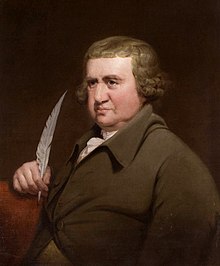
The grandfather of Charles Darwin, named Erasmus, is pretty famous in his own right.  Erasmus was a physician by trade; also a philosopher and poet.  He was born, and lived in, the same town as Samuel Johnson; Lichfield.  Erasmus died on April 18th, 1802.

The connection to Sir Walter Scott for today involves Darwin’s writing, and a controversy over some lines he “borrowed” from fellow Lichfieldian Anna Seward.  The issue is described in Ernst Krause’s “Erasmus Darwin".

‘The whole case is unintelligible, and in some respects looks more like highway robbery than simple plagiarism. Mr. Edgeworth [Richard, the father of Scott’s friend Maria Edgeworth], in a letter (Feb. 3, 1812) to Sir Walter Scott, says that he had expressed surprise to Dr. Darwin at seeing Miss Seward's lines at the beginning of his poem, and that Dr. Darwin replied : " It was a compliment  which he thought himself bound to pay to a " lady, though the verses were not of the same  tenor as his own." But this seems a lame excuse, and it is an odd sort of compliment to take the verses without any acknowledgment. Perhaps he thought it fair play, for Edgeworth goes on to say that " Miss Seward's ' Ode  to Captain Cook ' stands deservedly high  in public opinion. Now to my certain knowledge most of the passages which have been selected in the various reviews of the work were written by Dr. Darwin. I knew him well, and it was as far from his temper and habits, as it was unnecessary to his acquirements, to beg, borrow, or steal from any person on earth." These passages at any rate show how true and ardent a friend Edgeworth was to Dr. Darwin long after his death…’

Tuesday, April 10, 2012

The Adventurer


‘He now relieved the drudgery of his Dictionary, and the melancholy
of his grief, by taking an active part in the composition of The
Adventurer, in which he began to write April 10 [1753].’

The snippet above comes from James Boswell’s “Life of Johnson”.   To give a flavor of Johnson’s “The Adventurer”, here is a portion of Adventurer #137: 

Pythagoras

What have I been doing?
As man is a being very sparingly furnished with the power of prescience, he can provide for the future only by considering the past; and as futurity is all in which he has any real interest, he ought very diligently to use the only means by which he can be enabled to enjoy it, and frequently to revolve the experiments which he has hitherto made upon life, that he may gain wisdom from his mistakes, and caution from his miscarriages.
Though I do not so exactly conform to the precepts of Pythagoras, as to practise every night this solemn recollection, yet I am not so lost in dissipation as wholly to omit it; nor can I forbear sometimes to enquire of myself, in what employment my life has passed away. Much of my time has sunk into nothing, and left no trace by which it can be distinguished; and of this I now only know, that it was once in my power, and might once have been improved.
Of other parts of life, memory can give some account; at some hours I have been gay, and at others serious; I have sometimes mingled in conversation, and sometimes meditated in solitude; one day has been spent in consulting the ancient sages, and another in writing Adventurers…’

Walter Scott wrote a biography of Samuel Johnson, which is published as part of his “Miscellaneous Prose Works”.  It begins:

Of all the men distinguished in this or any other age, Dr. JOHNSON has left upon posterity the strongest and most vivid impression, so far as person, manners, disposition, and conversation, are concerned. We do but name him, or open a book which he has written, and the sound and action recall to the imagination at once, his form, his merits, his peculiarities, nay, the very uncouthness of his gestures, and the deep impressive tone of his voice. We learn not only what he said, but form an idea how he said it; and have, at the same time, a shrewd guess of the secret motive why he did so, and whether he spoke in sport or in anger, in the desire of conviction, or for the love of debate. It was said of a noted wag, that his bon-mots did not give full satisfaction when published, because he could not print his face. But with respect to Dr. Johnson, this has been in some degree accomplished; and, although the greater part of the present generation never saw him, yet he is, in our eye, a personification as lively, as that of Siddons in Lady Macbeth, or Kemble in Cardinal Wolsey…’

Saturday, March 31, 2012

John Donne


Poet John Donne died on March 31st, 1631.  Dubbed a metaphysical poet, by Samuel Johnson, his influence is recognized by Walter Scott in his “The Dramatic Works of John Dryden”, in which Donne is mentioned numerous times.

‘Although Dryden's residence at the university was prolonged to the unusual space of nearly seven years, we do not find that he
distinguished himself during that time by any poetical prolusions
excepting a few lines prefixed to a work, entitled, "Sion and Parnassus;  or Epigrams on several Texts of the Old and New Testament," published in  1650, by John Hoddesdon. Mr. Malone conjectures that our poet would  have contributed to the academic collection of verses, entitled, "Oliva  Pacis," and published in 1654, on the peace between England and Holland, had not his father's death interfered at that period. It is probable, we
lose but little by the disappearance of any occasional verses which may have been produced by Dryden at this time. The elegy on Lord Hastings, the lines prefixed to "Sion and Parnassus," and some complimentary stanzas which occur in a letter to his cousin Honor Driden, would have been enough to assure us, even without his own testimony, that
Cowley was the darling of his youth; and that he imitated his points of wit, and quirks of epigram, with a similar contempt for the propriety of their application. From these poems, we learn enough to be grateful, that Dryden was born at a later period in his century; for had not the road to fame been altered in consequence of the Restoration, his extensive information and acute ingenuity would probably have betrayed the author of the "Ode to St. Cecilia," and the father of English poetical harmony, into rivalling the metaphysical pindarics of Donne and Cowley.’