Showing posts with label Scott's Journal. Show all posts

Saturday, August 4, 2012

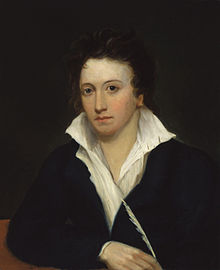
Percy Bysshe Shelley


August 4 is the birth-date of poet Percy Bysshe Shelley, who produced more in his twenty-nine years, than most of us do in longer life times.  Shelley was influential to many, but was also a source of controversy.  One of his earlier publications was titled “The Necessity of Athiesm”. 

Shelley had friends in common with Walter Scott, one of whom was Lord Byron, whose religious beliefs were also called into question through his writing.  In the entry from Scott’s Journal below, Scott distinguishes between the two.

February 4 [1828] --Wrote a little and was obliged to correct the Molière affair for R.P.G. I think his plan cannot go on much longer with so much
weakness at the helm. A clever fellow would make it take the field with
a vengeance, but poor G. will run in debt with the booksellers and let
all go to the devil. I sent a long letter to Lockhart, received from
Horace Smith, very gentlemanlike and well-written, complaining that Mr.
Leigh Hunt had mixed him up, in his Life of Byron, with Shelley as if he
had shared his irreligious opinions. Leigh Hunt afterwards at the
request of Smith published a swaggering contradiction of the inference
to be derived from the way in which he has named them together. Horatio
Smith seems not to have relied upon his disclamation, as he has
requested me to mention the thing to John Lockhart, and to some one
influential about Ebony, which I have done accordingly.

Wednesday, August 1, 2012

London Bridge


‘January 26 [1827].--My rheumatism is almost gone. I can walk without Major Weir, which is the name Anne gives my cane, because it is so often out of the way that it is suspected, like the staff of that famous wizard, to be capable of locomotion. Went to Court, and tarried till three o'clock, after which transacted business with Mr. Gibson and Dr. Inglis as one of Miss Hume's trustees. Then was introduced to young Mr. Rennie, or he to me, by [Sir] James Hall, a genteel-looking young man, and speaks well. He was called into public notice by having, many years before, made a draught of a plan of his father's for London Bridge. It was sought for when the building was really about to take place, and the assistance which young Mr. Rennie gave to render it useful raised his character so high, that his brother and he are now in first-rate practice as civil engineers.’


In 1799, a competition to design a replacement for the existing London Bridge was held.  John Rennie, from East Linton, in Scotland won the competition.  Work began in 1824, under Rennie’s son, also John, who Walter Scott records meeting (Scott’s Journal) on January 26th, 1827.  New London Bridge opened August 1, 1831.

According to London2012.com, thirty current olympic athletes share an August 1st birthday.  Among them, from the US (where I'm from), Asjha Jones, Jeff Larimer, and Stuart Mcnay.  And from host UK, Karen Carney. But to have their picture taken with Rennie's London Bridge, all will have to travel to Arizona.  Like the bridge it replaced, Rennie's bridge became outmoded, and was dismantled and shipped to the US in the 1970's.  London Bridge was recommissioned in Lake Havasu City, Arizona, in 1971.

Monday, July 23, 2012

Archibald Constable


Publisher Archibald Constable died on July 21st, 1827.  It took until two days later for Walter Scott to record his feelings, in his journal.  Scott was affected when Constable failed in 1826, contributing to Scott’s bankruptcy.

‘July 23 [1827]…Constable's death might have been a most important thing to me if it had happened some years ago, and I should then have lamented it much. He has
lived to do me some injury; yet, excepting the last £5000, I think most
unintentionally. He was a prince of booksellers; his views sharp,
powerful, and liberal; too sanguine, however, and, like many bold and
successful schemers, never knowing when to stand or stop, and not always
calculating his means to his objects with mercantile accuracy. He was
very vain, for which he had some reason, having raised himself to great
commercial eminence, as he might also have attained great wealth with
good management. He knew, I think, more of the business of a bookseller
in planning and executing popular works than any man of his time. In
books themselves he had much bibliographical information, but none
whatever that could be termed literary. He knew the rare volumes of his
library not only by the eye, but by the touch, when blindfolded. Thomas
Thomson saw him make this experiment, and, that it might be complete,
placed in his hand an ordinary volume instead of one of these _libri
rariores_. He said he had over-estimated his memory; he could not
recollect that volume. Constable was a violent-tempered man with those
that he dared use freedom with. He was easily overawed by people of
consequence, but, as usual, took it out of those whom poverty made
subservient to him. Yet he was generous, and far from bad-hearted. In
person good-looking, but very corpulent latterly; a large feeder, and
deep drinker, till his health became weak. He died of water in the
chest, which the natural strength of his constitution set long at
defiance. I have no great reason to regret him; yet I do. If he deceived
me, he also deceived himself.

Monday, July 16, 2012

Dionysius Lardner


‘July 16 [1829]…The work goes on as task-work must, slow, sure, and I trust not drowsy, though the author is. I sent off to Dionysius Lardner (Goodness be with us, what a name!) as far as page thirty-eight inclusive, but I will wait to add to-morrow's quota…’

An interesting name indeed, as Scott records in his Journal.  Scott agreed to supply Mr. Lardner a history of Scotland for his “Cabinet Cyclopedia”, which was published in 1831.  Among the contents of this cyclopedia was John Hershel’s “A Preliminary Discourse on the Study of Natural Philosophy”, which Charles Darwin found interesting.  Darwin was so entranced that he met with Hershel for a week in Cape Town during his voyage on the HMS Beagle the following year.

Lardner’s own career ended under difficult personal circumstances, with another odd name connection.  He was caught in an affair with a woman named Mary Heaviside. 

Monday, July 9, 2012

The First Poetess of Romantic Fiction


Ann Ward was born in London on July 9, 1764, about 7 years before Walter Scott.  Like Scott, her first novel - The Castles of Athlin and Dunbayne (1789) - was published anonymously.  This novel was published in the year following her marriage to journalist William Radcliffe.

The title of today’s post is a comment on Ann Radcliffe made by Walter Scott.  Radcliffe was influential in her time, and according to Scott’s journal entry of February 3rd, 1826, the author consciously dealt with that influence:

‘…James Ballantyne is severely critical on what he calls imitations of Mrs.
Radcliffe in Woodstock. Many will think with him, yet I am of opinion
he is quite wrong, or, as friend J. F[errier] says, vrong. In the
first place, I am to look on the mere fact of another author having
treated a subject happily as a bird looks on a potato-bogle which scares
it away from a field otherwise as free to its depredations as any one's
else! In 2d place, I have taken a wide difference: my object is not to
excite fear of supernatural tilings in my reader, but to show the effect
of such fear upon the agents in the story--one a man of sense and
firmness--one a man unhinged by remorse--one a stupid uninquiring
clown--one a learned and worthy, but superstitious divine. In the third
place, the book turns on this hinge, and cannot want it. But I will try
to insinuate the refutation of Aldiboronti's exception into the
prefatory matter…’

Tuesday, June 19, 2012

Luscar House


‘June 19--…Off we set at half-past eight o'clock, Lord Chief Commissioner being left at home
owing to a cold. We breakfasted at Luscar, a place belonging to Adam Rolland, but the gout
had arrested him at Edinburgh, so we were hospitably received by his family…’
 
Walter Scott enjoyed his visit to Luscar House on June 19th, 1830.  More on Luscar is found
in “Romantic Culross, Torryburn, Carnock, Cairneyhill, Saline, and Pitfarrine”, by
Andrew Cunningham.
 
‘…A daughter of the Rev. Dr Erskine of Greyfriars married Mr James Stewart of Dunearn, and the estate of Carnock passed to their son. The property and the estate of Luscar ultimately fell into the hands of Mr Hutchison, Kirkcaldy, and he in turn sold the properties in 1864 to Mr Alexander Hastie, M.P. for Glasgow. Mr Hastie's purchase included the farms of Carnock Mill, Loanhead, Easter and Wester Camps, Newbigging, Easter and Wester Bonhard, and Carneil. He died in 1864. The properties were held by the trustees until after the death of Mrs Hastie, when they were purchased by the late Mr Alexander Mitchell of Alloa. Mr Mitchell, who took possession in 1890, died in 1893, and was succeeded by his son, Mr Alexander Mitchell. The adjoining estate of Clune was recently purchased by Mr Mitchell. The present mansion-house of Luscar was built in 1840 by Mr Adam Holland of Gask, and was considerably enlarged by the father of the present proprietor. When Sir Walter Scott visited Loehore in June 1830 he spent some time at Luscar. In his Journal he says :—" We breakfasted at Luscar, a place belonging


to Adam Rolland, but the gout had arrested him in Edinburgh, so we were hospitably received by his family. At Luscar I saw, with pleasure, the painting by Raeburn of my old friend, Adam Rolland, Esq., who was, in the external circumstances, but not in frolic or fancy, my prototype for Paul Plydell." The Pitdinnies belong to Mr Lawrence Dalgleish of Keavil and Dalbeath…’