Showing posts with label December 18. Show all posts

Sunday, December 18, 2011

It grows dark, boys, you may go


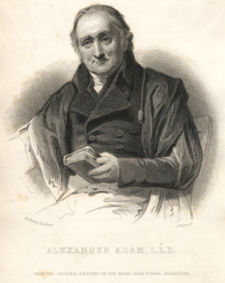
From Lord Henry Cockburn’s “Memorials of his time”: ‘…Two sad privations clouded the close of the year 1809. The High School lost Dr. Adam, and the College Dugald Stewart.

Adam died, after a few days illness, in December. His ruling passion, for teaching, was strong in death. It was in his bedchamber, and in the forenoon, that he died. Finding that he could not see, he uttered a few words, which have been variously given, but all the accounts of which mean—" It is getting dark, boys; we must put off the rest till to-morrow." It was the darkness of death. He was followed to the grave (in the Chapel of Ease near Windmill Street) by many eminent and grateful pupils. James Pillans, his successor, has given a good short sketch of him in the Encyclopaedia Britannica…’

Alexander Adam led the High School of Edinburgh at the time Walter Scott attended (1779 – 1783).  According to Edinburgh University’s Walter Scott archive, Adam encouraged Scott in his translations of Horace and Virgil.  A classical scholar, Adam also introduced Greek to the school’s curriculum.  Alexander Adam passed on December 18, 1809.

Saturday, December 18, 2010

Society of Antiquaries of Scotland

Per Rampant Scotland, the Society of Antiquaries was formed on December 18, 1780.  From Proceedings of the Society of Antiquaries of Scotland, Volume 4, comes the following Walter Scott related entry:  '..." Of the same class, also, is another slab figured here, the drawing of which was made by George Scott, the friend of Mungo Park, who accompanied him to Africa, aud died there. It was forwarded to the Society of Antiquaries by Sir Walter Scott in 1828, who described the original as a rough sandstone, about six feet long hy perhaps two and a half broad, which was raised by the plough at a place called Annan Street, upon the farm of Whitehope. The drawing is designated, probably by the original draftsman,—'A Druid stone found at Annan Street, figured with thr sun and moon.' Little doubt can be entertained that it had formed the cover of a cist, though few probably will now be inclined to attempt s. solution of the '•uigmatic devices rudely traced on its surface. The spot where it was found is about half a mile from the church at Yarrow, and close by there are two large stones, about 120 yards apart, which are believed to mark the scene of the memorable struggle that has given ' The dowie houms of Yarrow' so touching a place in the beautiful legendary poetry of Scotland.'


...With this drawing the following detailed MS. account was found:—


" Memoranda received by me from Sir Walter Scott, in regard to the drawing in Indian ink upon the other side. ' Edinburgh 9th March 1828


(Signed) " E. W. A. Drummond Hay."


" The drawing was made by (? George) Scott, who accompanied Mungo Park to Africa, and died there. " The original is a rough sandstone about six feet long, by perhaps two and a half feet broad, which was raised by the plough at a place called Annan Street, upon the farm of Wheathope, belonging to his Grace the Duke of Buccleuch.


" The place is about half a mile from the church of Yarrow, and is said at some remote period to have been the site of an ecclesiastical building. There are two largo fragments of rock at the distance of about 120 yards from each other. Here the memorable duel is said to have taken place, which gave occasion to Hamilton's ballad of ' Busk ye, busk ye, my bonny, bonny bride;' and other ballads on the same subject. The common tradition is, that both the knights, whose names are reported to have been Scott, fell in the duel.


" Sir Walter Scott had the good fortune of preserving this curious relic of antiquity, which, from circumstances which he does not think worthy (of) record, he had accidentally discovered was about to be blown up with gunpowder some years ago."


This paper is marked on the back :—


"Notice by Sir Waiter Scott of an anciently Inscribed Stone found at Annan Street, of which a drawing is annexed."


These memoranda, by Mr Hay, after a conversation with Sir Walter Scott, formed the subject of a communication on the 24th March 1828, when the Indian-ink sketch was presented by him from Sir Walter Scott to the Society of Antiquaries of Scotland.


The sketch has written on it the following descriptive title:—


" Selkirkshire,


" Druid stone found at Annan Street, figured with ye sun and moon."


This title however, instead of being in the handwriting of the original draftsman, according to Dr "Wilson's idea, is undoubtedly in the handwriting of Sir Walter Scott himself; and I may state that my friend Mr David Laing quite agrees with me on this point.


In the third volume of the second edition of the " Minstrelsy of the Scottish Border," published in 1803, page 73, Sir Walter Scott, with his well-known fondness for giving to any floating tradition or song a local habitation and a name, fixes upon this locality of Annan Street, with its standing stones, as the scene of the tragedy described in the old ballad of the " Dowie Dens of Yarrow," which is supposed to have suggested to Hamilton of Bangour his much admired ballad, " Busk ye, busk ye, my bonny, bonny bride." In Sir Walter's introductory notes to this ballad he says :—


" The name of the murderer is said to have been Annan, and the place of combat is still called Annan's Treat. It is a low moor, on the banks of the Yarrow, lying to the west of Yarrow Kirk. Two tall unhewn masses of stone are erected, about eighty yards distant from each other ; and the least child that can herd a cow will tell the passenger that here lie ' the two lords who were slain in single combat.' "...'

Friday, December 18, 2009

Saint Gatian


December 18 is the feast day of Saint Gatian, the first Bishop of Tours. Saint Gatian reached Gaul in the mid-third century. He proceeded to convert many of the Gauls to Christianity.


Scott includes the Church of St. Gatian - the Cathedral of Tours - in his Quentin Durward. This cathedral was erected between the 13th and 16th centuries.


"...The towers of the church of Saint Gatien were also visible, and the gloomy strength of the Castle, which was said to have been, in ancient times, the residence of the Emperor Valentinian..."