Showing posts with label Peveril of the Peak. Show all posts

Tuesday, July 24, 2012

Isle of Dogs


‘Monday 24 July 1665…We set out so late that it grew dark, so as we doubted the losing of our way; and a long time it was, or seemed, before we could get to the water-side, and that about eleven at night, where, when we come, all merry (only my eye troubled me, as I said), we found no ferryboat was there, nor no oares to carry us to Deptford. However, afterwards oares was called from the other side at Greenwich; but, when it come, a frolique, being mighty merry, took us, and there we would sleep all night in the coach in the Isle of Doggs. So we did, there being now with us my Lady Scott, and with great pleasure drew up the glasses, and slept till daylight, and then some victuals and wine being brought us, we ate a bit, and so up and took boat, merry as might be; and when come to Sir G. Carteret’s, there all to bed.’

Samuel Pepys records spending a night on the Isle of Dogs, known only to this blogger as a setting used by an author with the same surname as mine (Iain Sinclair).  Apparently an interesting place for a pint or two.  The Lady Scott in Pepys' diary entry was originally Carolina Carteret, who married Sir Thomas Scott.

Walter Scott knew the Isle of Dogs.  At least well enough to mention it as part of the dialogue in “Peveril of the Peak”.

 "I crave your Grace's pardon humbly," said Sir Geoffrey, "but it is an honour I design for myself, as I apprehend no one can so utterly surrender and deliver him up to his Majesty's service as the father that begot him is entitled to do.--Julian, come forward, and kneel.-- Here he is, please your Majesty--Julian Peveril--a chip of the old block--as stout, though scarce so tall a tree, as the old trunk, when at the freshest. Take him to you, sir, for a faithful servant, /à pendre/, as the French say; if he fears fire or steel, axe or gallows, in your Majesty's service, I renounce him--he is no son of mine--I disown him, and he may go to the Isle of Man, the Isle of Dogs, or the Isle of Devils, for what I care."

Wednesday, May 9, 2012

Colonel Blood and the Crown Jewels of England


"I spoke to no one," said the Duke hastily--"nay, I mistake, I remember
a fellow whispered in my ear, that one, who I thought had left London
was still lingering in town. A person whom I had business with."

"Was yon the messenger?" said Ormond, singling out from the crowd who
stood in the court-yard a tall dark-looking man, muffled in a large
cloak, wearing a broad shadowy black beaver hat, with a long sword of
the Spanish fashion--the very Colonel, in short, whom Buckingham had
despatched in quest of Christian, with the intention of detaining him in
the country.

When Buckingham's eyes had followed the direction of Ormond's finger, he
could not help blushing so deeply as to attract the King's attention.

"What new frolic is this, George?" he said. "Gentlemen, bring that
fellow forward. On my life, a truculent-looking caitiff--Hark ye,
friend, who are you? If an honest man, Nature has forgot to label it
upon your countenance.--Does none here know him?

 'With every symptom of a knave complete,
  If he be honest, he's a devilish cheat.'"

"He is well known to many, sire," replied Ormond; "and that he walks in
this area with his neck safe, and his limbs unshackled, is an instance,
amongst many, that we live under the sway of the most merciful Prince of
Europe."

"Oddsfish! who is the man, my Lord Duke?" said the King. "Your Grace
talks mysteries--Buckingham blushes--and the rogue himself is dumb."

"That honest gentleman, please your Majesty," replied the Duke of
Ormond, "whose modesty makes him mute, though it cannot make him blush,
is the notorious Colonel Blood, as he calls himself, whose attempt to
possess himself of your Majesty's royal crown took place at no very
distant date, in this very Tower of London."

"That exploit is not easily forgotten," said the King; "but that the
fellow lives, shows your Grace's clemency as well as mine."

The story of Colonel Thomas Blood is difficult to fathom.  He tried to murder the Duke of Ormonde more than once, managed to dupe Talbot Edwards, the aged keeper of the crown jewels into trusting him, was caught red-handed with the jewels, and despite these crimes, persuaded King Charles II not only to pardon him, but to give him a grant of land.   His infamies even gained him a place in Walter Scott’s “Peveril of the Peak (text above).  Blood’s famous attempt at the jewels in the Tower of London occurred on May 9th, 1671.

Friday, February 3, 2012

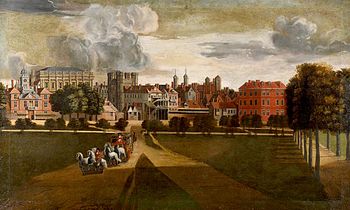
Whitehall Palace

‘Sunday 3 February 1666/67

(Lord’s day). Up, and with Sir W. Batten and [Sir] W. Pen to White Hall, and there to Sir W. Coventry’s chamber, and there staid till he was ready, talking, and among other things of the Prince’s being trepanned, which was in doing just as we passed through the Stone Gallery, we asking at the door of his lodgings, and were told so. We are all full of wishes for the good success; though I dare say but few do really concern ourselves for him in our hearts..’.

In Samuel Pepys’s Diary, Prince Rupert of the Rhine was a topic of discussion in the Stone Gallery; Whitehall Palace on February 3rd.  These two subjects play a role in Walter Scott’s “Peveril of the Peak” as well, though the setting is ten years later than Pepys’s diary entry.  Another twenty years, or so, and Whitehall Palace which was the largest palace in Europe at the time, was destroyed by fire (1698).  The following is from Scott’s Peveril:

‘Sir Geoffrey was unwilling, like most prudent persons, to own the existence of expectations which had proved fallacious, yet had too little art in his character to conceal his disappointment entirely. "Who, I, madam?" he said; "Alas! what should a poor country knight expect from the King, besides the pleasure of seeing him in Whitehall once more, and enjoying his own again? And his Majesty was very gracious when I was presented, and spoke to me of Worcester, and of my horse, Black Hastings--he had forgot his name, though--faith, and mine, too, I believe, had not Prince Rupert whispered it to him. And I saw some old friends, such as his Grace of Ormond, Sir Marmaduke Langdale, Sir Philip Musgrave, and so forth; and had a jolly rouse or two, to the tune of old times."…’

Thursday, January 19, 2012

Venner's Rising

"Charity is a fine thing and a fair," answered Sir Geoffrey; "but I must tell you, you do ill, dame, to wander about the country like a quacksalver, at the call of every old woman who has a colic-fit; and at this time of night especially, and when the land is so unsettled besides."
"I am sorry to hear that it so," said the lady. "I had heard no such news."
"News?" repeated Sir Geoffrey, "why, here has a new plot broken out among the Roundheads, worse than Venner's by a butt's length;[*] and who should be so deep in it as our old neighbour Bridgenorth? There is search for him everywhere; and I promise you if he is found, he is like to pay old scores."
[*] The celebrated insurrection of the Anabaptists and Fifth Monarchy
    men in London, in the year 1661.

A cooper named Thomas Venner, and the Fifth Monarchy Men, once attempted to overthrow Oliver Cromwell; in 1657.  Extreme religious sentiment is evident in England well after Cromwell, and the Civil Wars.  Scott’s “Peveril of the Peak”, from which the text above is taken, centers around the alleged Popist Plot of 1678, many years after Venner’s time.  Venner and his associates believed that Christ’s time to return to earth, the time of the Fifth Monarchy, was at hand.  Venner attempted a coup against Charles II, as well, which is what Scott’s text refers to.  Armed action began on January 1, 1661.  By the 4th, General Monck had suppressed the rebellion, and captured Venner.  Venner was executed, by being hanged, drawn and quartered, on January 19, 1661. 

Saturday, September 3, 2011

Battle of Worcester

‘…The circumstances are familiarly known, to the reader of English history, of the march of the Earl of Derby, in I65l, with a corps from the Isle of Man for the service of the King; his joining the royal army on the eve of the battle of Worcester ; his flight and imprisonment at Chester, after that signal defeat ; and his trial and execution at Bolton in Lancashire, by the officers of the Parliament, on the I5th October of that year.

Immediately afterwards, Colonel Duckenfield, who commanded at Chester on behalf of the Parliament, proceeded with an armament of ten ships, and a considerable military force, for the reduction of the Isle of Man…’

The Battle of Worcester, which is mentioned in the introduction to Walter Scott’s “Peveril of the Peak” (text above), took place on September 3rd, 1651.  The result was a victory for Parliamentarian forces under Oliver Cromwell.  James Stanley, the 7th Earl of Derby, was executed well after the efforts of Charles II to regain his throne had failed.  Not as fortunate in hiding as Charles, Stanley was captured near Nantwich, tried for treason, and executed on October 15th.

Tuesday, June 7, 2011

Siege of Jerusalem

'While the fire continued, the two parties laboured in active union, like the jarring factions of the Jews during the siege of Jerusalem, when compelled to unite in resisting an assault of the besiegers. But when the last bucket of water had hissed on the few embers that continued to glimmer--when the sense of mutual hostility, hitherto suspended by a feeling of common danger, was in its turn rekindled--the parties, mingled as they had hitherto been in one common exertion, drew off from each other, and began to arrange themselves at opposite sides of the hall, and handle their weapons, as if for a renewal of the fight.'

Sir Walter Scott uses the siege of Jerusalem as an analogy in "Peveril of the Peak".  The Siege of Jerusalem began on June 7, 1099, with Raymond of Toulouse and Godfrey of Bouillon taking the city by July 15.