Showing posts with label Napoleon. Show all posts

Friday, June 29, 2012

Lucien Bonaparte


‘…The debate of the day, remarkable as the last in which the republican party enjoyed the full freedom of speech in France, was opened on 19th Brumaire, at two o'clock, Lucien Bonaparte being president Gaudin, a member of the moderate party, began by moving, that a committee of seven members should be formed, to report upon the state of the Republic; and that measures should be taken for opening a correspondence with the Council of Ancients. He was interrupted by exclamations and clamour on the part of the majority.

"The constitution!" "The constitution or death!" was echoed and re-echoed on every side. "Bayonets frighten us not," said Delbrel; "we are free men." "Down with the dictatorship—no dictators!" cried other members. Lucien in vain endeavoured to restore order. Gaudin was dragged from the tribune; the voice of other moderates was overpowered by clamour— never had the party of democracy shown itself fiercer or more tenacious than when about to receive the death-blow.

"Let us swear to preserve the constitution of the year Three!" exclaimed Delbrel; and the applause which followed the proposition was so general, that it silenced all resistance. Even the members of the moderate party—nay, even Lucien Bonaparte himself—were compelled to take the oath of fidelity to the constitution, which he and they were leagued to destroy."The oath you have just taken," said Bigonnet, "will occupy a place in the annals of history, beside the celebrated vow taken in the tennis-court. The one was the foundation of liberty, the other shall consolidate the structure." ...’

Lucien Bonaparte was often at odds with his older brother, Napoleon.  The political environment in which he endeavored was difficult as well, as the passage above from Sir Walter Scott’s “The Life of Napoleon Bonaparte” indicates.  Lucien Bonaparte died on June 29, 1840, outliving Napoleon by 19 years.

Saturday, May 5, 2012

Tete d'Armee


‘…As if to mark a closing point of resemblance betwixt Cromwell and Napoleon, a dreadful tempest arose on the 4th of May, which preceded the day that was to close the mortal existence of this extraordinary man.  A willow, which had been the Exile’s favourite, and under which he had often enjoyed the fresh breeze, was torn up by the hurricane; and almost all the trees about Longwood shared the same fate.

The 5th of May came amid wind and rain.  Napoleon’s passing spirit was deliriously engaged in a strife more terrible than that of the elements around.  The words “tete d’armee,” the last thoughts which escaped from his lips, intimated that his thoughts were watching the current of a heady flight.  About eleven minutes before six in the evening, Napoleon, after a struggle which indicated the original strength of his constitution, breathed his last.’

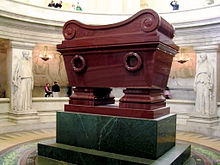
From Scott’s “Life of Napoleon Bonaparte”.  Napoleon passed on the island of St. Helena, on May 5th, 1821; now entombed in Les Invalides. 


Monday, February 20, 2012

President's Day


On President’s Day in the States, we think more of Presidents Washington and Lincoln than others.  President’s Day is effectively George Washington’s birthday (February 22nd), recognized officially (Federally), on the third Monday of February.  This year, the date is February 20th.  Lincoln’s birthday is February 12th.  Until 1971, that meant two February holidays for many of us.  Abraham Lincoln’s birthday is still recognized in several states, including those in the Tri-State region of NY, NJ, and CT. 

Walter Scott refers to another US President, James Madison, in a letter he writes to Irish barrister Matthew Weld Hartstonge.  Scott refers to Madison at a time when America had become directly relevant to issues that were of immediate importance to Scott.  The War of 1812 was raging, and Napoleon had just abdicated as emperor, with the Bourbons restored in France.

‘TO MATTHEW WELD HARTSTONGE

ABBOTSFORD 12th April 1814

MY DEAR SIR,. . . Swift after all is not quite finished, but very very nearly so-it is astonishing what a number of things are necessary to finish a work, which one never thinks of till they are getting it out of their hands, and to say the truth, the current of good news with the uncertainty which preceded it, has for some weeks so agitated and so stirred me, that Quidnunc the Upholsterer in the Farce, would have been as fit for an Editor- My own eyes have seen that which I had scarcely hoped my Son's should see, the downfall of the most accursed and relentless military despotism that ever wasted the blood and curbed the faculties of a civilized people.-I should have as soon expected the blade of a sword to bear a crop of corn, on its polished and hardened side, as any good or liberal institution to flow from Bonaparte. If he survives the ruin he has created, and it is strange he should even wish to survive it-it will be no slight proof of the Civilization of our age, which does not follow with private revenge even the most atrocious criminal. I should wish him to survive to teach a school in America, or to help President Maddison to discipline his Continental Warriors -I have a notion the said President is in danger of getting what the Blackguards call a proper hiding. The moderation of the Allied Princes has something peculiarly graceful in it-and gives much lustre by the contrast between lawful rule, and right supremacy, compared to military usurpation-. But I will not enlarge upon this topic, though it has been so near my heart for so many weeks-the joy in Edinr. is immeasurable-The mob always strong upon the stronger side, fell upon some grotesque modes of marking the dwellings of those who were considered as Friends to Bonny. One man's door they painted with tears like a hearse- …’

Thursday, July 14, 2011

Madame de Stael


Germaine de Stael may have wished to become the first woman in France during the French Revolution, but ran into a minor impediment; Napoleon’s disdain.  The author of Corinne, who was a part of the lives of Napoleon, Talleyrand and others, died on Bastille Day, July 14th, in the year 1817.  Madame de Stael adds some flavor to Walter Scott’s “Life of Napoleon Buonaparte”:

‘When he talked with the purpose of pleasing, Bonaparte often told anecdotes of his life in a very pleasing manner; when silent, he had something disdainful in the expression of his face; when disposed to be quite at ease, he was, in Madame de Stael's opinion, rather vulgar. His natural tone of feeling seemed to be a sense of internal superiority, and of secret contempt for the world in which he lived, the men with whom he acted, and even the very objects which he pursued. His character and manners were upon the whole strongly calculated to attract the attention of the French nation, and to excite a perpetual interest even from the very mystery which attached to him, as well us from the splendour of his triumphs. The supreme power was residing in the Luxembourg ostensibly; but Paris was aware, that the means which had raised, and which must support and extend that power, were to be found in the humble mansion of the newly-christened Rue de la Victoire.

Some of these features are perhaps harshly designed, as being drawn resentibus odiis. The disagreement between Bonaparte and Madame de Stael. from whom we have chiefly described them, is well known. It originated about this time, when, as a first-rate woman of talent, she was naturally desirous to attract the notice of the Victor of Victors. They appear to have misunderstood each other; for the lady, who ought certainly to know best, has informed us, "that far from feeling her fear of Bonaparte removed by repeated meetings, it seemed to increase, and his best exertions to please could not overcome her invincible aversion for what she found in his character."   His ironical contempt of excellence of every kind, operated like the sword in romance, which froze while it wounded. Bonaparte seems never to have suspected the secret and mysterious terror with which he impressed the ingenious author of Corinne; on the contrary, Las Cases tells us, that she combined all her efforts, and all her means, to make an impression on the general…’

Friday, November 12, 2010

Plymouth Incorporated

'The Bellerophon had hardly anchored, when orders came from the admiral, Lord Keith, which were soon after seconded by others from the Admiralty, enjoining that no one, of whatever rank or station, should be permitted to come on board the Bellerophon, excepting the officers and men belonging to the ship. On the 26th, the vessel received orders to move round to Plymouth Sound.'

Plymouth has long been an important coastal city for England, with passenger and commercial trade passing through its port.  It was the point of departure for the Pilgrims coming to America.  Napoleon Bonaparte wanted to go to America too.  But he was captured during his escape from France.  Instead of America, the ship carrying the defeated Napoleon Bonaparte aimed for the Plymouth Sound.  Later, Napoleon was shipped to St. Helena.

On November 12, 1439, Plymouth became the first town incorporated by the English Parliament.  The text above is from Walter Scott's "Life of Napoleon".

Tuesday, November 9, 2010

Eighteenth Brumaire

On November 9, 1799, Napoleon Bonaparte overthrew the French Directory, in a coup d'etat. The date was 18th Brumaire, in the second month of the eighth year on the French Republican calendar.  Sir Walter Scott introduced some information on the events of that day, which had previously been unpublished, in an appendix in his "Life of Napoleon Buonaparte". 


'HISTORICAL NOTES ON THE EIGHTEENTH BRUMAIRE.

The following facts, which have never been made public, but with which we have been favoured from an authentic channel, throw particular light on the troubled period during which Napoleon assumed the supreme power—the risks which he ran of being anticipated in his aim, or of altogether missing it.
 In the end of July, 1799, when all those discontents were fermenting, which afterwards led to the Revolution of the 18th Brumaire, General Augereau, with one of the most celebrated veterans of the Republican army, attended by a deputation of six persons, amongst whom were Salicetti and other members of Convention, came on a mission to General Bernadotte, their minister at war, at an early hour in the morning.

Their object was to call the minister's attention to a general report, which announced that there was to be a speedy alteration of the constitution and existing order of things. They accused Barras, Sieyes, and Fouche, as being the authors of these intrigues. It was generally believed, they said, that one of the directors (Barras) was for restoring the Bourbons ; another (Sieyes is probably meant) was for electing the Duke of Brunswick. The deputation made Bernadotte acquainted with their purpose of fulminating a decree of arrest against the two official persons. Having first enquired what proofs they could produce in support of their allegations, and being informed that they had no positive proof to offer, the minister informed them that he would not participate in the proposed act of illegal violence. " I require your word of honour," he said, " that you will desist from this project. It is the only mode to ensure my silence on the subject." One of the deputation, whom the minister had reason to regard as a man of the most exemplary loyalty, and with whom he had had connexions in military service, replied to him, " Our intention was to have placed you in possession of great power, being well persuaded that you would not abuse it. Since you do not see the matter as we do, the affair is at an end. We give up our scheme- Let the affair be buried in complete oblivion." In less than two months afterwards, Buonaparte's arrival gave a new turn to the state of affairs.


He landed, as is well known, at Frejus, after having abandoned his army, and broke the quarantine laws. When this intelligence reached Bernadotte, he intimated to the Directory, that there was not an instant to lose in having him brought before a council of war. General Debel was instructed to make this communication to a member of the Directory, who was one of his friends. Colonel St Martin, of the artillery^ spoke to •this director to the same purpose. His answer was, "We are 'not strong enough.". On its being said that Bernadotte was of 'opinion that Buonaparte should be proceeded against according to the principles of military discipline, and that the opportunity which occurred should be laid hold of, the director replied, "Let us wait."


Buonaparte arrived at Paris. All the generals went to visit him. A public dinner to him was proposed, and a list for that purpose handed about. When it was presented to Bernadotte by two members of the Council of Five Hundred, he said to them, " I would advise you to put off this dinner till he account satisfactorily for having abandoned his army."...'

Thursday, September 23, 2010

Battle of Jena

'September 23 [1826].—Wrought in the morning, but only at reading and proofs. That cursed battle of Jena is like to cost me more time than it did Bonaparte to gain it...'

Walter Scott was writing his "The Life of Napoleon Buonaparte" at the time today's entry was entered into his Journal.  Jena was a victory for Napoleon over the Prussian forces of Frederick William III.  Napoleon's losses amounted to a couple thousand soldiers.  Prussian losses were ten times this amount.

Scott took about a year to complete this work, which was published in June 1827.

Thursday, August 5, 2010

The Summer Tour Reaches Holland

In the wake of Napoleon's defeat at Waterloo (June 18, 1815), Walter Scott's 1815 Tour of Waterloo and Paris (published in John Scott's journal of that name) reached the shores of Helvoet, sailing up the Maes en route to Bergen-op-zoom.

A few words from Walter Scott on first visiting the Antwerp Gate reveal something of what he kept in his memory:

'Thence we proceeded to the Antwerp gate, between which and the water-port gate, an attack was made by the column under General Cooke; and were shown the place, near the former, where Colonel Macdonald fell. A demolished garden, in which part of Cooke's division had sustained severe loss, and the spot where General Skerret was wounded, were also pointed out to us.


While we walked along the ramparts, on which we remarked several of the trees riddled with musket shot, the sky was frequently illuminated with flashes of sheet lightning ; and I well recollect the solemn feelings with which the scene impressed us, when listening to the melancholy details given us of this bold, though unfortunate attempt; " and heard," as Sir W. Scott relates, " from below the hollow roll of the drums announcing the setting of the watch, and the deep and sullen ' Wer da' of the sentinels, as they challenged those who passed their station." *
 
* See Paul's Letters, letter ii...'

Monday, August 2, 2010

Battle of the Nile

The Battle of the Nile took place on August 2, 1798.  In this battle, Napoleon's navy under Vice Admiral Francois-Paul Brueys D'Aigalliers was defeated by the British Royal Navy under Admiral Horatio Nelson.  The British navy gained the upper hand in the Napoleonic Wars with this victory.

Walter Scott references this battle in the line 'On Egypt...' in his poem Marmion.

'Nor mourn ye less his perished worth,
Who bade the conqueror go forth,
And launch'd that thunderbolt of war
On Egypt, Hafnia, Trafalgar;
Who, born to guide such high emprize,
For Britain's weal was early wise;
Alas! to whom the Almighty gave,
For Britain's sins, an early grave!
His worth, who, in his mightiest hour,
A bauble held the pride of power,
Spum'd at the sordid lust of pelf,
And served his Albion for herself;
Who, when the frantic crowd amain
Strain'd at subjection's bursting rein,
O'er their wild mood full conquest gain'd,
The pride, he would not crush, restrain'd,
Show'd their fierce zeal a worthier cause,
And brought the freeman's arm, to aid the freeman's laws...'

Thursday, April 22, 2010

Battle of Eckmuhl

"...After the fatal battle of Eckmuhl, the Archduke Charles effected, as we have seen, his retreat into the mountainous country of Bohemia, full of defiles, and highly capable of defence, where he could remodel his broken army, receive reinforcements of every kind, and make a protracted defence, should Napoleon press upon him in that direction. But the victories of these memorable five days had placed the French Emperor in full possession of the right bank of the Danube, and of the high road to the city of Vienna, which is situated on the same side of the river. True to his principle of striking directly at the heart of his antagonist, Napoleon determined to march on the metropolis of Austria, instead of pursuing the Archduke into the mountains of Bohemia..."

The second day of the battle of Eckmuhl, on April 22, 1809, turned the War of the Fifth Coalition firmly in Napoleon's favor, in his conflict with Austrian Archduke Charles.  Walter Scott notes as much in the passage above, which is taken from his "The Life of Napoleon".  Success at Eckmuhl led, ultimately, to the fall of Vienna.

Monday, December 7, 2009

Marshal Michel Ney

"Le brave des braves", as Napoleon called him after commanding the rear guard in the retreat from Moscow, Michel Ney was killed this day in Paris, in 1815. It was no stray bullet that felled one of Napoleon's elite marshals, but the work of a firing squad. Soon after Napoleon's defeat at Waterloo and subsequent exile, Ney was charged with treason, tried, and found guilty by the Chamber of Peers.

The Chamber of Peers consisted of nobles under the Bourbon reign, which was restored to power following Napoleon's first defeat; at Paris. Ney facilitated Napoleon's abdication after this defeat, for which King Louis XVIII raised him to the level of Peer. When Napoleon returned from exile, Ney intercepted him with the stated intent of supporting Louis. Napoleon convinced him otherwise, and the 100 days campaign ensued. Marshal Ney was in charge of the left wing of the French army at Waterloo, which became trapped; a direct cause of the French defeat.

True to his Napoleonic sobriquet, Ney faced his firing squad without a blindfold, and in fact issued the orders to fire upon himself.

Scott includes the Marshal Ney in his "Life of Napoleon", his name appearing in the text more than 50 times.

Tuesday, September 1, 2009

The Sun Sets

On September 1, 1715, Louis XIV, France's Sun King, passed. Scott refers to Louis in Old Mortality:

"As few, in the present age, are acquainted with the ponderous folios to which the age of Louis XIV gave rise, that they combine the dulness of metaphysical courtship with all the improbabilities of the ancient romance of chivalry. Their character will most easily be learned from Boileau's Dramatic Satire, or Mrs. Lennox's Female Quixote."

Louis is also referenced several times in Scott's Life of Napoleon.