Showing posts with label May 5. Show all posts

Saturday, May 5, 2012

Tete d'Armee


‘…As if to mark a closing point of resemblance betwixt Cromwell and Napoleon, a dreadful tempest arose on the 4th of May, which preceded the day that was to close the mortal existence of this extraordinary man.  A willow, which had been the Exile’s favourite, and under which he had often enjoyed the fresh breeze, was torn up by the hurricane; and almost all the trees about Longwood shared the same fate.

The 5th of May came amid wind and rain.  Napoleon’s passing spirit was deliriously engaged in a strife more terrible than that of the elements around.  The words “tete d’armee,” the last thoughts which escaped from his lips, intimated that his thoughts were watching the current of a heady flight.  About eleven minutes before six in the evening, Napoleon, after a struggle which indicated the original strength of his constitution, breathed his last.’

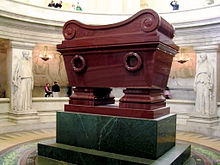
From Scott’s “Life of Napoleon Bonaparte”.  Napoleon passed on the island of St. Helena, on May 5th, 1821; now entombed in Les Invalides. 


Thursday, May 5, 2011

A Real Handyman

According to Rampant Scotland, steamboat developer James Taylor was born on May 5, 1758.  Twenty years later, he joined two other developers, Patrick Miller and William Symmington to build a 25 foot steamer which reached 5mph.  Sir Walter Scott mentions steamboats pulling fishing boats out of harbor in his journal entry of May 30, 1829.

May 30.--The Skenes came in to supper last night. Dr. Scott of Haslar Hospital came to breakfast. He is a nephew of Scott of Scalloway, who is one of the largest proprietors in Shetland. I have an agreeable recollection of the kindness and hospitality of these remote isles, and of this gentleman's connections in particular, who welcomed me both as a stranger and a Scott, being duly tenacious of their clan. This young gentleman is high in the medical department of the navy. He tells me that the Ultima Thule is improving rapidly. The old clumsy plough is laid aside. They have built several stout sloops to go to the deep-sea fishing, instead of going thither in open boats, which consumed so much time between the shore and the haaf or fishing spot. Pity but they would use a steam-boat to tow them out! I have a real wish to hear of Zetland's advantage. I often think of its long isles, its towering precipices, its capes covered with sea-fowl of every class and description that ornithology can find names for, its deep caves, its smoked geese, and its sour sillocks. I would like to see it again. After the Court I came round by Cadell, who is like Jemmy Taylor, 

    "Full of mirth and full of glee,"

for which he has good reason, having raised the impression of the Magnum to 12,000 copies, and yet the end is not, for the only puzzle now is how to satisfy the delivery fast enough.

Wednesday, May 5, 2010

Charles I Surrenders to Covenanting Forces

On May 5, 1646, a beleaguered Charles I of England surrendered to Scottish forces under Alexander Leslie, Lord Leven.  Charles was between a rock and a hard place - Parliamentary forces or Scots Covenanters.  Walter Scott covers this history in his "Tales of a Grandfather":

"...In circumstances so desperate, it was difficult to make a choice. A frank surrender to the Parliament, or an escape abroad, would have perhaps been the most advisable conduct. But the Parliament and their own independent army were now on the brink of quarrelling. The establishment of the Presbyterian Church was resolved upon, though only for a time and in a limited form, and both parties were alike dissatisfied ; the zealous Presbyterians, because it gave the Church courts too little power ; the Independents, because it invested them with any control whatever over persons of a different communion. Amidst the disputes of his opponents, the King hoped to find his way back to the throne.


For this purpose, and to place himself in a situation, as he hoped, from whence to negotiate with safely, Charles determined to surrender himself to that Scotish army which had been sent into England, under the Earl of Leven, as auxiliaries of the English Parliament. The King concluded that he might expect personal protection, if not assistance, from an army composed of his own countrymen. Besides, the Scottish army had lately been on indifferent terms with the English. The Independent troops, who now equalled or even excelled them i:i discipline, and were actuated by an enthusiasm which the Scots did not possess, looked with an evil eye on an army composed of foreigners and Presbyterians. The English in general, as soon as their assistance was no longer necessary, began to regard their Scottish brethren as an incumbrance ; and the Parliament, while they supplied the Independent forces liberally with money and provisions, neglected the Scots in both these essentials, whose honour and interest were affected in proportion. A perfect acquaintance with the discontent of the Scottish army, induced Charles to throw himself upon their protection in his misfortunes.


He left Oxford in disguise, on 27th April, having only two attendants. Nine days after his departure, he surprised the old Earl of Leven and the Scottish camp, who were then forming the siege of Newark, by delivering himself into their hands. The Scots received the unfortunate monarch with great outward respect, but guarded his person with vigilance. They immediately broke up the siege, and marched with great speed to the north, carrying the person of the King along with them, and observing the strictest discipline on their retreat. When their army arrived at Newcastle, a strong town which they themselves had taken, and where they had a garrison, they halted to await the progress of negotiations at this singular crisis.


Upon surrendering himself to the Scottish army, King Charles had despatched a message to the Parliament, expressing his having done so, desiring that they would send him such articles of pacification as they should agree upon, and offering to surrender Oxford, Newark, and whatever other garrisons or strong places he might still possess, and order the troops he had on foot to lay down their arms. The places were surrendered accordingly, honourable terms being allowed ; and the army of Montrose in the Highlands, and such other forces as the Royalists still maintained throughout England, were disbanded, as I have already told you, by the King's command.


The Parliament showed great moderation, and the civil war seemed to be ended. The articlesof pacification which they offered were not more rigorous than the desperate condition of the King must have taught him to expect. But questions of religion interfered to prevent the conclusion of the treaty.


In proportion as the great majority of the Parliament were attached to the Presbyterian forms, Charles was devoted to the system of Episcopacy. He deemed himself bound by his coronation oath to support the Church of England, and he would not purchase his own restoration to the throne by consenting to its being set aside. Here, therefore, the negotiation betwixt the King and his Parliament was broken off; but another was opened between the English Parliament and the Scottish army, concerning the disposal of the King's person.


If Charles could have brought his mind to consent to the acceptance of the Solemn League and Covenant, it is probable that he would have gained all Scotland to his side. This, however, would have been granting to the Scots what he had refused to the Parliament"; for the support of Presbytery was the essential object of the Scottish invasion. On the 'other hand, it could hardly be expected that the Scottish Convention of Estates should resign the very point on which they had begun and continued the war. The Church of Scotland sent forth a solemn warning, that all engagement with the King was unlawful. The question, therefore, was, what should be done with the person of Charles..."