Showing posts with label Life of Johnson. Show all posts

Saturday, October 29, 2011

James Boswell Born


‘There was a variation of spirits about James Boswell which indicated some slight touch of insanity.  His melancholy, which he complained of to Johnson, was not affected, but constitutional, though doubtless he thought it a mark of high distinction to be afflicted with hypochondria like his moral patron.  But Johnson, however indulgent to his own sinking of the spirits, had little tolerance for those of his imitator.  After all, Bozzy, though submitting to Johnson in everything, had his means of indemnification.  Like the jackanapes mounted on the bear’s back, he contrived now and then to play the more powerful animal a trick by getting him into situations, like the meeting with Wilkes, merely to see how he would look.  The voyage to the Hebrides exhibited some tricks of that kind, the weather being so stormy at that late season that everyone thought they must have drowned.  Undoubtedly Bozzy wanted to see how the Doctor would look in a storm.’ 

October 29, 1740, is the day that James Boswell came into the world.  Sir Walter Scott writes of Bozzy to John Wilson Croker, who later sought Scott’s help toward gaining access to Boswell's papers, through Scott's connection with Boswell's sons, as material for his annotated version of Boswell’s “The Life of Samuel Johnson”.  Scott’s letter is dated January 30, 1829.

Wednesday, June 15, 2011

William Julius Mickle

'On Monday, June 14, and Tuesday, 15, Dr. Johnson and I dined, on one of them, I forget which, with Mr. Mickle, translator of the Lusiad, at Wheatley, a very pretty country place a few miles from Oxford; and on the other with Dr. Wetherell, Master of University College. ....'

This entry from Boswell's "Life of Johnson" was took place in the year Johnson died; 1784.  “The Lusiad or The Discovery of India" was an epic poem written by Luis de Camoes.  Mickle dedicated his 1776 translation to a friend of Sir Walter Scott’s - Henry Scott, the 3rd Duke of Buccleuch.

My Lord,
The first idea of offering my Lusiad to some distinguished personage, inspired the earnest wish, that it might be accepted by the illustrious representative of that family under which my father, for many years, discharged the duties of a clergyman.

Both the late Duke of Buccleugh, and the Earl of Dalkeith, distinguished him by particular marks of their favour; and I must have forgotten him, if I could have wished to offer the first Dedication of my literary labours to any other than the Duke of Buccleugh.

I am, with the greatest respect,
My Lord,
Your Grace's most devoted
And most obedient humble servant,

WILLIAM JULIUS MICKLE


Sir Walter Scott mentions Mickle in his Introductory Remarks on Popular Poetry, in the 1830 publication of his “Minstrelsy of the Scottish Border”:

 ‘Of Ritson's own talents as an editor of ancient poetry, we shall have occasion to speak hereafter. The first collector who followed the example of Dr. Purr, was Mr. T. Evans, bookseller, father of the gentleman we have just quoted. His 'Old Ballads, historical narrative, with some of modern date, appeared in two volumes, in 1777, and were eminently successful. In 1T84, a. second edition appeared, extending the work to four volumes. In this collection many ballads found acceptance, which Bishop Percy had not considered as possessing sufficient merit to claim admittance into the Reliques The 8vo. Miscellany of 1723 yielded a great part of  the materials. The collection of Evans contained several modern pieces of great merit, which are not to be found elsewhere, and which are understood to be the productions of William Julius Mickle, translator of the Lusiad, though they were never claimed by him, nor received among his works. Amongst them is the elegiac poem of Cumnor Hall, which suggested the fictitious narrative entitled Kenilworth. The Red-Cross Knight, also by Mickle, which has furnished words for a beautiful glee, first occurred in the same collection. As Mickle, with a vein of great facility, united a power of verbal melody which might have been envied by bards of much greater renown, he must be considered as very successful in these efforts, if the ballads be regarded as avowedly modern. If they are to be judged of as accurate imitations of ancient poetry, they have less merit: the deception being only maintained by a huge store of double consonants, strewed at random into ordinary words, resembling the real fashion of antiquity as little as the niches, turrets, and tracery of plaster stuck upon a modern front.’

Scott dedicated this publication to the 5th Duke of Buccleuch, Walter Francis Montagu Douglas Scott:

TO HIS GRACE
WALTER FRANCIS MONTAGU DOUGLAS SCOTT,
DUKE OF BUCCLEUCH AND QUEENSBERRY,

&c. &c. &c. My Lord Duke,
In inscribing these volumes* to your Grace, I am fortunately emancipated from the necessity of intruding upon you the commonplace subjects of dedication. Most of these Poems have been long before the public, and were inscribed, at the time of their publication, to the various excellent persons nearly connected with your Grace, whose names they retain. I am, therefore, well aware, that these compositions, of little intrinsic value in themselves, will, like other memorials of dear friends, who have been removed from the world, claim some value in your Grace's estimation, from the names of their former patrons.

May your Grace live long to exercise the virtues of your predecessors, whose duties you inherit along with their rank and possessions. Such is the sincere wish of, My Lord Duke,
Your Grace's early Friend,
And much obliged humble Servant,
WALTER SCOTT. Abbotsford, April 3, 1830.

Wednesday, August 25, 2010

A Light Dims

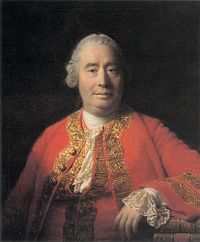
David Hume (picture linked to source) was covered in an earlier post.  On August 25, 1776, the great philosopher died.  Hume is thought to have died of cancer.  As related by James Boswell in this snippet of conversation with the incredulous Samuel Johnson (from "Life of Johnson"), Hume may not have feared his death.  'BOSWELL: When we were alone, I introduced the subject of death, and endeavoured to maintain that the fear of it might be got over. I told him that David Hume said to me, he was no more uneasy to think he should NOT BE after this life, than that he HAD NOT BEEN before he began to exist. JOHNSON. Sir, if he really thinks so, his perceptions are disturbed; he is mad: if he does not think so, he lies. He may tell you, he holds his finger in the flame of a candle, without feeling pain; would you believe him? When he dies, he at least gives up all he has.'

Walter Scott records passing Hume's grave in his Journal (January 24, 1826): '...Went to the funeral of Chevalier Yelin, the literary foreigner mentioned on 22d. How many and how various are the ways of affliction! Here is this poor man dying at a distance from home, his proud heart broken, his wife and family anxiously expecting letters, and doomed only to learn they have lost a husband and father for ever. He lies buried on the Calton Hill, near learned and scientific dust--the graves of David Hume and John Playfair being side by side.'

Sunday, May 30, 2010

Alexander Pope

"...Pope, who then filled the poetical throne without a rival, it may reasonably be presumed, must have been particularly struck by the sudden appearance of such a poet; and, to his credit, let it be remembered, that his feelings and conduct on the occasion were candid and liberal. He requested Mr. Richardson, son of the painter, to endeavour to find out who this new authour was. Mr. Richardson, after some inquiry, having informed him that he had discovered only that his name was Johnson, and that he was some obscure man, Pope said; 'he will soon be deterre.' We shall presently see, from a note written by Pope, that he was himself afterwards more successful in his inquiries than his friend..."

From Boswell's "Life of Johnson".

At the time Samuel Johnson burst onto the literary scene, with the publication of his satirical poem "London" (1738), Alexander Pope was the first poet in England.  He was also big enough to recognize Johnson's talent.  Johnson was appreciative of Pope as well, commenting on his translation of the Iliad that it was "a performance which no age or nation could hope to equal".  Pope was to live only six years after first learning of Johnson, dying on May 30, 1744.

Around 1819, Walter Scott engaged in some correspondence with Charles Kirkpatrick Sharpe, who had contributed to his "Minstrelsy of the Scottish Border", referencing Alexander Pope.

Sunday, January 16, 1819.


MY DEAR SHARPE,

I have already bespoke Spence, but of late I have not been looking after my books, so have not received him. Never suppose you want such books as I have while I am to the fore. I have always detested literary quarrels, in which, as in common gambling-houses, you stake your tie and temper against those of very unworthy antagonists. But Pope was a fine fellow. His fault was, he was quite literary, and had neither the business nor the idleness of life to divide his mind from his Parnassian pursuits. Those who have not his genius may be so far compensated by avoiding his foibles, and least of all ought they to be nourished by your true and sincere friend,


WALTER SCOTT.


I return with best thanks La Belle Chuck.

Wednesday, May 19, 2010

James Boswell

History is replete with examples of people who die on or around significant dates in their lives.  Former US Presidents John Adams and Thomas Jefferson dying on July 4 are prime examples.  The date May 19 was very close to a significant date for James Boswell.  Boswell met Samuel Johnson in London on May 16, 1763.  He published his "Life of Johnson" on May 16, 1791.  The 9th Laird of Auchinlech passed on May 19, 1795.

Auchinlech was close to Walter Scott's Abbotsford, and Scott knew Boswell's family.  John Croker enlisted Walter Scott's help in attempting (unsuccessfully) to obtain material from Boswell's children for his edition of Boswell's "Life of Johnson", published in 1831.  Scott did, however, provide numerous contributions for notes, etc., including:

From "Life of Johnson":
I  told Dr. Johnson I was in some difficulty how to act at Inverary. I had reason to think that the Duchess of Argyle disliked me, on account of my zeal in the Douglas cause.1

Scott's Note:
1 [Elizabeth Gunning, celebrated (like her sister, Lady Coventry) for her personal charms, had been previously Duchess of Hamilton, and was mother of Douglas, Duke of Hamilton, the competitor for the Douglas property with the late Lord Douglas: she was, of course, prejudiced against Boswell, who bad shown all the bustling importance of his character in the Douglas cause, and it was said, I know not on what authority, that he headed the mob which broke the windows of some of the judges, and of Lord Aucbinleck, his father, in particular.—Walter Scott.

Tuesday, April 13, 2010

Charles Burney

Dr. Charles Burney was an English music historian and composer.  In 1776, Burney published the first volume of his "History of Music", which was followed by three additional volumes by 1789.  Dr. Burney passed on April 13, 1814.

Burney is probably best known now as the father of author Fanny Burney, and to a lesser extent Fanny's half-sister, author Sarah Burney.  During his day, Charles Burney was well known in London circles, and was familiar to Samuel Johnson.  Boswell records the following correspondence between Burney and Johnson in his "Life of Johnson".

"...In 1755 we behold him to great advantage; his degree of Master of Arts conferred upon him, his Dictionary published, his correspondence animated, his benevolence exercised.


Mr. Charles Burney, who has since distinguished himself so much in the science of Musick, and obtained a Doctor's degree from the University of Oxford, had been driven from the capital by bad health, and was now residing at Lynne Regis, in Norfolk. He had been so much delighted with Johnson's Rambler and the Plan of his Dictionary, that when the great work was announced in the news-papers as nearly finished,' he wrote to Dr. Johnson, begging to be informed when and in what manner his Dictionary would be published; intreating, if it should be by subscription, or he should have any books at his own disposal, to be favoured with six copies for himself and friends.


In answer to this application, Dr. Johnson wrote the following letter, of which (to use Dr. Burney's own words) 'if it be remembered that it was written to an obscure young man, who at this time had not much distinguished himself even in his own profession, but whose name could never have reached the authour of The Rambler, the politeness and urbanity may be opposed to some of the stories which have been lately circulated of Dr. Johnson's natural rudeness and ferocity.'


'TO MR. BURNEY, IN LYNNE REGIS, NORFOLK.

'SIR,--If you imagine that by delaying my answer I intended to shew any neglect of the notice with which you have favoured me, you will neither think justly of yourself nor of me. Your civilities were offered with too much elegance not to engage attention; and I have too much pleasure in pleasing men like you, not to feel very sensibly the distinction which you have bestowed upon me. 'Few consequences of my endeavours to please or to benefit mankind have delighted me more than your friendship thus voluntarily offered, which now I have it I hope to keep, because I hope to continue to deserve it.


'I have no Dictionaries to dispose of for myself, but shall be glad to have you direct your friends to Mr. Dodsley, because it was by his recommendation that I was employed in the work.


'When you have leisure to think again upon me, let me be favoured with another letter; and another yet, when you have looked into my Dictionary. If you find faults, I shall endeavour to mend them; if you find none, I shall think you blinded by kind partiality: but to have made you partial in his favour, will very much gratify the ambition of, Sir, your most obliged and most humble servant,


'SAM. JOHNSON.'


'Gough-square, Fleet-street, April 8,1755.'..."

Walter Scott met Fanny Burney in 1826 (November 18).  Sarah Burney was also a fan of Scott's.

Sunday, April 4, 2010

Oliver Goldsmith

'Dr. Goldsmith is one of the first men we now have as an authour, and he is a very worthy man too. He has been loose in his principles, but he is coming right.'

- Samuel Johnson, as quoted by James Boswell in his "Life of Johnson"

The author of "The Traveler", and "The Vicar of Wakefield" died on April 4, 1774.  Walter Scott wrote a short biography of Goldsmith, contained in his "Miscellaneous Prose Works."  Goldsmith was known for his foibles as well as his talents, and Scott recognizes the influence of Samuel Johnson on Goldsmith's work:

"..Still, however, though subsisting thus precariously, he was getting forward in society; and had already, in the year 1761, made his way as far as Dr. Johnson, who seems, from their first acquaintance, till death separated them, to have entertained for Goldsmith the most sincere friendship, regarding his genius with respect, his failings with indulgence, and his person with-affection.


It was probably soon after this first acquaintance, that Necessity, the parent of so many works of genius, gave birth to the Vicar of Wakefield. The circumstances attending the sale of the work to the fortunate publisher, are too singular to be told in any other words than those of Johnson, as reported by his faithful chronicler, Boswell.


" I received one morning a message from poor Goldsmith, that he was in great distress; and as it was not in his power to come to me, begging that I would come to him as soon as possible. I sent him a guinea, and promised to come to him directly. I accordingly went as soon as I was dressed, and found that his landlady had arrested him for his rent, at which he was in a violent passion. I perceived that he had already changed my guinea, and had got a bottle of Madeira and a glass before him. I put the cork into the bottle, desired he would be calm, and began to talk to him of the means by which he might be extricated.- He then told me that he had a novel ready for the press, which he produced to me. I looked into it, and saw its merit; told the landlady I should soon return, and, having gone to a bookseller, sold it for sixty pounds. I brought Goldsmith the money, and he discharged his rent, not without rating his landlady in a high tone for having used him so ill."..."

Friday, March 19, 2010

Tobias Smollet

"The Life of Smollett, whose genius has raised an imperishable monument to his fame, has been written, with spirit and elegance- by his friend and contemporary, the celebrated Dr Moore, and more lately by Dr Robert Anderson of Edinburgh, with a careful research, which leaves to us little except the task of selection and abridgement..."

Thus Walter Scott begins his brief biography of Tobias Smollett, published in "The Miscellaneous Prose Works of Sir Walter Scott".  Smollett, born on March 19, 1721, died the month following Scott's own birth (Smollett passed Sept. 17, 1771).  His youth was spent in what is now Renton, in West Dunbartonshire.  Scott describes the scene: "Tobias Smollett (baptized Tobias George) was born in 1721, in the old house of Dalquhurn, in the valley of Leven, in perhaps the most beautiful district in Britain."

Smollett trained as a surgeon at the University of Glasgow, and served as a naval surgeon.  His true calling however, was to literature, and he was also partial to Scotland.  His first publication was the poem " The Tears of Scotland", about the Battle of Culloden.  Scott reports a story of Smollet's working on this poem:  "...The late Robert Graham, Esq. 01 Gartmore, a particular friend and trustee of Smollett, has recorded the manner in which this effusion was poured forth.

" Some gentlemen having met at a tavern were amusing themselves before supper with a game at cards j while Smollett, not choosing to play, sat down to write. One of the company, who also was nominated by him one of his trustees," ( Gartmore himself,) " observing his earnestness, and supposing lie was writing verses, asked him if it was not so. He accordingly read them the first sketch of his Tears of Scotland, consisting only of six stanzas ; and on their remarking that the termination of the poem, being too strongly expressed, might give offence to persons whose political opinions were different, he sat down, without reply, and, with an air of great indignation, subjoined the concluding stanza:—


" While the warm blood bedews my veins.
And unimpaired remembrance reigns,
Resentment of my Country's fate

Within my filial breast shall heat.

Yes, spite of thine insulting foe,

My sympathizing verse shall flow.

Mourn, hapless Caledonia, mourn,

Thy banish'd peace, thy laurels torn !"..."
 
Smollett established himself as a literary figure with the publication of his novel "The Adventures of Roderick Random, in 1748.  Smollett's great work, to his own thinking, was his "A Complete History of England."  Smollett had already achieved quite a literary reputation before embarking on this study, which took from 1757 - 1765 to complete.
 
Smollett was contemporary with Samuel Johnson, who he nicknamed "the great Cham of literature".  James Boswell records this conversation in his "Life of Johnson" (April 10, 1776), which highlights the great esteem Smollett was held in, as well as his reputation as a critic: "...He (Johnson) talked of Lord Lyttelton's extreme anxiety as an authour; observing, that 'he was thirty years in preparing his History, and that he employed a man to point it for him; as if (laughing) another man could point his sense better than himself.' Mr. Murphy said, he understood his history was kept back several years for fear of Smollet. JOHNSON. 'This seems strange to Murphy and me, who never felt that anxiety, but sent what we wrote to the press, and let it take its chance.' MRS. THRALE. 'The time has been, Sir, when you felt it.' JOHNSON. 'Why, really, Madam, I do not recollect a time when that was the case.'..." Dr. Johnson edited the Latin inscription on a memorial column at Smollett's burial site.

Friday, January 29, 2010

Croker's Edition of Boswell's Life of Johnson

January 29. (1831)—I had a vacant day once more by the kindness of Sir Robert, unasked, but most kindly afforded. I have not employed it to much purpose. I wrote six pages to Croker, who is busied with a new edition of Boswell's Life of Johnson, to which most entertaining book he hopes to make large additions from Mrs. Piozzi, Hawkins and other sources. I am bound by many obligations to do as much for him as I can, which can only respect the Scottish Tour.

John Wilson Croker did compile an annotated version of Boswell's Life of Johnson, publishing it in 1831.  In addition to the writing referred to above, Croker asked Walter Scott to approach James Boswell's sons (Alexander and James) with a request for source material for his new edition. Scott attempted to contact the Boswell's, who he was acquainted with, but wasn't able to connect - much as had been Croker's experience.

Croker's publication became the source of much controversy.  He included several errors in his work, and these were picked up by a political enemy - Thomas Macaulay.  Macaulay published a critical review that damaged both Croker and Boswell.

Tuesday, December 15, 2009

Whigs and Tories

December 15, 1826 - from Scott's Journal:

"...Our discussion went off very decently; no discussions or aggravating speeches. Sir John Jackass seconded the Whig's nominee. So much they will submit to get a vote. ... The Tory interest was weak among the old stagers, where I remember it strong, but preferment, country residence, etc., has thinned them..."

James Boswell provided this Samuel Johnson description of the difference between a Whig and a Tory (Life of Johnson):

"A wise Tory and a wise Whig, I believe, will agree. Their principles are the same, though their modes of thinking are different. A high Tory makes government unintelligible; it is lost in the clouds. A violent Whig makes it impracticable: he is for allowing so much liberty to every man, that there is not power enough to govern any man. The prejudice of the Tory is for establishment: the prejudice of the Whig is for innovation. A Tory does not wish to give more real power to Government; but that Government should have more reverence. Then they differ as to the Church. The Tory is not for giving more legal power to the Clergy, but wishes they should have a considerable influence, founded on the opinion of mankind: the Whig is for limiting and watching them with a narrow jealousy."