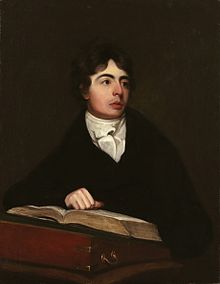
Showing posts with label Robert Southey. Show all posts

Wednesday, March 21, 2012

Robert Southey


‘On my return here, I found, to my no small surprise, a letter tendering to me the laurel vacant by the death of the poetical Pye. I have declined the appointment.... Will you forgive me, my friend, if I own I had you in my recollection? I have given Croker the hint, and otherwise endeavored to throw the office into your option. I am uncertain if you will like it, for the laurel has certainly been tarnished by some of its wearers, and, as at present managed, its duties are inconvenient and somewhat liable to ridicule. But the latter might be amended, as I think the Regent's good sense would lead him to lay aside these regular commemorations; and as to the former point, it has been worn by Dryden of old, and by Warton in modern days.’

The text above comes from a letter Walter Scott wrote to Robert Southey (September 4, 1813). Scott recommended Southey for the honor of Poet Laureate for Britain.  Southey held the post form 1813 to 1843.  Robert Southey died on March 21st, 1843.

Tuesday, August 9, 2011

Godfather


On August 9, 1815, Charles Lamb wrote to Robert Southey on his pending godfathership:

‘I am going to stand godfather; I don’t like the business; I cannot muster up decorum for these occasions; I shall certainly disgrace the font.  I was at Hazlitt’s marriage, and had like to have been turned out several times during the ceremony.  Anything awful makes me laugh.  I misbehaved once at a funeral.  Yet I can read about these ceremonies with pious and proper feelings.  The realities of life only seem the mockeries.’

That letter was included in the Folio Book of Days.  Sir Walter Scott was probably godfather to more than one child, and he writes of one instance with more apparent zeal than did Lamb.  The text below comes from a letter to John Morritt, dated January 14, 1818, now published in “Familiar Letters of Walter Scott”.

‘…But my immediate labour has been in behalf of my friend Terry, the comedian, in whom, on account of his sense, information, and modesty I take a great interest. He has named a child after me, and I am preparing a godfather's gift in the shape of a drama.1 But godfathers, as in the time of conjurors and fames, may append what conditions they please to their gifts, and mine is that as I take no concern in the merit or in the emoluments of the piece in case of success, so I shall only be damn'd by proxy if damn'd I am. In a word, Terry takes his chance, and I believe there will be no medium, for if it does not succeed very decidedly, it will be damn'd most infernally. I have tried to coax the public to relax some of the rules of criticism, and to be amused with that medley of tragic and comic which life presents us, not only in the same course of action but in the same character. To deprecate all rigidity of judgment, I introduce the marvellous, the absurd, and something like the heroic, all to make the gruel slab…

Friday, July 15, 2011

Michael Bruce

Robert Southey described poet Michael Bruce as "A youth of real genius, whose life was embittered and shortened by poverty". The author of "Elegy Written in Spring" died on July 15, 1767, at the young age of 21.  Having achieved a fair measure of success by this age, one wonders what he could have produced had he lived longer. 

Sir Walter Scott seems to have held a different opinion than Southey, at least in comparison to William Knox, who managed to live into his mid thirties.  Scott comments in his journal on December 8, 1825: 'Talking of the vixisse, it may not be impertinent to notice that Knox, a young poet of considerable talent, died here a week or two since. His father was a respectable yeoman, and he himself, succeeding to good farms under the Duke of Buccleuch, became too soon his own master, and plunged into dissipation and ruin. His poetical talent, a very fine one, then showed itself in a fine strain of pensive poetry, called, I think, The Lonely Hearth, far superior to those of Michael Bruce, whose consumption, by the way, has been the life of his verses.

Monday, June 20, 2011

John Skelton

Walter Scott shares at least one thing in common with today's subject - John Skelton.  Both were offered the Poet Laureateship.  Scott refused, recommending Robert Southey, who became Poet Laureate in 1813.  Skelton became Poet Laureate in 1513 or 1514.  Skelton tutored the future Henry VIII while he was a prince, becoming Poet Laureate during his reign.  Skelton managed to keep his head, dying on June 21, 1529, at nearly 70 years of age.

Skelton wrote sometimes of women who inspired him, including the mother of Jane Seymour:


To Mistress Margery Wentworth

WITH margerain gentle,
The flower of goodlihead,
Embroidered the mantle
Is of your maidenhead.
Plainly I cannot glose;
Ye be, as I divine,
The pretty primrose,
The goodly columbine.

Benign, courteous, and meek,
With wordes well devised;
In you, who list to seek,
Be virtues well comprised.
With margerain gentle,
The flower of goodlihead,
Embroidered the mantle
Is of your maidenhead.


Monday, November 29, 2010

A Letter from Southey

Poet Robert Southey was somewhat of a radical from an early age.  He got himself expelled from Westminster School in 1792 (approx. 18 years old) for publishing an article in the school paper against flogging.  In 1794, he contemplated migrating to Pennsylvania with Samuel Taylor Coleridge to establish a commune.  He seems to have been temperamental, as evidenced by Sir Walter Scott's journal reaction to a letter he received from Southey on November 29, 1825.

'A letter from Southey, malcontent about Murray having accomplished the change in the Quarterly without speaking to him, and quoting the twaddle of some old woman, male or female, about Lockhart's earlier jeux d'esprit, but concluding most kindly that in regard to my daughter and me he did not mean to withdraw. That he has done yeoman's service to the Review is certain, with his genius, his universal reading, his powers of regular industry, and at the outset a name which, though less generally popular than it deserves, is still too respectable to be withdrawn without injury. I could not in reply point out to him what is the truth, that his rigid Toryism and High Church prejudices rendered him an unsafe counsellor in a matter where the spirit of the age must be consulted; but I pointed out to him what I am sure is true, that Murray, apprehensive of his displeasure, had not ventured to write to him out of mere timidity and not from any [intention to offend]. I treated [lightly] his old woman's apprehensions and cautions, and all that gossip about friends and enemies, to which a splendid number or two will be a sufficient answer, and I accepted with due acknowledgment his proposal of continued support. I cannot say I was afraid of his withdrawing. Lockhart will have hard words with him, for, great as Southey's powers are, he has not the art to make them work popularly; he is often diffuse, and frequently sets much value on minute and unimportant facts, and useless pieces of abstruse knowledge. Living too exclusively in a circle where he is idolised both for his genius and the excellence of his disposition, he has acquired strong prejudices, though all of an upright and honourable cast. He rides his High Church hobby too hard, and it will not do to run a tilt upon it against all the world. Gifford used to crop his articles considerably, and they bear mark of it, being sometimes décousues. Southey said that Gifford cut out his middle joints. When John comes to use the carving-knife I fear Dr. Southey will not be so tractable. Nous verrons. I will not show Southey's letter to Lockhart, for there is to him personally no friendly tone, and it would startle the Hidalgo's pride. It is to be wished they may draw kindly together. Southey says most truly that even those who most undervalue his reputation would, were he to withdraw from the Review, exaggerate the loss it would thereby sustain. The bottom of all these feuds, though not named, is Blackwood's Magazine; all the squibs of which, which have sometimes exploded among the Lakers, Lockhart is rendered accountable for. He must now exert himself at once with spirit and prudence.  He has good backing—Canning, Bishop Blomfield, Gifford, Wright, Croker, Will Rose,—and is there not besides the Douglas?  An excellent plot, excellent friends, and full of preparations? It was no plot of my making, I am sure, yet men will say and believe that [it was], though I never heard a word of the matter till first a hint from Wright, and then the formal proposal of Murray to Lockhart announced. I believe Canning and Charles Ellis were the prime movers. I'll puzzle my brains no more about it.'

Saturday, July 3, 2010

Castle of Giant Despair

July 3 (1828).—Corrected proofs in the morning, and wrote a little. I was forced to crop vol. i. as thirty pages too long; there is the less to write behind. We were kept late at the Court, and when I came out I bethought me, like Christian in the Castle of Giant Despair, "Wherefore should I walk along the broiling and stifling streets when I have a little key in my bosom which can open any lock in Princes Street Walks, and be thus on the Castle banks, rocks, and trees in a few minutes?" I made use of my key accordingly, and walked from the Castle Hill down to Wallace's Tower, and thence to the west end of Princes Street, through a scene of grandeur and beauty perhaps unequalled, whether the foreground or distant view is considered—all down hill, too. Foolish never to think of this before. I chatted with the girls a good while after dinner, but wrote a trifle when we had tea.

Scott alludes to John Bunyan's "The Pilgrim's Progress" several times in his journal, and in his published works.  He also reviewed Robert Southey's "Life of Bunyan", which review was published in the Quarterly Review (vol 43).  Scott evidently believed that Bunyan derived from gypsy stock: "...we surmise the probability that Bunyan's own family, though reclaimed and settled, might have sprung from this caste of vagabonds..."

From Bunyan's "The Pilgrim's Progress":

...So Mr Great-Heart, old Honest, and the four young men, went to go up to Doubting Castle, to look for Giant Despair. When they came at the castle gate, they knocked for entrance with an unusual noise. At that the old giant comes to the gate, and Diffidence his wife follows. Then said he, Who and what is he that is so hardy, as after this manner to molest the Giant Despair? Mr Great-Heart replied, It is I, Great-Heart, one of the King of the celestial country's conductors of pilgrims to their place; and I demand of thee that thou open thy gates for my entrance: prepare thyself also to fight, for I am come to take away thy head, and to demolish Doubting Castle...