Showing posts with label Tour to the Hebrides with Samuel Johson. Show all posts

Tuesday, November 1, 2011

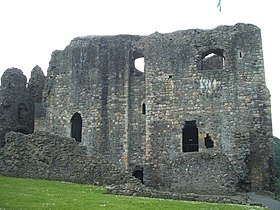
Castle of DunDonald

‘Monday, November I. 
Though Dr. Johnson was lazy, and averse to move, I insisted that he should go with me, and pay a visit to the Countess of Eglintoune, mother of the late and present earl. I assured him, he would find himself amply recompensed for the trouble; and he yielded to my solicitations, though with some unwillingness...

As we passed very near the castle of Dundonald, which was one of the many residences of the kings of Scotland, and in which Robert the Second lived and died, Dr. Johnson wished to survey it particularly. It stands on a beautiful rising ground, which is seen at a great distance on several quarters, and from whence there is an extensive prospect of the rich district of Cuninghame, the western sea, the isle of Arran, and a part of the northern coast of Ireland. It has long been unroofed ; and, though of considerable size, we could not, by any power of imagination, figure it as having been a suitable habitation for majesty. Dr. Johnson, to irritate my old Scottish enthusiasm, was very jocular on the homely accommodation of ' King Bob,' and roared and laughed till the ruins echoed..’

Dr. Johnson and James Boswell are on their leg home at the end of their trip to the Western Isles on November 1st, 1773.  “King Bob’s” dying place, which he had built in 1371, is provided with a few more historical facts and much more seriousness in Walter Scott’s treatment, in his “The History of Scotland”.

‘The regent, after he had been invested with his office, showed considerable energy. The earl of Nottingham, marshal of England, trusted with the wardenship of the east marches, had reproached the Percies for their defeat at Otterbourne, and boasted of what he would himself have done in similar circumstances. But when the regent Robert, at the head of an equal army, defied him to action, Nottingham declined the combat with the unsoldier-like excuse, " that he was not commissioned to expose the king's liege subjects to danger."  The Scots burned Tynemouth, and returned to their own country. . In the summer of the same year, 1389, a truce of three years was formed betwixt France and England, in which Scotland was included as the ally of the former power. Shortly after this event king Robert II died at his castle of Dundonald in Ayrshire. He was at the advanced age of seventy-five, and had reigned nineteen years.’

Wednesday, October 27, 2010

Commissary Smollett and Cameron House

On October 27, 1773, the Johnson/Boswell Tour of the Western Isles, which we have been following intermittently, is winding down.  The duo visits Commissary Smollett's Cameron House (from "The Journal of a Tour to the Hebrides with Samuel Johnson, LL.D."):

'...We were favoured with Sir James Colquhoun's coach to convey us in the evening to Cameron, the seat of Commissary Smollet. Our satisfaction of finding ourselves again in a comfortable carriage was very great. We had a pleasing conviction of the commodiousness of civilization, and heartily laughed at the ravings of those absurd visionaries who have attempted to persuade us of the superior advantages of a state of nature.

Mr Smollet was a man of considerable learning, with abundance of animal spirits; so that he was a very good companion for Dr Johnson, who said to me, 'We have had more solid talk here than at any place where we have been.'...'

On the banks of the Leven River, there is a column dedicated to Commissary Smollett that Samuel Johnson helped inscribe. 

Sir Walter Scott was familiar with Commissary Smollett, who died in 1775, perhaps mainly through Commissary's cousin, the author Tobias.  Scott published "Select Works of Tobias Smollett", adding his own Prefatory Memoir of the Life and Writings of Tobias Smollett".  Scott includes references to Cameron House and Commissary Smollett in this preface:

'Tobias Smollett (baptized Tobias-George) was born in 1721, in the old house of Dalquhurn, in the valley of Leven, in perhaps the most beautiful district in Britain. Its distinguished native has celebrated the vale of Leven, not only in the beautiful ode addressed to his parent stream, but in the expedition of Humphrey Clinker, where he mentions the home of his forefathers in the following enthusiastic, yet not exaggerated terms; "A veiy little above the source of the Leven, on the lake, stands the house of Cameron, belonging to Mr Smollett,* so embosomed in an oak wood that we did not see it till we were within fifty yards of the door. The lake approaches, on one side, to within six or seven yards of the window. It might have been placed in a higher situation, which would have afforded a more extensive prospect, and a drier atmosphere ; but this imperfection is not chargeable on the present proprietor, who purchased it ready built, rather than be at the trouble of repairing his own family house of Bonhill, which stands two miles from hence, on the Leven, so surrounded with plantations, that it used to be known by the name of the mavis (or thrush) nest. Above that house is a romantic glen, or cleft of a mountain, covered with hanging woods, having, at bottom, a stream of fine water, that forms a number of cascades in its descent to join the Leven, so that the scene is quite enchanting.
* The late Commissary Smollett '
Commissary (James) Smollett is introduced by Tobias into his own novel "The Expedition of Humphry Clinker", which Scott mentions in the passage above.