Showing posts with label November 1. Show all posts

Tuesday, November 1, 2011

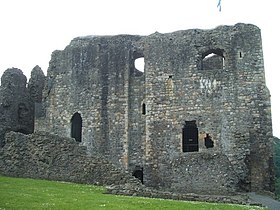
Castle of DunDonald

Monday, November I. 

Though Dr. Johnson was lazy, and averse to move, I insisted that he should go with me, and pay a visit to the Countess of Eglintoune, mother of the late and present earl. I assured him, he would find himself amply recompensed for the trouble; and he yielded to my solicitations, though with some unwillingness...

As we passed very near the castle of Dundonald, which was one of the many residences of the kings of Scotland, and in which Robert the Second lived and died, Dr. Johnson wished to survey it particularly. It stands on a beautiful rising ground, which is seen at a great distance on several quarters, and from whence there is an extensive prospect of the rich district of Cuninghame, the western sea, the isle of Arran, and a part of the northern coast of Ireland. It has long been unroofed ; and, though of considerable size, we could not, by any power of imagination, figure it as having been a suitable habitation for majesty. Dr. Johnson, to irritate my old Scottish enthusiasm, was very jocular on the homely accommodation of ' King Bob,' and roared and laughed till the ruins echoed..’

Dr. Johnson and James Boswell are on their leg home at the end of their trip to the Western Isles on November 1st, 1773.  “King Bob’s” dying place, which he had built in 1371, is provided with a few more historical facts and much more seriousness in Walter Scott’s treatment, in his “The History of Scotland”.

‘The regent, after he had been invested with his office, showed considerable energy. The earl of Nottingham, marshal of England, trusted with the wardenship of the east marches, had reproached the Percies for their defeat at Otterbourne, and boasted of what he would himself have done in similar circumstances. But when the regent Robert, at the head of an equal army, defied him to action, Nottingham declined the combat with the unsoldier-like excuse, " that he was not commissioned to expose the king's liege subjects to danger."  The Scots burned Tynemouth, and returned to their own country. . In the summer of the same year, 1389, a truce of three years was formed betwixt France and England, in which Scotland was included as the ally of the former power. Shortly after this event king Robert II died at his castle of Dundonald in Ayrshire. He was at the advanced age of seventy-five, and had reigned nineteen years.’

Monday, November 1, 2010

Lady Eglington

On Novermber 1, 1773, the Johnson/Boswell Western Isles tour visits Susanna Kennedy, the Countess Eglington.  Eglington was described by King George II as "the most beautiful woman in my dominions" (wikipedia).  But Ms. Eglington is known equally well for her talents and her patronage of poets.  The entry below, from Boswell's journal of his tour with Johnson is repeated in full in Sir Walter Scott's "Chronicles of the Canongate".

Monday, 1st November


'Though Dr Johnson was lazy, and averse to move, I insisted that he should go with me, and pay a visit to the Countess of Eglintoune, mother of the late and present earl. I assured him, he would find himself amply recompensed for the trouble; and he yielded to my solicitations, though with some unwillingness. We were well mounted, and had not many miles to ride...

Lady Eglintoune, though she was now in her eighty-fifth year, and had lived in the retirement of the country for almost half a century, was still a very agreeable woman. She was of the noble house of Kennedy, and had all the elevation which the consciousness of such birth inspires. Her figure was majestick, her manners high-bred, her reading extensive, and her conversation elegant. She had been the admiration of the gay circles of life, and the patroness of poets. Dr Johnson was delighted with his reception here. Her principles in Church and state were congenial with his. She knew all his merit, and had heard much of him from her son, Earl Alexander, who loved to cultivate the acquaintance of men of talents, in every department.

All who knew his lordship, will allow that his understanding and accomplishments were of no ordinary rate. From the gay habits which he had early acquired, he spent too much of his time with men, and in pursuits far beneath such a mind as his. He afterwards became sensible of it, and turned his thoughts to objects of importance; but was cut off in the prime of his life. I cannot speak, but with emotions of the most affectionate regret, of one, in whose company many of my early days were passed, and to whose kindness I was much indebted...

In the course of our conversation this day, it came out, that Lady Eglintoune was married the year before Dr Johnson was born; upon which she graciously said to him, that she might have been his mother; and that she now adopted him; and when we were going away, she embraced him, saying, 'My dear son, farewell!' My friend was much pleased with this day's entertainment, and owned that I had done well to force him out.'


Ms. Eglinton appears in Scott's work in the following passage, where the Boswell/Johnson is also noted :
 
'In the course of her becoming habituated with foreign manners, Mrs. Bethune Baliol had, perhaps, acquired some slight tincture of them herself. Yet I was always persuaded, that the peculiar vivacity of look and manner—the pointed and appropriate action—with which she accompanied what she said—the use of the gold and gemmed tabatiere, or rather I should say bonbonniere, (for she took no snuff, and the little box contained only a few pieces of candied angelica, or some such lady-like sweetmeat,) were of real old-fashioned Scottish growth, and such as might have graced the tea-table of Susannah, Countess of Eglinton,* the patroness of Allan Ramsay, or of the Hon. Mrs. Colonel Ogilvy, who was another mirror by whom the maidens of Auld Reekie were required to dress themselves. Although well acquainted with the customs of other countries, her manners had been chiefly formed in her own, at a time when great folk lived within little space, and when the distinguished name of the highest society gave to Edinburgh the eclat, which we now endeavour to derive from the unbounded expense and extended circle of our pleasures.
 
* Susannah Kennedy, daughter of Sir Archibald Kennedy of Cullean, Bart., by Elizabeth Lesly, daughter of David Lord Newark, third wife of Alexander 9th Earl of Eglinton, and mother of the 10th and llth Earls. She survived her husband, who died 1729, no less than fifty-seven years, and died March, 1780, in her 91st year. Allan Ramsay's Gentle Shepherd, published 1726, is dedicated to her, in verse, by Hamilton of Bangour.'

Sunday, November 1, 2009

All Saints Day

All Saints Day has been important in the Catholic/Anglican calendars, and in Christian countries. The Edinburgh Edition of the Waverly Novels includes the short story "The Two Drovers". There is a note in this work concerning the annual fair schedule in Rosley (SW of Carlisle), in which cattle, sheep, cloth and other goods were sold. The main event occurred on Whitsun Monday, and the fairs continued every fortnight thereafter, until All Saints Day.
The source of this note is The History and Antiquities of the Counties of Westmorland and Cumberland.