Sunday, November 6, 2011

Lion of the North

"It came slow, my lord, dooms slow," replied Dalgetty; "but as my Scottish countrymen, the fathers of the war, and the raisers of those valorous Scottish regiments that were the dread of Germany, began to fall pretty thick, what with pestilence and what with the sword, why we, their children, succeeded to their inheritance. Sir, I was six years first private gentleman of the company, and three years lance speisade; disdaining to receive a halberd, as unbecoming my birth. Wherefore I was ultimately promoted to be a fahndragger, as the High Dutch call it (which signifies an ancient), in the King's Leif Regiment of Black-Horse, and thereafter I arose to be lieutenant and ritt-master, under that invincible monarch, the bulwark of the Protestant faith, the Lion of the North, the terror of Austria, Gustavus the Victorious."

Gustavus Adolphus, or Gustavus II, of Sweden was considered by Napoleon to be one of the eight great captains the world has known.  The Lion of the North, as he was nicknamed, died on November 6, 1632, during the Battle of Lutzen.  The loss of Gustavus II’s life was detrimental to the Protestant cause during the Thirty Years’ War, though the Swedes won the day at Lutzen. 

Sir Walter Scott’s character Captain/Major Dalgetty invokes the name Gustavus throughout his speaking parts in “A Legend of the Wars of Montrose”.  Many Scots fought alongside Gustavus against German soldiers in the Thirty Years War, including David Leslie, who later fell to Cromwell's forces at Dunbar (1650).  It was another military man who influenced Scott’s novel.  According to the historical note in the Edinburgh Edition of this work, one of Scott's primary resources was a book about the military experiences of one Colonel Robert Monro, who fought for Gustavus.  Dalgetty’s words are taken after Monro’s.  Monro’s book has an enormously long title: “Monro his Expedition with the Worthy Scots Regiment (called Mac-Keyes Regiment) levied in August 1626…”.  Scholars have even found Scott’s annotation on a volume that was in the Advocates Library during his lifetime. 

Scott’s Montrose is less than 200 pages long.  What better way to spend Gustavus Adolphus day?

Saturday, November 5, 2011

James Clerk Maxwell


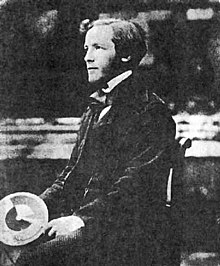
Scottish physicist James Clerk Maxwell died this day, November 5th, in 1879. Maxwell is remembered most for his theory of electromagnetic fields.  He is less well known for his love of Scottish poetry, though he even wrote some of his own.  This affinity is one he held in common with Sir Walter Scott, but their lives overlapped by only one year, and there is a connection more contemporary with Scott’s era.  Maxwell’s grandfather, Robert Hodshon Cay was a friend of Sir Walter’s.  

John Gibson Lockhart mentions Cay in his “Memoirs of the Life of Sir Walter Scott”.  ‘…I ought to have mentioned before, that in June, 1795, he [Scott] was appointed one of the curators of the Advocates' Library, an office always reserved for those members of the Faculty who have the reputation of superior zeal in literary affairs. He had for colleagues David Hume, the Professor of Scots Law, and Malcolm Laing, the historian; and his discharge of his functions must have given satisfaction, for I find him further nominated, in March, 1796, together with Mr. Robert Hodgson Cay—an accomplished gentleman, afterwards Judge of the Admiralty Court in Scotland—to "put the Faculty's cabinet of medals in proper arrangement."…’

The James Clerk Maxwell Foundation has much that is worth knowing about Maxwell on their website: http://www.clerkmaxwellfoundation.org/index.html
 

Friday, November 4, 2011

William of Orange


Last year’s post covered William of Orange’s marriage to Mary Stuart (November 4, 1677).  November 4 was important to William for another reason: it was his birthday.  The year was 1650, making him just 27 when he and Mary wed.  The eldest son of the daughter (also a Mary Stuart) of Charles I of England was never far from the Stuart’s domain.  Sir Walter Scott portrays some of the background for William’s eventual ascendancy to the English throne in his “Tales of a Grandfather”.

‘When the Duke of York ascended the throne on the death of his brother Charles, he assumed the title of James II. of England, and James VII. of Scotland. His eldest daughter, Mary (whom he had by his first wife), was married to William, Prince of Orange, the Stadtholder or President of tfce Dutch United Provinces; a Prince of great wisdom, sense, and courage, distinguished by the share he had taken in opposing the ambition of France. He was now next heir to the crown of England, unless the King, his father-in-law, should have a surviving son by his present Queen, Mary of Este. It was natural to conclude, that the Prince of Orange viewed with the most intense interest the various revolutions and changes of disposition which took place in a kingdom where he possessed so deep a stake. It did not escape remark, that the Duke of Monmouth, the Earl of Argyle, and the various malcontents who were compelled to fly from England or Scotland, seemed to find support, as well as refuge, in Holland. On this subject James made several remonstrances to his son-in-law, which the Prince evaded, by alleging that a free state, like the Dutch republic, could not shut its ports against fugitives, of whatever description; and with such excuses James was obliged to remain satisfied. Nevertheless, the enemies of the monarch were so completely subdued, both in Scotland and England, that no prince in Europe seemed more firmly seated upon his throne…’

Thursday, November 3, 2011

William Cullen Bryant

American journalist, editor, and poet William Cullen Bryant was born on November 3, 1794, twenty-three years after Walter Scott.  His most famous poem is “Thanatopsis”, written when he was just 17.  Bryant enjoyed 83 years of life, passing in 1878, which enabled him to participate in the Scott Centenary celebration (100th anniversary of Scott’s birth) in New York.  Bryant delivered the address at the unveiling of the Scott Statue in New York's Central Park, (November 2, 1872).  His address is below (from Bryant's "Prose Writings") .


The Scottish residents of this city, whose public spirit and reverence for genius have moved them to present to the people of New York the statue of their countryman which has just now been unveiled to the public gaze, have honored me with a request that I should so far take part in these ceremonies as to speak a few words concerning the great poet and novelist, of whose renown they are so justly proud.

As I look round on this assembly I perceive few persons of my own age—few who can remember, as I can, the rising and setting of this brilliant luminary of modern literature. I well recollect the time when Scott, then thirty-four years of age, gave to the world his " Lay of the Last Minstrel," the first of his works which awakened the enthusiastic admiration that afterward attended all he wrote. In that poem the spirit of the old Scottish ballads—the most beautiful of their class— lived again. In it we had all their fire, their rapid narrative, their unlabored graces, their pathos, animating a story to which he had given a certain epic breadth and unity. We read with scarcely less delight his poem of " Marmion," and soon afterward the youths and maidens of our country hung with rapture over the pages of his " Lady of the Lake." I need not enumerate his other poems, but this I will say of them all, that no other metrical narratives in our language seem to me to possess an equal power of enchaining the attention of the reader, and carrying him on from incident to incident with such entire freedom from weariness. These works, printed in cheap editions, were dispersed all over our country; they found their way to almost every fireside, and their popularity raised up, both here and in Great Britain, a multitude of imitators now forgotten.

This power over the mind of the reader was soon to be exemplified in a more remarkable manner, and when, at the age of forty-three, Scott gave to the world, without any indication of its authorship, his romance of " Waverley," all perceived that a new era in the literature of fiction had begun. "Here," they said, "is a genius of a new order. What wealth of materials, what free mastery in moulding them into shape, what invention, humor, pathos, vivid portraiture of character—nothing overcharged or exaggerated, yet all distinct, spirited, and lifelike! Are we not," they asked, " to have other works by the same hand?"

The desire thus expressed was soon gratified. The expected romances came forth with a rapidity which amazed their readers. Some, it is true, ascribed them to Scott as the only man who could write them. "It cannot be," said others; "Scott is occupied with writing histories and poems, and editing work after work which require great labor and research; he has no time for writing romances like these." So he went on, throwing off these remarkable works as if the writing of them had been but a pastime, and fairly bombarding the world with romances from his mysterious covert. It was like what in the neighborhood of this city we see on a fine evening of the Fourth of July, when rocket after rocket rises from the distant horizon and bursts in the air, throwing off to right and left jets of flame and fireballs of every brilliant hue, yet whose are the hands that launch them we know not. So we read and wondered, and lost ourselves in conjectures as to the author who ministered to our delight; and, when at length, at a public dinner in the year 1827, Scott avowed himself to be the sole author of the "Waverley Novels," the interest which we felt at this disclosure was hardly less than that with which we heard of the issue of the great battle of Waterloo.

I have seen a design by some artist in which Scott is shown surrounded by the personages whom in his poems and romances he called into being. They formed a vast crowd, face beyond face, each with its characteristic expression—a multitude so great that it reminded me of the throng—the cloud I may call it—of cherubim which in certain pictures on the walls of European churches surround the Virgin Mother. For forty years has Scott lain in his grave, and now his countrymen place in this park an image of the noble brow, so fortunately copied by the artist, beneath which the personages of his imagination grew into being. Shall we say grew, as if they sprang up spontaneously in his mind, like plants from a fruitful soil, while his fingers guided the pen that noted down their words and recorded their acts? Or should we imagine the faculties of his mind to have busied themselves at his bidding in the chambers of that active brain, and gradually to have moulded the characters of his wonderful fictions to their perfect form? At all events, let us say that He who breathed the breath of life into the frame of which a copy is before us, imparted with that breath a portion of his own creative power.
And now, as the statue of Scott is set up in this beautiful park, which a few years since possessed no human associations historical or poetic connected with its shades, its lawns, its rocks, and its waters, these grounds become peopled with new memories. Henceforth the silent earth at this spot will be eloquent of old traditions, the airs that stir the branches of the trees will whisper of feats of chivalry to the visitor. All that vast crowd of ideal personages created by the imagination of Scott will enter with his sculptured effigy and remain—Fergus and Flora Maclvor, Meg Merrilies and Dirk Hatteraik, the Antiquary and his Sister, and Edie Ochiltree, Rob Roy and Helen Macgregor, and Baillie Jarvie and Dandie Dinmont, and Diana Vernon and Old Mortality—but the night would be upon us before I could go through the muster-roll of this great army. They will pass in endless procession around the statue of him in whose prolific brain they had their birth, until the language which we speak shall perish, and the spot on which we stand shall be again a woodland wilderness.

Wednesday, November 2, 2011

Dispute with Gourgaud

November 2 [1827].—I was a little bilious to-night—no wonder. Had sundry letters without any power of giving my mind to answer them—one about Gourgaud with his nonsense. I shall not trouble my head more on that score.

It’s easy to see how General Gaspard Gourgaud might upset one’s stomach, as Scott complains in his journal.  John Gibson Lockhart, in his “Memoirs of the Life of Sir Walter Scott”, provides substantial detail on the dispute between Gourgaud and Scott, which had been brewing since 1826, after the publication of Scott’s “Life of Napoleon Buonaparte”..  Per Lockhart, About the close of August [1827] Sir Walter's Diary is chiefly occupied with an affair which, as the reader of the previous chapter is aware, did not come altogether unexpectedly on him. Among the documents laid before him in the Colonial Office, when he was in London at the close of 1826, were some which represented one of Buonaparte's attendants at St. Helena, General Gourgaud, as having been guilty of gross unfairness, giving the English Government private information that the Emperor's complaints of ill-usage were utterly unfounded, and yet then, and afterwards, aiding and assisting the delusion in France as to the harshness of Sir Hudson Lowe's conduct towards his captive…’

Gourgaud sent an angry letter which was published in the Edinburgh Weekly Journal.  He eventually came to London (from France), and all signs and speculation pointed toward a duel.  Scott responded with a strongly worded letter of his own.  

‘TO THE EDITOR OP THE EDINBURGH WEEKLY JOURNAL.
Abbotsford, September 14, 1827.

Sir, — I observed in the London papers which I received yesterday, a letter from General Gourgaud, which I beg you will have the goodness to reprint, with this communication and the papers accompanying it.
It appears that the General is greatly displeased, because, availing myself of formal official documents, I have represented him, in my Life of Buonaparte, as communicating to the British Government and the representatives of others of the Allied Powers, certain statements in matter, which he seems at present desirous to deny or disavow, though in what degree, or to what extent, he has not explicitly stated.

Upon these grounds, for I can discover no other, General Gourgaud has been pleased to charge me, in the most intemperate terms, as the agent of a plot, contrived by the late British Ministers, to slander and dishonor him. I will not attempt to imitate the General either in his eloquence or his invective, but confine myself to the simple fact, that his accusation against me is as void of truth as it is of plausibility. I undertook, and carried on, the task of writing the Life of Napoleon Buonaparte, without the least intercourse with, or encouragement from, the Ministry of the time, or any person connected with them; nor was it until my task was very far advanced, that I asked and obtained permission from the Earl Bathurst, then Secretary for the Colonial Department, to consult such documents as his office afforded, concerning the residence of Napoleon at St. Helena. His Lordship's liberality, with that of Mr. Hay, the Under Secretary, permitted me, in the month of October last, personal access to the official records, when I inspected more than sixteen quarto volumes of letters, from which I made memoranda or extracts at my own discretion, unactuated by any feeling excepting the wish to do justice to all parties…’

Scott had the weight of verifiable documents on his side, and Gourgard never effectively responded to Scott’s points.  The dispute subsided without bloodshed.

Tuesday, November 1, 2011

Castle of DunDonald

Monday, November I. 

Though Dr. Johnson was lazy, and averse to move, I insisted that he should go with me, and pay a visit to the Countess of Eglintoune, mother of the late and present earl. I assured him, he would find himself amply recompensed for the trouble; and he yielded to my solicitations, though with some unwillingness...

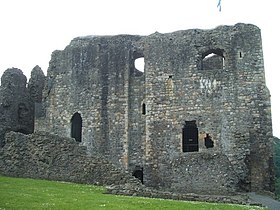
As we passed very near the castle of Dundonald, which was one of the many residences of the kings of Scotland, and in which Robert the Second lived and died, Dr. Johnson wished to survey it particularly. It stands on a beautiful rising ground, which is seen at a great distance on several quarters, and from whence there is an extensive prospect of the rich district of Cuninghame, the western sea, the isle of Arran, and a part of the northern coast of Ireland. It has long been unroofed ; and, though of considerable size, we could not, by any power of imagination, figure it as having been a suitable habitation for majesty. Dr. Johnson, to irritate my old Scottish enthusiasm, was very jocular on the homely accommodation of ' King Bob,' and roared and laughed till the ruins echoed..’

Dr. Johnson and James Boswell are on their leg home at the end of their trip to the Western Isles on November 1st, 1773.  “King Bob’s” dying place, which he had built in 1371, is provided with a few more historical facts and much more seriousness in Walter Scott’s treatment, in his “The History of Scotland”.

‘The regent, after he had been invested with his office, showed considerable energy. The earl of Nottingham, marshal of England, trusted with the wardenship of the east marches, had reproached the Percies for their defeat at Otterbourne, and boasted of what he would himself have done in similar circumstances. But when the regent Robert, at the head of an equal army, defied him to action, Nottingham declined the combat with the unsoldier-like excuse, " that he was not commissioned to expose the king's liege subjects to danger."  The Scots burned Tynemouth, and returned to their own country. . In the summer of the same year, 1389, a truce of three years was formed betwixt France and England, in which Scotland was included as the ally of the former power. Shortly after this event king Robert II died at his castle of Dundonald in Ayrshire. He was at the advanced age of seventy-five, and had reigned nineteen years.’