Gustavus Adolphus, who Walter Scott’s "A Legend of Montrose" character Major
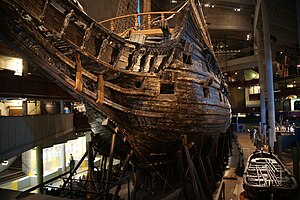
Dalgetty served during the Thirty Years’ War, built a navy to patrol the Baltic. The Vasa was to serve at sea, joining land efforts
of men such as Dalgetty in this same war.
Many know the story, of how this top-heavy vessel sank, minutes into its
maiden voyage, on August 10, 1628.
Thankfully, the Vasa was salvaged, in 1961. For those of you who have not yet seen the
Vasa Museum in Stockholm, it is well worth the trip (Link: http://www.vasamuseet.se/en/The-Ship/ ).
Vasa is a family name, a family of which Gustavus
Adolphus (Gustavus II of Sweden) was a member. Scott met Prince
Gustav of Vasa, who is descended from a different line than Gustavus Adolphus, when
that prince resided in Edinburgh, in 1820.
From John Gibson Lockhart’s “Memoirs of Sir Walter Scott”:
‘…In
a letter, already quoted, there occurs some mention of the Prince Gustavus Vasa, who was spending this winter in Edinburgh, and his
Royal Highness's accomplished attendant, the Baron Poller. I met them
frequently in Castle Street, and remember as especially interesting the first
evening that they dined there. The only portrait in Scott's Edinburgh
dining-room was one of Charles XII. of Sweden, and he was struck, as indeed
every one must have been, with the remarkable resemblance which the exiled
Prince's air and features presented to the hero of his race. Young Gustavus, on
his part, hung with keen and melancholy enthusiasm on Scott's anecdotes of the
expedition of Charles Edward Stuart. — The Prince, accompanied by Scott and myself, witnessed the ceremonial of the
proclamation of King George IV. on the 2d of February at the cross of
Edinburgh, from a window over Mr Constable's shop in the High Street; and on
that occasion also, the air of sadness that mixed in his features with eager
curiosity, was very affecting. Scott explained all
the details to him, not without many lamentations over the barbarity of Auld
Reekie Bailies, who had removed the beautiful Gothic Cross itself, for the sake
of widening the thoroughfare. The weather was fine, the sun shone bright; and
the antique tabards of the heralds, the trumpet notes of God sate the King, and the hearty
cheerings of the immense uncovered multitude that filled the noble old street,
produced altogether a scene of great splendour and solemnity. The Royal Exile
surveyed it with a flushed cheek and a watery eye; and Scott,
observing his emotion, withdrew with me to another window,
whispering—" Poor lad! poor lad! God help him." Later in the season,
the Prince spent a few days at Abbotsford…’


