Showing posts with label Robert II of Scotland. Show all posts

Tuesday, November 1, 2011

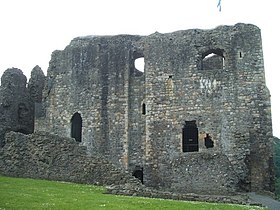
Castle of DunDonald

Monday, November I. 

Though Dr. Johnson was lazy, and averse to move, I insisted that he should go with me, and pay a visit to the Countess of Eglintoune, mother of the late and present earl. I assured him, he would find himself amply recompensed for the trouble; and he yielded to my solicitations, though with some unwillingness...

As we passed very near the castle of Dundonald, which was one of the many residences of the kings of Scotland, and in which Robert the Second lived and died, Dr. Johnson wished to survey it particularly. It stands on a beautiful rising ground, which is seen at a great distance on several quarters, and from whence there is an extensive prospect of the rich district of Cuninghame, the western sea, the isle of Arran, and a part of the northern coast of Ireland. It has long been unroofed ; and, though of considerable size, we could not, by any power of imagination, figure it as having been a suitable habitation for majesty. Dr. Johnson, to irritate my old Scottish enthusiasm, was very jocular on the homely accommodation of ' King Bob,' and roared and laughed till the ruins echoed..’

Dr. Johnson and James Boswell are on their leg home at the end of their trip to the Western Isles on November 1st, 1773.  “King Bob’s” dying place, which he had built in 1371, is provided with a few more historical facts and much more seriousness in Walter Scott’s treatment, in his “The History of Scotland”.

‘The regent, after he had been invested with his office, showed considerable energy. The earl of Nottingham, marshal of England, trusted with the wardenship of the east marches, had reproached the Percies for their defeat at Otterbourne, and boasted of what he would himself have done in similar circumstances. But when the regent Robert, at the head of an equal army, defied him to action, Nottingham declined the combat with the unsoldier-like excuse, " that he was not commissioned to expose the king's liege subjects to danger."  The Scots burned Tynemouth, and returned to their own country. . In the summer of the same year, 1389, a truce of three years was formed betwixt France and England, in which Scotland was included as the ally of the former power. Shortly after this event king Robert II died at his castle of Dundonald in Ayrshire. He was at the advanced age of seventy-five, and had reigned nineteen years.’

Tuesday, February 22, 2011

Crown passes from David II to Robert II

'THE genealogy of the Stewart family, who now acceded to the throne of Scotland, has been the theme of many a fable. But their pedigree has by late antiquaries been distinctly traced to the great Anglo-Norman family of Fitz-Alan in England; no unworthy descent, even for a race of monarchs.  In David I.'s time, Walter Fitz-Alan held the high post of seneschal or steward of the king's household; and the dignity becoming hereditary in the family, what was originally a title was converted into a surname, and employed as such. Walter, the sixth high-steward, fought bravely at Bannockburn, defended Berwick with the most chivalrous courage, and was unanimously thought worthy of the hand of Marjory Bruce, the daughter of the liberator of Scotland; and to their only child, the seventh lord high-steward, often mentioned during the last reign, the crown descended, on the extinction of the Brace's male line in his only son David II.'

On February 22, 1371, King David II of Scotland died.  He was succeeded by the first Stewart king, Robert II.  The text above is from Walter Scott's "Scotland".

Tuesday, March 2, 2010

Robert II of Scotland

Robert Stuart, the first Stuart king, was born on March 2, 1316.  Robert succeeded David II, who was the last ruler of the direct Bruce line.  Walter Scott covers Stewart's accession to the throne in his "Tales of a Grandfather".

"As David the Second died childless, the male line of his father, the great Robert Bruce, was at end. But the attachment of the Scottish nation naturally turned to the line of that heroic prince, and they resolved to confer the crown on a grandson of his by the mother's side. Marjory, the daughter of Robert Bruce, had married Walter, the Lord High Steward of Scotland, and the sixth of his family who had enjoyed that high dignity, in consequence of possessing which the family had acquired the surname of Stewart. This Walter Stewart, with his wife Marjory, were ancestors of that long line of Stewarts who afterwards ruled Scotland, and came at length to be Kings of England also. The last King of the Stewart family lost his kingdoms at the great national Revolution in 1688, and his son and grandsons died in exile. The female line have possession of the crown at this moment, in the person of our sovereign, King George the Fourth. When, therefore, you hear of the line of Stewart, you will know that the descendants of Walter Stewart and Marjory Bruce are the family meant by that term. It is said, that the Stewarts were descended from Fleance, the son of Banquo, whose posterity the witches declared were to be Kings of Scotland, and who was murdered by Macbeth. But this seems a very doubtful tradition.


Walter, the Steward of Scotland, who married Bruce's daughter, was a gallant man, and fought bravely at Bannockburn, where he had a high command. But he died young, and much regretted. Robert Stewart, his son by Marjory Bruce, grandson, of course, of King Robert, was the person now called to the throne. He was a good and kind-tempered prince. When young he had been a brave soldier; but he was now fifty-five years old, and subject to a violent inflammation in his eyes, which rendered them as red as blood. From these reasons he lived a good deal retired, and was not active enough to be at the head of a fierce and unmanageable nation like the Scots.


Robert Stewart's ascent to the throne was not unopposed, for it was claimed by a formidable competitor. This was William Earl of Douglas. That family, in which so many great men had arisen, was now come to a great pitch of power and prosperity, and possessed almost a sovereign authority in the south parts of Scotland. The Earl of Douglas was on the present occasion induced to depart from his claim, upon his son being married with Euphemia, the daughter of Robert II. Stewart therefore was crowned without farther opposition..."

Tuesday, November 24, 2009

David II of Scotland

David II was the only surviving son of Robert the Bruce, when Bruce died in 1329. David was born in 1324, when Robert was 50. When David was 4, he was married to 7 year old Joan, sister of Edward III of England. On November 24, 1331, David was crowned at Scone, as King of Scotland.

David is included in Scott's Tales of a Grandfather: Liberation and Death of King David II. David died in Edinburgh Castle in 1371, without issue. The Bruce line thus ended, and the Stuart line began with the accession of Robert II of Scotland. King Robert Stuart was the son of Marjorie, who was Robert the Bruce's daughter, and Walter Stuart.