Monday, December 19, 2011

Emily Bronte


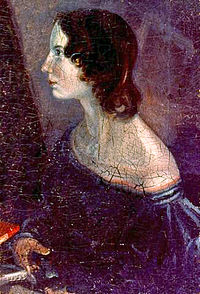
Emily Bronte, the author of Wuthering Heights, died on December 19, 1848.  Walter Scott’s impact on literature and the Brontes can be seen in the following text, which describes the Bronte sisters inventing plays.  The text comes from “Emily Bronte”, by Agnes Robinson.

‘…Emily’s and my best plays were established on the 1st of December, 1827   I [Charlotte Bronte] will sketch out the origin of our plays more explicitly if I can.  .Papa bought Branwell some wooden soldiers at Leeds…Emily and I jumped out of bed, and I snatched up one and exclaimed, “This is the Duke of Wellington!  This shall be the Duke.” … In another play Emily chooses Sir Walter Scott, Mr. Lockhart, and Johnny Lockhart as her representatives…’

Sunday, December 18, 2011

It grows dark, boys, you may go


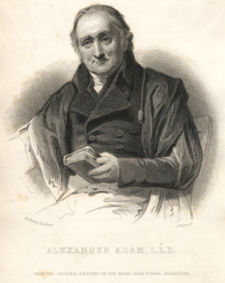
From Lord Henry Cockburn’s “Memorials of his time”: ‘…Two sad privations clouded the close of the year 1809. The High School lost Dr. Adam, and the College Dugald Stewart.

Adam died, after a few days illness, in December. His ruling passion, for teaching, was strong in death. It was in his bedchamber, and in the forenoon, that he died. Finding that he could not see, he uttered a few words, which have been variously given, but all the accounts of which mean—" It is getting dark, boys; we must put off the rest till to-morrow." It was the darkness of death. He was followed to the grave (in the Chapel of Ease near Windmill Street) by many eminent and grateful pupils. James Pillans, his successor, has given a good short sketch of him in the Encyclopaedia Britannica…’

Alexander Adam led the High School of Edinburgh at the time Walter Scott attended (1779 – 1783).  According to Edinburgh University’s Walter Scott archive, Adam encouraged Scott in his translations of Horace and Virgil.  A classical scholar, Adam also introduced Greek to the school’s curriculum.  Alexander Adam passed on December 18, 1809.

Saturday, December 17, 2011

Comet of 1664


‘Saturday December 17, 1664…So home and to my office, where late, and then home to bed. Mighty talke there is of this Comet that is seen a’nights; and the King and Queene did sit up last night to see it, and did, it seems. And to-night I thought to have done so too; but it is cloudy, and so no stars appear. But I will endeavour it…’

The comet Samuel Pepys mentions in his diary was visible over England for several months, beginning around December 14, 1664.  Comets equal portents, to some, including, perhaps, John Dryden, as related in “The Life of John Dryden”, with notes, historical, critical, and explanatory, by Walter Scott, esq,

‘A comet was seen on the 14th of December, 1664, which lasted almost three months…Comets, it is well known, were in extremely bad repute among the astrologers of this period.  Lilly, an unquestionable authority, treats these stars with extreme severity; hardly justifiable by his blunt averment, that “truth is truth, and a horse is a horse.”  Dryden himself, not contented with turning these two blazing stars (1664 and 1665) into farthing candles, has elsewhere, in this poem, charged with causing pestilence, and the great fire of London:
The utmost malice of the stars is past;
            And two dire comets, which have scourged the town,
In hteir own plague and fire have breathed their last,
            Or dimly in their sinking sockets frown.….’ 

Friday, December 16, 2011

Bill of Rights


‘…As for the Queen, and the credit that she hath done to a poor man's daughter,and the mercy and the grace ye found with her, I can only pray for her weel-being here and hereafter, for the establishment of her house now and for ever, upon the throne of these kingdoms. I doubt not but what you told her Majesty, that I was the same David Deans of whom there was a sport at the Revolution, when I noited thegither the heads of twa false prophets, these ungracious Graces the prelates, as they stood on the Hie Street, after being expelled from the Convention-parliament…’


Sir Walter Scott refers in this section of “The Heart of Midlothian”, to the expulsion of Scotch Bishops from the Convention Parliament.  On this day (December 16) in 1689, the Convention Parliament passed the Bill of Rights, under which William and Mary were invited to assume the throne of England.

Thursday, December 15, 2011

Battle of St. Lucia


On December 15, 1778, the British Royal Navy fought the French Navy, as part of the Battle of American Independence.  The English, under Samuel Barrington, won this battle.  St. Lucia, in the West Indies, ended up being the last home of someone known to Walter Scott; General David Stewart of Garth.
From Mr. Croftangry introduces another tale (the Two Drovers), in Walter Scott’s “Chronicles of the Canongate”, comes the following text and note on Stewart of Garth:

‘…Much might have been made at an earlier time, out of the history of a Highland regiment, and the singular revolution of ideas which must have taken place in the minds of those who composed it, when exchanging their native hills for the battle-fields of the Continent, and their simple , and sometimes indolent domestic habits, for the regular exertions demanded by modern discipline.  There is Mrs. Grant of Laggan, has drawn the manners, customs, and superstitions of the mountains in their natural unsophisticated state; and my friend, General Stewart of Garth*, in giving the real history of the Highland regiments, has rendered any attempt to fill up the sketch with fancy-colouring extremely rash and precarious….

* The gallant and amiable author of the History of the Highland Regiments, in whose services his own share had been great, went out Governor of St. Lucia in 1828, and died in that island on the 18th of December, 1829, - no man more regretted, or perhaps by a wider circle of friends and acquaintance…’