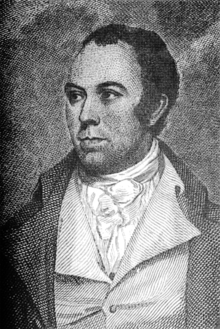
Another engraver today (William Faithorne yesterday). Thomas Bewick, who died on November 8, 1828, at age 75. Bewick was eighteen when Walter Scott was born, and lived to within five years of Scott’s death. His fame was made with the two volume “History of British Birds” (image below). But it is the woodcut Chillingham Wild Bull that is considered his best piece.
 Robert Robinson in “Thomas Bewick: his life and times” says: ‘…On wood, Bewick was a master without a rival. To this fortunate preference for the material best fitted for the display of his genius and wonderful talent as a wood-engraver we are indebted for the most accurate representation of the Chillingham Wild Bull in existence, and unquestionably the finest example of animal portraiture ever cut on wood. The skill displayed in this cut exhibits a perfect knowledge of the resources and capability of wood-engraving for the faithful rendering of foliage and of the natural texture of this noble animal, as well as for the display of those tints and gradations of light and shade observable in nature, and required to give finish and colour to the composition. The undisputed merits of this fine work amply justify the judgment of connoisseurs and art critics in pronouncing it to be the chef-d’-oeuvre of the artist . Mr. Bewick himself always considered it his masterpiece. The ancient breed of cattle, of which this bull is a member, has become nearly extinct. They were supposed by Sir Walter Scott to have inhabited, from pre-historic times, the vast primeval forest extending from the Tweed to Glasgow, at the two extremities of which—namely, Chillingham and Hamilton—they are still found…’
Thomas Hugo, in “The Bewick Collector…”, agrees with Robinson: ‘…The work which by right claims among these the first place of honour is the engraving of the Chillingham Bull, considered by Thomas Bewick to be his masterpiece; and I am very happy to be able to furnish a far more minute account of the early history of this famous Cut than any which has hitherto been committed to the press.
The Chillingham Bull was engraved in the year 1789, at the request and by the direction of Marmaduke Tunstall, Esq., of Wycliffe, near Greta Bridge. It had in the first instance an ornamental border, and measures with it 9 inches by 7. Its many and great excellencies have been the theme of all writers on the subject of wood-engraving in England, and more than justify the admiration of the Bewick Collector. "The grass and the foliage of the trees," says Mr. Chatto, "are most beautifully expressed; but there is a want of variety in the more distant trees, and the bark of that in the foreground is too rough. . . . The style in which the bull is engraved is admirably adapted to express the texture of the short white hair of the animal; the dewlap, however, is not well represented; it appears to be stiff instead of flaccid and pendulous, and the lines intended for the hairs on its margin are too wiry." This, it must be admitted, is rather hypercritical, and by far the most unfavourable sentence that could be quoted, but is valuable as such, and satisfactory as proceeding from a most able but most unsparing and fastidious judge...’

