Showing posts with label Harriet Martineau. Show all posts

Tuesday, June 12, 2012

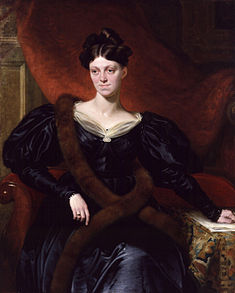
Harriet Martineau


English sociologist and writer Harriet Martineau was born on June 12, 1810.  Martineau is remembered here for her bio of Walter Scott’s son-in-law, John Gibson Lockhart, which includes an account of Lockhart’s meeting Scott.

‘…After the Peace he went to Germany a not very common undertaking at that time and saw Göthe; and his account of this incident seems to have struck Scott, when they who were to become so closely related met for the first time in private society, in May, 1818. A few days after the dinner-party at which this happened, the Messrs. Ballantyne sent to Lockhart, to propose that he should undertake a task which Scott had delayed, and wished to surrender: the writing the historical portion of the "Edinburgh Annual Register" for 1816. When he called on Scott to talk it over, the great novelist, who was then receiving 10,000£ a year from the new vein he had opened, assigned a characteristic reason for giving up the Register. He said that if the war had gone on, he should have enjoyed writing the history of each year as it passed; but that he would not be the recorder of Radical riots, Corn Bills, Poor Bills, and the like. These things, he said, sickened him; and he thought it fair to devolve such work upon his juniors. Mr. Lockhart first saw Abbotsford the next October, when he was sent for from Elleray, with his friend John Wilson, to meet Lord Melville, and take the chance of some professional benefit arising from the interview with the First Lord of the Admiralty, if their sins in Blackwood could be overlooked by him. This shows that Blackwood's Magazine was already rising under the re-enforcement of Wilson's strength. The strength which raised it was not Lockhart's. His satire had, then and always, a quality of malice in it, where Wilson's had only fun; and he never had Wilson's geniality of spirit. Wilson's satire instructed the humble, and amused the proud who were the objects of it; but Lockhart's caused anguish in the one case, and excited mere wrath or contempt in the other, Scott confessed that it might be from complacency at Lockhart's account of this visit to Abbotsford that he judged so favorably of "Peter's Letters to his Kinsfolk," which appeared a few months afterward. He called its satire lenient; but all the Edinburgh Whigs were up against it as a string of libels; and Lockhart himself tells us candidly that it was a book which none but a very young and a very thoughtless person would have written…’

Sunday, November 14, 2010

Bristol Riots of 1831

On November 14, 1831, Sir Walter Scott is traveling to historic sites, and hoping to improve his health.  As recorded in his journal, the party on board hears disturbing news on happenings back home...

'...We stood into the Bay of Gibraltar and approached the harbour firing a gun and hoisting a signal for a boat: one accordingly came off—a man-of-war's boat—but refused to have any communication with us on account of the quarantine, so we can send no letters ashore, and after some pourparlers, Mr. L——, instead of joining his regiment, must remain on board. We learned an unpleasant piece of news. There has been a tumult at Bristol and some rioters shot, it is said fifty or sixty. I would flatter myself that this is rather good news, since it seems to be no part of a formed insurrection, but an accidental scuffle in which the mob have had the worst, and which, like Tranent, Manchester, and Bonnymoor, have always had the effect of quieting the people and alarming men of property.  The Whigs will find it impossible to permit men to be plundered by a few blackguards called by them the people, and education and property probably will recover an ascendency which they have only lost by faintheartedness.'

The spark for the Bristol Riots was rejection by the House of Lords of a reform bill, which would have provided Bristol and other cities with greater representation in the House of Commons.  In "History of the Peace...", Harriet Martineau and Charles Knight depict a situation that was exploited by nefarious intrests based in London.  'London rogues could have had no such power as in this case if the political and moral state of Bristol had not been bad. Its political state was disgraceful. The venality of its elections was notorious. It had a close corporation, between whom and the citizens there was no community of feeling on municipal subjects. The lower parts of the city were the harbourage of probably a worse seaport populace than any other place in England, while the police was ineffective and demoralised. There was no city in which a greater amount of savagery lay beneath a society proud, exclusive, and mutually repellent, rather than enlightened and accustomed to social co-operatiou. These are circumstances which go far to account for the Bristol riots being so fearfully bad as they were. Of this city, Sir Charles Wctherell— then at the height of his unpopularity as a vigorous opponent of the Reform Bill—was recorder; and there he had to go, in the last days of October, in his judicial capacity. Strenuous efforts had been made to exhibit before the eyes of the Bristol people the difference between the political and judicial functions of their recorder, and to shew them that to receive the judge with respect was not to countenance his political course; yet the symptoms of discontent were such as to induce the mayor, Mr l'inney, to apply to the home-office for military aid. Lord Melbourne sent down some troops of horse, which were quartered within reach, in the neighbourhood of the city. It was an unfortunate circumstance that, owing to the want of a common interest between the citizens and the corporation, scarcely any gentlemen offered their services as special constables but such as were accustomed to consider the lower classes with contempt as a troublesome rabble, and rather relished an occasion for defying and humbling them. Such was the preparation made in the face of the fact that Sir Charles Wetherell could not be induced to relinquish his public entry, though warned of danger by the magistrates themselves; and of the other important fact that the London rogues, driven from the metropolis by the new police, were known to be infesting every place where there was hope of confusion and spoil...'