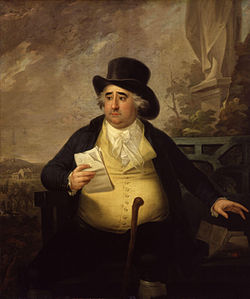
Showing posts with label Charles James Fox. Show all posts

Friday, January 27, 2012

Tally ho to the Fox

‘On June 27, 1806, Scott wrote his “Health to Lord Melville”, the Tory governing spirit of Scotland, whom the Whigs were impeaching.  James Ballantyne sang this lay at a public dinner on Lord Melville’s acquittal.  The Princess of Wales was saluted in this song, which contained the words “Tally ho to the Fox” (C.J. Fox).  This does not appear an amazing indiscretion, in a parcel of party verses, but the Whigs were greatly shocked…’

Walter Scott’s Tory sentiment is evident in the text above, which comes from Andrew Lang’s “Sir Walter Scott”.  Whig Charles James Fox did not last much past June of 1806, dying the following September (13th).  Fox was opposed to the war with Napoleon, who he met three times in 1798.  Fox was, therefore, at odds with William Pitt (the younger) who had pushed for war with France.  Pitt died earlier, in January of the same year. 

Monday, May 9, 2011

Cozeners

May 9.[1828]—Grounds of Foote's farce of the Cozeners. Lady ——. A certain Mrs. Phipps audaciously set up in a fashionable quarter of the town as a person through whose influence, properly propitiated, favours and situations of importance might certainly be obtained—always for a consideration. She cheated many people, and maintained the trick for many months. One trick was to get the equipage of Lord North, and other persons of importance, to halt before her door as if the owners were within. With respect to most of them, this was effected by bribing the drivers. But a gentleman, who watched her closely, observed that Charles J. Fox actually left his carriage and went into the house, and this more than once. He was then, it must be noticed, in the Ministry. When Mrs. Phipps was blown up, this circumstance was recollected as deserving explanation, which Fox readily gave at Brooks's and elsewhere. It seems Mrs. Phipps had the art to persuade him that she had the disposal of what was then called a hyæna—that is, an heiress—an immense Jamaica heiress, in whom she was willing to give or sell her interest to Charles Fox. Without having perfect confidence in the obliging proposal, the great statesman thought the thing worth looking after, and became so earnest in it, that Mrs. Phipps was desirous to back out of it for fear of discovery. With this view she made confession one fine morning, with many professions of the deepest feelings, that the hyæna had proved a frail monster, and given birth to a girl or boy—no matter which. Even this did not make Charles quit chase of the hyæna. He intimated that if the cash was plenty and certain, the circumstance might be overlooked. Mrs. Phipps had nothing for it but to double the disgusting dose. "The poor child," she said, "was unfortunately of a mixed colour, somewhat tinged with the blood of Africa; no doubt Mr. Fox was himself very dark, and the circumstance might not draw attention," etc. etc. This singular anecdote was touched upon by Foote, and is the cause of introducing the negress into the Cozeners, though no express allusion to Charles Fox was admitted. Lady ——— tells me that, in her youth, the laugh was universal so soon as the black woman appeared. It is one of the numerous hits that will be lost to posterity. Jack Fuller, celebrated for his attempt on the Speaker's wig, told me he was editing Foote, but I think he has hardly taste enough. He told me Colman was to be his assistant...

Samuel Foote's comedy "The Cozeners" opened in 1774.  It was performed at the Theater Royal in the Haymarket.  Foote himself acted, and was known for his mimicry of public figures.  The Whig politician Charles James Fox that Scott discusses in his Journal entry of May 9, 1828, served in Parliament for 38 years.  His personal life was the subject of scandal, as can be inferred from the text above.

Saturday, January 23, 2010

William Pitt the Younger

'The mighty chiefs sleep side by side;
Drop upon Fox's grave the tear,
'Twill trickle to his rival's bier.'

Walter Scott's first line above refers to the two William Pitt's; the Elder Lord Chatham, and the Younger, who died on January 23, 1806.  Line two, the Whig Charles James Fox, rival of Pitt the Younger.

Pitt's public career included functioning as a prime minister from 1783 - 1801 and again between 1804 - 1806. This timeframe includes the great events of the era; the French Revolution and the Napoleonic Wars.  Pitt's career was necessarily shaped by these events.

One outcome of these times, which Pitt actively supported, was the uniting of Ireland with Great Britain; the Act of Union of 1800.  In one respect, a defensive measure, as Irish nationalists had attempted a rebellion in 1798, and the threat of intercession from France was considered great.

Pitt, in his second ministry encouraged Great Britain's involvement in the Third Coalition, joining Austria, Russia, and Sweden against Napoleon.  Not long after, in October 1805, Horatio Nelson prevailed over the French at the Battle of Trafalgar, establishing English naval supremacy for the duration of the war.

Pitt figures prominently in Scott's "The Life of Napoleon".