Sunday, August 15, 2021


Saturday, August 15, 2020
365 Days and Counting
August 15 is a memorable date for at least two important 18th/19th century figures. Napoleon Buonaparte was born August 15, 1769, and Sir Walter Scott, who wrote a biography of the man, the same day in 1771. In between, and less celebrated, was French General Jean Sarrazin, born August 15, 1770; 365 days before Scott.
Buonaparte became Emperor of the French in 1804. Sir Walter Scott effectively invented the romantic historical novel. In between was a man who became a spy for the British, against Napoleon.
It is one year from the 250th anniversary of Sir Walter Scott's birth.
Wednesday, August 15, 2012
1771
I’ve always enjoyed John Buchan’s framing of the environment surrounding Edinburgh in the year 1771. The first three paragraphs say so much in a brief space. Walter Scott, of course, was born on August 15, 1771. From Buchan’s biography “Sir Walter Scott”:
‘Antecedants
In the autumn of the year 1771 an Edinburgh citizen, returning after many years' absence, would have noted certain changes in his native city. If, on the morning after his arrival at the White Horse Inn in the Canongate, he had ascended to the high places of the Castle hill, and looked north and east, he would have missed one familiar landmark. The Nor' Loch, his haunt on youthful holidays and the odorous grave of city refuse, had been drained, and its bed was now grass and shingle. Across the hollow which once had held its waters a huge mound of earth had been thrown, giving access to the distant fields. Farther east, another crossing was in process of making, a bridge to carry a broad highway. Before he had left home the Canongate had burst its bonds into New Street and St John Street, and he noted that the city had spilled itself farther southward beyond the South Bridge of the Cowgate into new streets and squares. But now the moat of the Nor' Loch was spanned, and on its farther shore building had begun according to the plans of the ingenious Mr Craig. He had heard much of these plans that morning in Lucky Boyd's hostelry—of how a new Register House, with the Adam brothers as architects, and paid for out of the forfeited Jacobite estates, was designed to rise at the end of the new bridge. And the spectator, according as he was a lover of old things or an amateur of novelties, would have sighed or approved. The little city, strung from the Castle to Holyroodhouse along her rib of hill, where more history had been made than in any place of like size save Athens, Rome and Jerusalem—which, according to the weather and the observer's standpoint, looked like a flag flung against the sky or a ship riding by the shore—was enlarging her bounds and entering upon a new career.
Another sight of some significance was to be had in the same year at the same season. From every corner of the north droves of black cattle were converging on Falkirk moor for the great autumn Tryst. It was the clearing-house of the Highlands, as Stagshawbank on the Tyne was the clearing-house of Scotland. The drover from Glen Affric, herding his kyloes among the autumn bracken, could see from his bivouac a cloud of dark smoke on the banks of the Carron river, and hear by day and night the clang of hammers. This was the Carron Ironworks, now eleven years old, and a canal was being made from Grangemouth-on-Forth to carry their products to the world. There, within sight of the Highland Line, a quarter of a century after a Jacobite army had campaigned on that very ground, the coal and iron of the Scottish midlands were being used in a promising industry. Cannon were being made for many nations, and the Carron pipes and sugar-boilers and fire-grates were soon to be famous throughout the land. The Highland drover, already perplexed by the intrusion of Lowland sheep on his hills and the cutting of his native woods by English companies, saw in the flame and smoke of the ironworks a final proof that his ancient world was crumbling.
There was a third portent, the most pregnant of all, which our returned exile, if he were a man of some education, had a chance of noting. He had heard with pleasure during his absence a rumour of good literature coming from the north. The London critics had spoken well of Mr David Hume's works in history and philosophy, of Mr Robertson's excursions in the former domain, of Mr Ferguson's treatise on civil society, and of the poetry of Mr Beattie of Aberdeen, while visitors had reported the surpassing eloquence of Mr Hugh Blair of the High Kirk of St Giles'. Our traveller, when he had access to these famous men, found that Edinburgh had indeed become a home of brilliant talk and genial company—Edinburgh with her endless taverns where entertainment was cheap, since the Forth at the door gave her oysters, and sound claret was to be had at eighteen shillings a dozen. Around the tavern board or the dinner-table he found the illuminati good Scotsmen, speaking the tongue he fondly remembered, and perpetuating the tales and humours of his youth. But their public performance surprised him, for it was a sedulous aping of London. They strove without much success to acquire an English accent, and Mr Adam Smith was envied because Balliol had trimmed the roughness of his Fife tongue. They cultivated a thing called rhetoric, which was supposed to be a canonical use of language freed from local vulgarities, and in the shabby old college Mr Hugh Blair lectured on that dismal science with much acceptance. In their writings they laboriously assisted each other to correct the solecisms of the northern idiom, and a year or two later, when David Hume lay on his death-bed, it was the jest of a caustic Lord of Session that the philosopher confessed not his sins but his Scotticisms.
So our restored exile may have regarded the scene with mingled feelings. His countrymen beyond doubt had their heads at last above water, but the land they were making for was not the kindly soil he had known. …
The Family of Buccleuch
From the family of Buccleuch there was an early offshoot, called first of Sinton and then of Harden, whose tower still stands in a dark nook of Borthwick water. The Scotts of Harden were scarcely less noted in the Border wars than the parent house, and they produced such figures of ballad and folk story as Auld Wat of Harden, who in 1567 married Mary Scott, the "Flower of Yarrow," and his son William, who espoused the daughter of Sir Gideon Murray of Elibank, the "Muckle Mou'd Meg," of a tale which is probably apocryphal. The third son of this William of Harden became laird of Raeburn, and his wife was a MacDougal of Makerstoun, of a family which has some claim to be the oldest in Scotland. This Walter Scott was a Whig and a Quaker, but his sons walked in other paths, for his eldest fell in {22} a duel, and the second, Walter, was known on Teviotside as Beardie, from the great beard which he allowed to grow in token of his regret for the banished Stuarts. Beardie, after narrowly escaping the gallows on account of his politics, married a kinswoman of the Campbells of Blythswood, and in his old age had some repute for learning. His second son took to sheep-farming, and leased the farm of Sandy Knowe from the Scotts of Harden, after staking all his fortune on the purchase of a hunter, which he fortunately sold for double the price he gave. He prospered, and made a great name on the Border as a judge of stock. His wife was a Haliburton of Newmains, who brought to the family the right of burial in Dryburgh Abbey. The sheep-farmer's eldest son, Walter, forsook the family pursuits and, first of his race, settled in a town and adopted a learned profession, for he became a Writer to the Signet in Edinburgh, the highest stage in Scotland of the solicitor's calling. His wife was Anne Rutherford, the eldest daughter of the professor of medicine in the University, and with her came into the blood two other ancient strains. For the Rutherfords had been longer settled on the Border than the Scotts, and her mother was a Swinton of that ilk, one of the most sounding names in early Scottish history, and a descendant of Ben Jonson's friend, the poet Earl of Stirling.
Scott’s Ancestry
So much for the details of pedigree. The child born in August, 1771, to Anne Rutherford and Walter Scott at the head of the College Wynd, had a more varied ancestry than falls to the lot of most men. No doubt the ancestry of all of us is oddly mixed, but in his case the record was known. He was linked collaterally through the Buccleuchs with the greater noblesse. He had behind him the most historic of the Border stocks in Scott and Murray and Rutherford and Swinton. He had Celtic blood from MacDougal and Campbell. Of the many painted shields on the ceiling of the hall at Abbotsford which enshrine his pedigree, only three lack a verified heraldic cognizance. Among his forbears were saints and sinners, scholars and sportsmen and {23} men-at-arms, barons and sheep-farmers, divines and doctors of medicine, Whigs and Jacobites, Cavaliers and Quakers. Above all he had that kindest bequest of the good fairies at his cradle, a tradition, bone of his bone, of ancient pastoral, of a free life lived among clear waters and green hills as in the innocency of the world. …’
Tuesday, August 14, 2012
Constitution of Man

Lawyer and phrenologist George Combe, author of “The
Constitution of Man” died on August 14, 1858.
Combe’s work, which was published in Walter Scott’s lifetime (1828),
downplays the role of religion and philosophy in human behavior, in favor of
physical characteristics of the human skull.
In his role as a lawyer, Combe disagreed with Walter
Scott on aspects of the legal profession.
From Charles Gibbon’s “The Life
of George Combe: Author of “The Constitution of Man”:
" In Sir Walter Scott's autobiography,
just published by John Gibson Lockart,
his son-in-law, Sir Walter
states various reasons for declining an offer made to him by his father to
become his partner as a writer to the signet, to which profession Sir Walter
had served an apprenticeship with his father, and for preferring the bar, the
import of which is disparaging to the inferior branch of the profession. I do not know what might be the
relative character in moral
and intellectual respectability of writers to the signet and advocates
in Sir Walter's day, but I know what they have been in mine, and I am twenty
years his junior, and I differ considerably from his estimate. The points on which there can be no dispute
are, that the gentlemen of the bar have by their education and professional
practice greater knowledge of composition, written and oral, more comprehensive
views of the principles of law;
and greater talents of reasoning, than the writers to the signet ; and if Sir Walter had confined himself to this
claim of superiority it would
have been undoubtedly well founded.
But
he insinuates that the morale, of
the attorney is inferior to that of the barrister, and to this I demur.
" In
Scotland, writers to the signet are employed in various branches. Some act
chiefly as agents in litigations. These are the men with whom the barristers
come chiefly into contact; and
as litigation is a warfare in which victory is contended for at all hazards,
within the limits of the rules prescribed by the law and by the forms of court,
it is naturally to be supposed that the most adroit, energetic, and able
combatant will be preferred by those who need to hire a champion…’
Combe’s work was controversial. Writing in 1837, five years after Walter
Scott’s death, author William Scott, in “The Harmony of Phrenology with
Scripture..” invokes Sir Walter’s name in refuting Combe’s phrenological theories:
‘…Sir
Walter Scott did
not avail himself of the lights of Phrenology, yet his representations of character are, in many cases, such as no phrenologist
could presume to mend. These are but two instances out of many.
Various others might be cited, among our dramatists, poets, historians, and
moralists, of writers who possessed an intuitive
perception of the motives and springs of human action, and whose analysis of
mental feelings agrees almost entirely with that which would be given by
a phrenologist. Almost the only exceptions to this among our great writers,
occur in the case of the metaphysicians; and the
reason seems to be, that they have studied human nature in their closets, and
not in the world. But many of our eminent divines,
in their sermons and other compositions, shew a thorough practical knowledge of the human heart; and sometimes
hold up a glass, in which the sinner may see his character portrayed with
fearful accuracy. Upon the whole, therefore, I am inclined to anticipate, that
when Phrenology has been brought to a higher state of
cultivation than it has hitherto reached, there
will be found much less difference between the views which it offers, and those
which have been hitherto entertained by men of practical good sense, than
Mr Combe seems to
suppose. That it will prove of essential benefit to society I entertain not the least doubt;
but that it will ever, as he supposes, reach to revolutionize, reform, and
regenerate the world, I look upon to be a dream as vain and unsubstantial as
the wildest chimeras of the alchemists…’
Monday, August 13, 2012
Order of the Garter
‘Thursday
13 August 1663
…Thence
to Mrs. Hunt’s, where I left my wife, and I to walk a little in St. James’s
Park, while Mrs. Harper might come home, with whom we came to speak about her
kinswoman Jane Gentleman to come and live with us as a chamber mayde, and there
met with Mr. Hoole my old acquaintance of Magdalen, and walked with him an hour
in the Parke, discoursing chiefly of Sir Samuel Morland, whose lady is gone
into France. It seems he buys ground and a farm in the country, and lays out
money upon building, and God knows what! so that most of the money he sold his
pension of 500l. per annum for, to Sir Arthur Slingsby, is believed is gone. It
seems he hath very great promises from the King, and Hoole hath seen some of
the King’s letters, under his own hand, to Morland, promising him great things
(and among others, the order of the Garter, as Sir Samuel says); but his lady
thought it below her to ask any thing at the King’s first coming, believing the
King would do it of himself, when as Hoole do really think if he had asked to
be Secretary of State at the King’s first coming, he might have had it. And the
other day at her going into France, she did speak largely to the King herself,
how her husband hath failed of what his Majesty had promised, and she was sure
intended him; and the King did promise still, as he is a King and a gentleman,
to be as good as his word in a little time, to a tittle: but I never believe it…’
Being appointed to The order of the Garter would have
been quite an honor for Samuel Morland, or anyone. Morland entered Charles II’s service due to
his work in the field of espionage, and his development of cryptography. Morland was an associate of Samuel Pepys, whose diary is the source of today's post (August 13th).
John Gibson Lockhart’s “Memoirs of the Life of Sir Walter
Scott” includes the following story of Scott a member of this order, in 1813.
‘Scott
had been for some time under an engagement
to meet the Marquis of Abercorn
at Carlisle, in the first week of August, for the transaction
of some business connected with his brother
Thomas's late administration of that nobleman's
Scottish affairs; and he had designed to pass from Drumlanrig to Carlisle for
this purpose, without going back to Abbotsford. In consequence of these repeated harassments, however, he so far altered
his plans as to cut short his stay at Drumlanrig, and turn homewards for two or
three days, where James Ballantyne met him with such a statement as in some
measure relieved his mind.
He then proceeded to
fulfil his engagement with Lord Abercorn, whom he encountered travelling in a
rather peculiar style between Carlisle and Longtown. The ladies
of the family and the household
occupied four or five carriages, all drawn by the Marquis's
own horses, while the noble Lord himself brought up
the rear, mounted on horseback, and decorated with the ribbon of the order of the
Garter. On meeting the cavalcade, Scott turned with them, and he was not a little amused
when they reached the village of
Longtown, which he had ridden through an hour or two before, with the preparations which he found there made for the dinner of the party. The Marquis's major-domo and cook had arrived there at an
early hour in the morning, and everything was now
arranged for his reception in the paltry little
public-house, as nearly as possible in the style
usual in his own lordly mansions. The ducks and
geese that had been dabbling three or four hours ago in the
village-pond were now ready to make their appearance under numberless
disguises as entrees; a regular
bill-of-fare flanked the noble
Marquis's allotted cover; every huckaback towel in the place
had been pressed to do service as a napkin; and, that nothing
might be wanting to the mimicry of splendour, the landlady's
poor remnants of crockery and pewter had been
furbished up, and mustered in solemn order on a
crazy old beauffet, which was to represent a sideboard worthy of Lucullus. I think it worth while to preserve this
anecdote, which Scott delighted in telling, as
perhaps the last relic of a
style of manners now passed away, and never likely
to be revived among us...’
Sunday, August 12, 2012
Macbeth
12
August in 1668
… Home
to dinner, where Pelling dines with us, and brings some partridges, which is
very good meat; and, after dinner, I, and wife, and Mercer, and Deb., to the
Duke of York’s house, and saw “Mackbeth,” to our great content, and then home,
where the women went to the making of my tubes, and I to the office, and then
come Mrs. Turner and her husband to advise about their son, the Chaplain, who
is turned out of his ship, a sorrow to them, which I am troubled for, and do
give them the best advice I can, and so they gone we to bed.’
That lover of the theater Samuel Pepys saw “Macbeth” this
day, 344 years ago (per his diary). Shakesperian scholar William J. Rolfe, draws on writing from Walter Scott to show that Shakespeare’s
use of material about Macbeth was not especially historically accurate.
"Duncan, by his mother Beatrice a grandson of Malcolm II, succeeded to the throne on his grandfather's death, in 1033: he reigned only six years. Macbeth, his near relation, also a grandchild of Malcolm II, though by the mother's side, was stirred up by ambition to contest the throne with the possessor. The Lady of Macbeth also, whose real name was Graoch, had deadly injuries to avenge on the reigning prince. She was the granddaughter of Kenneth IV, killed 1003, fighting against Malcolm II, and other causes for revenge animated the mind of her who has been since painted as the sternest of women. The old annalists add some instigations of a supernatural kind to the influence of a vindictive woman over an ambitious husband. Three women, of more than human stature and beauty, appeared to Macbeth in a dream or vision, and hailed him successively by the titles of Thane of Cromarty, Thane of Moray, which the king afterwards bestowed on him, and finally by that of King of Scots; this dream, it is said, inspired him with the seductive hopes so well expressed in the drama...'
Friday, August 10, 2012
Vasa
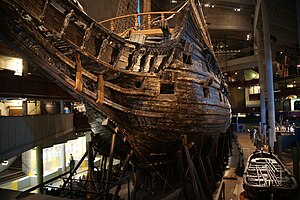
Gustavus Adolphus, who Walter Scott’s "A Legend of Montrose" character Major
Dalgetty served during the Thirty Years’ War, built a navy to patrol the Baltic. The Vasa was to serve at sea, joining land efforts
of men such as Dalgetty in this same war.
Many know the story, of how this top-heavy vessel sank, minutes into its
maiden voyage, on August 10, 1628.
Thankfully, the Vasa was salvaged, in 1961. For those of you who have not yet seen the
Vasa Museum in Stockholm, it is well worth the trip (Link: http://www.vasamuseet.se/en/The-Ship/ ).
Vasa is a family name, a family of which Gustavus
Adolphus (Gustavus II of Sweden) was a member. Scott met Prince
Gustav of Vasa, who is descended from a different line than Gustavus Adolphus, when
that prince resided in Edinburgh, in 1820.
From John Gibson Lockhart’s “Memoirs of Sir Walter Scott”:
‘…In
a letter, already quoted, there occurs some mention of the Prince Gustavus Vasa, who was spending this winter in Edinburgh, and his
Royal Highness's accomplished attendant, the Baron Poller. I met them
frequently in Castle Street, and remember as especially interesting the first
evening that they dined there. The only portrait in Scott's Edinburgh
dining-room was one of Charles XII. of Sweden, and he was struck, as indeed
every one must have been, with the remarkable resemblance which the exiled
Prince's air and features presented to the hero of his race. Young Gustavus, on
his part, hung with keen and melancholy enthusiasm on Scott's anecdotes of the
expedition of Charles Edward Stuart. — The Prince, accompanied by Scott and myself, witnessed the ceremonial of the
proclamation of King George IV. on the 2d of February at the cross of
Edinburgh, from a window over Mr Constable's shop in the High Street; and on
that occasion also, the air of sadness that mixed in his features with eager
curiosity, was very affecting. Scott explained all
the details to him, not without many lamentations over the barbarity of Auld
Reekie Bailies, who had removed the beautiful Gothic Cross itself, for the sake
of widening the thoroughfare. The weather was fine, the sun shone bright; and
the antique tabards of the heralds, the trumpet notes of God sate the King, and the hearty
cheerings of the immense uncovered multitude that filled the noble old street,
produced altogether a scene of great splendour and solemnity. The Royal Exile
surveyed it with a flushed cheek and a watery eye; and Scott,
observing his emotion, withdrew with me to another window,
whispering—" Poor lad! poor lad! God help him." Later in the season,
the Prince spent a few days at Abbotsford…’
Tuesday, August 7, 2012
Conventicles
‘Sunday
7 August 1664
…While
we were talking came by several poor creatures carried by, by constables, for
being at a conventicle. They go like lambs, without any resistance. I would to
God they would either conform, or be more wise, and not be catched!...’
Samuel Pepys lived through a time when conventicles were
a source of physical and legal dispute. Earlier
in 1664, Pepys wrote about what became the Conventicle Act of 1664.
'Friday
13 May 1664
… In
the Painted Chamber I heard a fine conference between some of the two Houses
upon the Bill for Conventicles. The Lords would be freed from having their
houses searched by any but the Lord Lieutenant of the County; and upon being
found guilty, to be tried only by their peers; and thirdly, would have it
added, that whereas the Bill says, “That that, among other things, shall be a
conventicle wherein any such meeting is found doing any thing contrary to the
Liturgy of the Church of England,” they would have it added, “or practice.” The
Commons to the Lords said, that they knew not what might hereafter be found out
which might be called the practice of the Church of England; for there are many
things may be said to be the practice of the Church, which were never
established by any law, either common, statute, or canon; as singing of psalms,
binding up prayers at the end of the Bible, and praying extempore before and
after sermon: and though these are things indifferent, yet things for aught
they at present know may be started, which may be said to be the practice of
the Church which would not be fit to allow….’
Walter Scott wrote about conventicles as well, more from
a historical perspective, as in the following from “Tales of a Grandfather”:
‘…But
this modified degree of zeal by no means gratified the more ardent and rigid
Covenanters, by whom the stooping to act under the Indulgence was accounted a
compromise with the Malignants —a lukewarm and unacceptable species of worship,
resembling salt which had lost its savour. Many, therefore, held the indulged
clergy as a species of king's curates ; and rather than listen to their
doctrines, which they might have heard in safety, followed into the wilderness
those bold and daring preachers, whose voices thundered forth avowed opposition
and defiance against the mighty of the earth. The Indulged were accused of
meanly adopting Erastian opinions, and acknowledging the dependence and
subjection of the Church to the civil magistrate,—a doctrine totally alien from
the character of the Presbyterian religion. The elevated wish of following the
religion of their choice, in defiance of danger and fear, and their animosity
against a government by whom they had been persecuted, induced the more zealous
Presbyterians to prefer a conventicle
to their parish church; and a congregation -where
the hearers attended in arms to defend themselves, to a more peaceful meeting,
when, if surprised, they might save themselves by submission or night. Hence
these conventicles became frequent, at which the hearers attended with weapons.
The romantic and dangerous character of this species of worship recommended it
to such as were constitutionally bold and high-spirited; and there were others,
who, from the idle spirit belonging to youth, liked better to ramble through
the country as the life-guard to some outlawed preacher, than to spend the six
days of the week in ordinary labour, and attend their own parish church on the
seventh, to listen to the lukewarm doctrine of an Indulged minister…’
Monday, August 6, 2012
More on Ben Jonson
‘…It is impossible to
see Hawthornden, and mention its poetical owner [William Drummond], without
thinking upon the time when
"Jonson sate in Drummond's social shade."
and lamenting the loss of Ben's
-"journey
into Scotland song,
With
all the adventurers."
And from thence it is with anxiety that we find ourselves
urged upon something like a controversy with the learned, acute, and ingenious
editor of Jonson's works, who, in his zeal to do full justice to his subject,
has, we think, uttered some undue injury to the memory of Drummond. The attempt
has indeed been prohibited to us, under a heavy denunciation. We presume,
nevertheless, in all honourable courtesy, to take up the gage which is thus
thrown down, and venture the following remarks on the memorable interview of
Drummond of Hawthornden and the great English dramatist, and the brief account
which the former has left of the manners and opinions of Ben
Jonson.
That Ben Jonson did Drummond
the distinguished honour of visiting Scotland, partly with a view of spending
some time with a man whom he esteemed—that he accordingly lived about three
weeks at Hawthornden, and was gratified by Drummond's hospitality—that they
parted friends, and remained in an amicable intercourse until death—are facts
on which all are agreed; as also, that in the shape of loose memoranda,
Drummond has preserved some severe censures passed by Jonson
upon other poets, and added a very unfavourable
picture of the dramatist's self-opinion, as well as of his intemperance, his
literary jealousies and peculiarities, the laxity of his speculative opinions,
and other foibles which darkened his great qualities. Hinc iliae lachrymae.
These scraps of information, for they are nothing more,
may be considered in two points of view, as they affect the character of Jonson, or that of Drummond; in other words, as they
contain truth with respect to the former, or as they infer malice and calumny
(whether in themselves true or false) on the part of him who recorded them.
On the first point, it is not easy to discover Mr.
Gifford's opinion. He seems to receive as truth what circumstances Drummond has
narrated concerning Jonson's birth, parentage, and earlier adventures; and far
from doubting the accuracy of his report concerning Jonson's criticisms on
contemporary authors, he only regrets that they are not sufficiently detailed.
It is therefore apparently only where Drummond bears testimony to Jonson's
failings, that the editor, in laudable zeal for the honour of his author, is
disposed to impugn his testimony…’
Ben Jonson was
covered last year, as well. But he certainly deserves additional coverage. In this post, we bring in Scott’s discussion
of a friendship between Jonson and Scottish poet William Drummond. The text above comes from “Provincial
Antiquities of Scotland”. The English
dramatist died on August 6th, 1637.
Sunday, August 5, 2012
Gowrie Conspiracy
On August 5, 1600, the mysterious
incident known as the Gowrie Conspiracy, involving the Ruthven brothers, John,
the 3rd Earl of Gowrie, and Alexander, took place in Perth. In “The History of Scotland”, Walter Scott
devotes a fair amount of acreage to this episode. The action of the story, per Scott, is below. There is more to enjoy in Scott's history.
‘The Earl of Gowrie's younger brother, Alexander Ruthven, was
a young man of great hopes, and both were considered as possessing a share of
the king's favour. Learned, handsome, young, and active, they belonged to the
class of men which most readily attracted the king's notice; and, generous,
brave, and religious to a degree not common with men so young, they were the
darlings of the people. Alexander Ruthven was made a gentleman of the
bed-chamber; one of his sisters advanced to be a chief attendant upon the
queen; a considerable post in the government was designed for Gowrie himself;
and no house in the kingdom appeared more flourishing, at the very time when a
number of violent and mysterious circumstances brought on its total ruin.
On the 5 of August, 1600, as the king, then residing at
Falkland, had taken horse at daybreak to follow his favourite exercise of
stag-hunting, he was joined by Alexander Ruthven, who requested a private
audience, and communicated to James, as they rode together, apart from the
other huntsmen, a story of a most extraordinary kind. He had been, he said,
walking near his brother's house at Perth, when,
in a retired spot, he encountered a fellow of a down-looking aspect, and
altogether suspicious in his appearance, who was wrapt in a cloak, and seemed
desirous to escape observation. Ruthven continued, that, conceiving it his duty
to lay hands on this man, he had, in doing so, discovered on this person a
large pot full of gold pieces of foreign coinage. He then deemed it his duty,
he said, to carry the stranger to his brother's castle, and privately imprison
him, in a remote apartment, in order that his majesty might have the earliest
information upon a subject so extraordinary; he urged the king, therefore, to
ride with him instantly to his brother, the Earl of Gowrie's castle, in the
town of Perth, examine the captive himself and secure the treasure for his own
royal use. The king replied, that he saw no reason why the man should not be
regularly examined by the magistrates of Perth, of whom the Earl of Gowrie was provost.
This proceeding young Ruthven eagerly opposed : alleging the necessity that a
matter so mysterious should be subjected to the king's own scrutiny, so much
deeper than that of any subject, and stating eagerly the risk of the treasure
being embezzled, if any
inferior person was to be trusted with the examination. He, therefore,
repeatedly urged James instantly to ride with him to Perth; and this in a
manner so hurried and vehement, that the king was induced to ask some of his
attendants whether Ruthven had ever been known to be affected with fits of
insanity: they replied, that they had never known him, save as a sober and
sensible young man. Reassured by this information, feeling, it may be supposed,
the compliment paid to his superior wisdom, and desirous to secure a windfall
which did not often come in his way, James agreed that as soon as he had seen the
buck killed he would accompany Alexander Ruthven to Perth, and examine the
prisoner.
During the whole chase, which was a short one,
Ruthven hung upon the king, and at every opportunity which it afforded plied
him with earnest importunity to set out upon his journey. It must be observed,
that a person named Andrew Henderson, a dependant upon the Earl of Gowrie, and
whose part in this affair is not the least extraordinary in the whole mystery,
was then at a distance in attendance upon Alexander Ruthven, who, after his
conferences with the king, ordered Henderson to ride back with the utmost speed
to Perth, and announce to the Earl of Gowrie that the king was coming
immediately to Gowrie House with a small company. Henderson reached Perth about ten o'clock in
the morning. So soon as ever the earl
saw him, he came apart from the persons with whom he was speaking, and inquired
secretly what tidings he had brought him from his brother Alexander. Henderson delivered the message which he had
received from Mr. Ruthven; adding, he had no letter to his brother, which the
Earl of Gowrie seemed to have expected. Henderson
then asked what service his lordship had for him to do, who, within an hour
afterwards, bid him put on his armour, as he had a Highlander to take prisoner in
the town of Perth. It does not appear that the Earl of Gowrie at this time made
any preparation to receive the king, although apprised of his approach, nor did
he even put off the service of his own dinner until that of his majesty should
be provided. On the contrary, he proceeded to his own meal, with one or two
chance guests who happened to be in the castle, at the usual hour of half past
twelve o'clock. Their dinner was scarcely finished, when notice was given of
the king's near approach.
Upon the death of the stag, the king fulfilled his promise
of riding to Perth with Mr. Ruthven, but before this, which is material, by-the-bye,
to the evidence of the case, he communicated to the Duke of Lennox the story of
the treasure which had been found. The duke replied, he did not think the tale
a likely one. In consequence, perhaps, of this communication, the- duke, the Earl
of Mar, and a small train of gentlemen, followed the king to Perth. They were
met by the Earl of Gowrie, who, although he appeared surprised at the visit,
conducted him to his mansion, a large Gothic building; walled in and defended by
towers, and having a garden or pleasure ground which extended straight down to
the river Tay. The king, according to
etiquette, dined by himself. Lord Lennox, the Earl of Mar, and his train, had
their repast served in another apartment. The dinner was cold and ill-arranged;
and everything had the air of haste and precipitation which need not have
existed had the Earl of Gowrie been disposed to avail himself of the timely
information which he had received from Henderson. The conduct of the
entertainer himself was cold, abstracted, and unequal, unlike to that expected
from a subject who is honoured with the presence of his sovereign as a guest.
When the king had dined, he good-humouredly reminded the Earl of Gowrie that he
ought to go into the next room and drink a cup of welcome to the lords and
gentlemen of his train. Gowrie did so; and upon his leaving the room, his
brother Alexander whispered to the king that this was the fitting time to
inquire into the business of the prisoner and the money pot. The king was,
apparently, not altogether void of suspicion, though probably it extended no
farther than a floating idea that Ruthven, whose tale and conduct were so
extraordinary, might possibly, after all, be distracted. He had, therefore, in
the course of their journey to Perth, privately desired the Duke of Lennox to
take notice where he should pass with Alexander Ruthven, and to follow him. But
as they were in separate chambers, the duke had no opportunity to observe the
charge given to him.
Alexander Ruthven conducted the king from chamber to
chamber, until he introduced him into a large gallery, at the angles of which
were two rounds or turrets, which gave room, as is usual in such buildings, the
one to a small closet or cabinet, the other to a private passage called a
turnpike stair. On Ruthyen's opening that which constituted a cabinet, the king
discovered, to his surprise, a man not bound or captive, but armed and at
liberty.
This was Henderson, already mentioned, whom the brothers had
employed in their plan, though they had not deemed it safe to trust him with
its purpose. His deposition bore, that after his return from Falkland, and his
assuming his armour by the earl's orders, Gowrie had asked him for the key of
the gallery-chamber. It was not at first to be found, so little were things
prepared for an attempt so dangerous. Being at length-found, the earl commanded
Henderson to go there, and to act as he should be directed by his brother
Alexander. Henderson obeyed with the unresisting and ready submission of a
vassal of the time; and Ruthven planted him in the little cabinet in which he was found, and locked him in. These
preparations made, the man became afraid where all this might end. Left alone
in the cabinet, he prayed to God to guard him from approaching evil; and after
waiting about half an hour, Ruthven and the king appeared. The account of the
extraordinary scene which followed rests upon the evidence of the king and Henderson.
They agree in the main, but differ in several minute particulars. This is in n
way surprising. Upon scarce any occasion do the witnesses of a perturbed,
violent, and agitating scene agree minutely in narrating what has passed before
for their eyes; and there often exist circumstances of discrepancy much more
remarkable than any that occur in the present case, which, nevertheless, are
not considered as affecting the general truth and consistency of the evidence.
The truth is, that the surprise or shock which the mind receives when
individual witnesses anything very extraordinary have an operation in
preventing exact circumstantial recollection of what has passed, and the witness,
insensibly on his own part, is, in the detail of minute particulars, extremely
apt to substitute the suggestions of imagination for those of recollection. There
may be also seen, in the varieties of the king's declaration and the evidence
of Henderson, a desire on the part of each to set his own conduct in the best
point of view; Henderson taking the merit of assisting the king in one or two
instances, where James ascribes his safety to his own personal exertions.
The outline of the fact is this: So soon as Ruthven and the
king entered the cabinet, the former exchanged
the deference of a subject for the demeanor of an assassin: he threw his hat upon his head, snatched a dagger
from the side of Andrew Henderson, and placing the point to the king's breast,
said, "Sir, you must be my prisoner:—think on my father's death; Henderson
pushed the weapon aside: as the king attempted to speak, Ruthven replied,
"Hold your tongue, or, by heaven, you shall
die:"—"Alexander," replied the king, "think upon our
intimacy, and remember, that at the time of your father's death I was but a minor,
and the council might have done any thing they pleased:—even should you slay me
you cannot possess the crown: for I have both sons and daughters, and friends,
and faithful subjects, who will not leave my death unavenged."—Ruthven replied,
by swearing that he neither sought the king's life nor blood.— What, then, is
it you demand?" said the king.—"It is but a promise," answered the
conspirator, who seems to have been irresolute, or intimidated.—"What
promise?" demanded James; and added, with becoming spirit, "What
though you were to take off your hat."—" My brother will tell you,''
replied Ruthven, uncovering, in obedience to the king's command.—" Fetch
him hither," said the king. And Ruthven, having first taken James's word
that he would not open the window or raise any alarm, left him, in order, as he
pretended, to seek his brother, although, as Henderson says, he thinks that Ruthven
never stirred from the gallery. He retired, most probably, only with the
purpose of fortifying his own failing resolution, or preparing the means of
binding the king. During his absence, the king demanded of Henderson how he
came there. “As I live," answered the poor man, much alarmed by all that
had passed in his presence, "I was shut up here like a dog." The king
then asked if the Ruthvens would do him any injury. "As I live,"
answered Henderson, "I will die ere I witness it." The king, finding
this person at his command, desired him to open the window of the turret. It
had two, one of which looked down towards the castle garden and the river side,
the other to the court-yard in front of the castle. The king, with the presence
of mind which he seems to have maintained during the whole transaction, seeing
that Henderson opened the former of those windows, from which no alarm could be
given, called out that he undid the wrong window. Henderson was going to the other, when
Ruthven again entered, with a garter in his hand, and laid violent hands upon
his majesty, declaring there was no remedy. James, replying with indignation
that he was a free prince, and would not be bound, resisted Ruthven manfully,
and, though much inferior to him in strength and stature, had rather the better
of the struggle. Henderson, who appears to have been confounded with terror,
and divided betwixt his respect for the king and for his feudal lord, took no
part in the struggle, otherwise than by snatching the garter from Ruthven's
hand, and, as he says, Alexander's hand from the king's mouth. Ruthven had
expected his co-operation, for he exclaimed, "Wo worthy thee! is there no
help in thee?" Mean time the king, by violent exertion, dragged the
conspirator as far as the second window, which Henderson opened. The king then,
still struggling with Ruthven, called out, "Treason!" and Help!"
and was heard by his followers in the court-yard below.
We must here give some account how the royal train came to
be so opportunely within hearing of their master's cries. After drinking the
pledge which had been recommended by the king, the Duke of Lennox and the rest
of the royal retinue arose from table; the former recollecting the charge which
he had to follow his majesty, when he should see him go out with Ruthven. The Earl
of Gowrie, however, alleged that the king desired to be private for a few
minutes; and calling for the key of his garden, carried his visitors to walk
there until James should descend. They had stayed there but a few minutes when
John Cranstoun, a retainer or friend of the Earl, came into the garden, and
said that the king was on horseback, and already past the middle of the South
Inch, upon his return to Falkland. The Duke of Lennox and the other attendants
of .James, conceiving them failing in their duty, instantly hastened out of the
garden towards the court-yard, and called to horse. The porter at the gate
informed them the king had not passed. As they stood in surprise, the Earl of
Gowrie entreated them to stay till he should obtain sure information concerning
the king's motions. He entered the house, and returning almost immediately,
declared that the king was actually set forth. The porter still contradicted
the report of his master, replying to the royal attendants that the king must
be still in the mansion, since he could not have gone out without his having
seen him. "Thou liest, knave!" exclaimed the earl; and to reconcile
his own account with that of his servant, Gowrie alleged that the king was gone
forth at a postern gate. "It is impossible, my lord, answered the porter,
"for I am in possession of the key of that postern." During this
dispute cries of treason and help were heard from the turret. "That is the
king's voice," said the Duke of Lennox, "be he where he will."
James's attendants looked up to the window from whence the noise was heard, and
perceived the head of the king partly thrust out at the window, inflamed by struggling,
and a hand grasping him by the throat. The greater part of the king's
attendants reentered the mansion by the principal gate lo hasten to their master's
assistance, while Sir Thomas Erskine and others threw themselves upon the Earl
of Gowrie, accusing him of treason. Gowrie, with the assistance of Thomas Cranstoun
and others his retainers and servants, extricated himself from their grasp, and
at first fled a little way up the street; then halted, and drew two swords,
which, according to a fashion of the time practised in Italy, he carried in the
same scabbard. "What will you do, my lord?" said Cranstoun, who
attended with the purpose of seconding him. "I will either make my way to
my own house," said the earl, adopting, it would seem, a desperate
resolution, "or I will die for it." He rushed on, followed by
Cranstoun and other friends and domestics, who also drew their swords. A
lackey, named Crookshanks. threw a steel headpiece upon the earl's head as he
passed.
A dreadful scene in the mean while was taking place in Gowrie
House. Lennox, Mar, and by far the greater part of the king's attendants, endeavoured
to find their way to the place of the king's confinement by the public stair-case
of the castle; but this only conducted them to the outer door of the gallery,
within which, and from one of its extremities, opened the fatal cabinet in
which the king and Alexander Ruthven were still grappling with each other.
It must be remembered, that a scene, the details of which
take some time in narrating, passed in the course of two or three minutes. Sir
John Ramsay, a page of James, who had in keeping his majesty's hawk, had heard
James's cry of distress; and while the other attendants of the king ran up the
main staircase, he lighted by accident upon a small turnpike or winding stair,
which led to the cabinet in which the struggle was still taking place, alarmed
by the noise and shuffling of feet, he exerted his whole strength in such a
manner as to force open the door at the head of that turnpike, which introduced
him into the fatal cabinet. The king and Ruthven were still wrestling together;
and although James had forced his antagonist almost upon his knees, Ruthven had
still his hand upon James's face and mouth. He also saw another form, that of
the passive Andrew Henderson, who left the closet almost the instant he saw
Ramsay enter.
The page, at the sight of his master's danger, cast the king’s
hawk from his hand, and drew his whinger, or hunting sword. The king, at that
moment of emergency, called out, "Fie! strike him low, for he has a pine
doublet,"—meaning a secret shirt of mail under his garments. Ramsay stabbed
Ruthven accordingly; and James lending his assistance, they thrust the wounded
man down the turnpike by which Ramsay had ascended. Voices and steps were now
heard advancing upwards: and Ramsay, knowing the accents called out to Sir
Thomas Erskine to come up the turnpike stair, even to the head. Sir Thomas
Erskine was accompanied by Sir Hugh Harris, the king's physician, a lame man,
and unfit for fighting. Near the bottom of the turnpike Sir Thomas Erskine, in his
ascent met Ruthven, bleeding in the face and neck and called out, "Fie!
strike! this is the traitor on which Alexander Ruthven was run through the
body, having only breath remaining to say, "Alas! I had no blame of
it."
Sir Thomas Erskine pressed to the head of the staircase,
where he found the king and Ramsay alone. "I thought." said Erskine,
your majesty would have trusted me so much as at least to have commanded me to
await at the door for your protection, if you had not thought it meet to take
me with you. James replied, and the words first spoken in such a moment of
agitation are always worthy of notice, "Alas! the traitor deceived me in
that as he did in the rest; for I commanded him to bring you to me, but he only
went out and locked the door."
At this point of the extraordinary transaction the Karl of
Gowrie entered with a drawn sword in each hand, a steel bonnet on his head, and
six servants following him in arms. In the chamber there were only three of the
king's retinue, Sir Hugh Horns, Sir John Ramsay, and Sir Thomas Erskine, with one
Wilson, a servant. Of these, Sir Hugh Harris might be considered as unfit for
combat. They thrust the king back into the turret closet, and turned to
encounter Gowrie and his servants, exasperated as they were by the death of
Alexander Ruthven, whose body they had found at the bottom of the turnpike
stair. The battle was for a short time fierce and unequal on the part of the
king's retinue; hut Erskine having exclaimed to the Earl of Gowrie,
"Traitor, you have slain our master, and now you would murder us!"
the Earl, as if astonished, dropped the point of his sword, and Erskine in the
same moment ran him through the body. The thrust was fatal, and the Earl fell
dead, without a single word. His servants and assistants fled...’
Saturday, August 4, 2012
Percy Bysshe Shelley
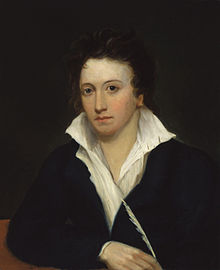
August 4 is the birth-date of poet Percy Bysshe
Shelley, who produced more in his twenty-nine years, than most of us do in
longer life times. Shelley was
influential to many, but was also a source of controversy. One of his earlier publications was titled “The
Necessity of Athiesm”.
Shelley had friends in common with Walter Scott, one of
whom was Lord Byron, whose religious beliefs were also called into question
through his writing. In the entry from
Scott’s Journal below, Scott distinguishes between the two.
February 4 [1828] --Wrote a little and was obliged to correct the
Molière affair for R.P.G. I think his plan cannot go on much longer
with so much
weakness at the helm. A clever fellow would make it take the
field with
a vengeance, but poor G. will run in debt with the
booksellers and let
all go to the devil. I sent a long letter to Lockhart,
received from
Horace Smith, very gentlemanlike and well-written,
complaining that Mr.
Leigh Hunt had mixed him up, in his Life of Byron, with
Shelley as if he
had shared his irreligious opinions. Leigh Hunt afterwards
at the
request of Smith published a swaggering contradiction of the
inference
to be derived from the way in which he has named them
together. Horatio
Smith seems not to have relied upon his disclamation, as he
has
requested me to mention the thing to John Lockhart, and to
some one
influential about Ebony, which I have done accordingly.
Friday, August 3, 2012
Saint Olaf
‘The conscript fathers of Jarlshof, having settled their
own matters, took next under their consideration the case of Swertha, the
banished matron who had been expelled from the castle, whom, as an experienced
and useful ally, they were highly desirous to restore to her office of
housekeeper, should that be found possible. But as their wisdom here failed
them, Swertha, in despair, had recourse to the good offices of Mordaunt
Mertoun, with whom she had acquired some favour by her knowledge in old
Norwegian ballads, and dismal tales concerning the Trows, or Drows (the dwarfs
of the Scalds), with whom superstitious eld had peopled many a lonely cavern
and brown dale in Dunrossness, as in every other district of Zetland.
'Swertha,' said the youth, 'I can do but little for you, but you may do
something for yourself. My father's passion resembles the fury of those ancient
champions — those Berserkars, you sing songs about.'
'Ay — ay, fish of my heart,' replied the old woman, with
a pathetic whine; 'the Berserkars were champions who lived before the blessed
days of St. Olave, and who used to run like madmen on swords, and spears, and
harpoons, and muskets, and snap them all into pieces, as a finner* would go
through a herring-net, and then, when the fury went off, they were as weak and
unstable as water.'…’
Walter Scott managed to bring a saint into a book on
piracy. Saint Olaf was King of Norway
from 1015 to 1030. His influence on
Orkney and the Faroes, where ”The Pirate” was set is remembered still. Olaf's historical range is wide, from the Baltic countries to England and Normandy (at least). Samuel Pepys, a frequent source for this blog, is buried at Saint Olave's Chuch Hart Street, in London. King Olaf II Haroldsson’s beatification took place on August 3rd,
1031, about a year after his death at the Battle of Stiklestad.
Thursday, August 2, 2012
William Rufus
‘While the
princes and barons of the first Crusade were establishing in Palestine the
little Latin kingdom of Jerusalem, various alterations took place in Europe, by
which the rights of the absentees were materially affected. No one suffered
more by these than Robert Duke of Normandy. To furnish himself forth for the
Crusade, this eldest son of William the Conqueror
had imprudently pledged the Duchy of Normandy, being the only part of his
father's dominions which had descended to him, to his brother William, called Rufus, or the
Red, King of England, for a large sum of money. But while Robert was employed
in cleaving Mahometan champions asunder, and exhibiting feats of the most
romantic valour, William was privately engaged in
securing and rendering permanent the temporary interest which the mortgage gave
him in the fief of the duchy, and it soon became evident, that even if Robert
should be able and desirous to redeem the territory, it was not likely that his
more powerful brother would renounce the right he had acquired over it. But the
death of William Rufus brought into play a third
son of the Conqueror. This was Henry, the youngest, whom his brothers, both
Robert and William, had treated with considerable
severity after their father's death, and refused to grant any appanage becoming
his rank. Civil war ensued among the brothers, and on one memorable occasion,
Henry was besieged by his two brethren, in the fortress of Mount Saint Michael,
and reduced to the greatest extremity for want of water. His distress being
communicated to Robert, who was always generous, he instantly sent him a
supply. William, who was of a harder and more
inflexible disposition, upbraided Robert with his imprudent generosity.
"What else could I do?" answered the generous Norman. "He is our
brother. Had he died for lack of water, how were we to supply his loss?"
Upon the surrender of the fortress, however, Henry was
reduced to the condition of a private individual, although his bravery was
equal to that of either of his brothers; his sagacity was
also much superior, and his learning, which was uncommon in those days, so
considerable, that he obtained the name of Beauclerc, or Fine Scholar.
William Rufus was
killed accidentally with an arrow, while hunting in the New Forest, 'which had
been so unscrupulously formed or enlarged, by his father the Conqueror. Henry
was engaged in the same sport in a different part of the forest, and learning
this accident as soon as it happened, rode post-haste to London, and availed
himself of Robert's absence to procure his own election to the crown of
England, which was confirmed by Parliament…’
The fateful
arrow that slew William II of England was fired by Walter Tirel, on August 2nd,
1100. Sir Walter Scott’s history is
found in “Tales of a Grandfather”.
Wednesday, August 1, 2012
London Bridge

In 1799, a competition to design a replacement for the existing
London Bridge was held. John Rennie, from
East Linton, in Scotland won the competition.
Work began in 1824, under Rennie’s son, also John, who Walter Scott
records meeting (Scott’s Journal) on January 26th, 1827. New London Bridge opened August 1, 1831.
According to London2012.com, thirty current olympic athletes share an August 1st birthday. Among them, from the US (where I'm from), Asjha Jones, Jeff Larimer, and Stuart Mcnay. And from host UK, Karen Carney. But to have their picture taken with Rennie's London Bridge, all will have to travel to Arizona. Like the bridge it replaced, Rennie's bridge became outmoded, and was dismantled and shipped to the US in the 1970's. London Bridge was recommissioned in Lake Havasu City, Arizona, in 1971.
According to London2012.com, thirty current olympic athletes share an August 1st birthday. Among them, from the US (where I'm from), Asjha Jones, Jeff Larimer, and Stuart Mcnay. And from host UK, Karen Carney. But to have their picture taken with Rennie's London Bridge, all will have to travel to Arizona. Like the bridge it replaced, Rennie's bridge became outmoded, and was dismantled and shipped to the US in the 1970's. London Bridge was recommissioned in Lake Havasu City, Arizona, in 1971.
Tuesday, July 31, 2012
Review of Moore's "Life of Byron"
‘…When
the power of the mind is growing so fast, it is of immense importance to make
the feeling of literary obligation firm and strong, and to enforce it with an
authority which will neither be defied nor resisted; and this can be done
without difficulty, because men of taste, and poets more than others, have
their intellectual being in the world’s good opinion. The poet, more than all,
needs this restraint of general opinion. The historian makes a slow and patient
impression on others; the force of the orator, except in subjects of unusual
interest, is felt in a space hardly broader than the thunder-cloud of the
storm; but the works of Byron, like those of Scott, not confined to the bounds
of their language, have been read, we have no doubt, by the northern light at
Tornea, and by the pine-torch under the Rocky Mountains; and in all the various
regions between made the wayfaring forget their weariness, and the lonely their
solitude, bearing enjoyment to a million of hearts at once, as if by
supernatural power….’
The great poet Lord Byron and Walter Scott are placed in
company with one another in William Peabody’s review of Moore’s “Life of Byron”,
which was published in the “North American Review”. The article
appeared on July 31, 1830.
Subscribe to:
Posts (Atom)