Showing posts with label Lord Byron. Show all posts

Tuesday, July 31, 2012

Review of Moore's "Life of Byron"


‘…When the power of the mind is growing so fast, it is of immense importance to make the feeling of literary obligation firm and strong, and to enforce it with an authority which will neither be defied nor resisted; and this can be done without difficulty, because men of taste, and poets more than others, have their intellectual being in the world’s good opinion. The poet, more than all, needs this restraint of general opinion. The historian makes a slow and patient impression on others; the force of the orator, except in subjects of unusual interest, is felt in a space hardly broader than the thunder-cloud of the storm; but the works of Byron, like those of Scott, not confined to the bounds of their language, have been read, we have no doubt, by the northern light at Tornea, and by the pine-torch under the Rocky Mountains; and in all the various regions between made the wayfaring forget their weariness, and the lonely their solitude, bearing enjoyment to a million of hearts at once, as if by supernatural power….’

The great poet Lord Byron and Walter Scott are placed in company with one another in William Peabody’s review of Moore’s “Life of Byron”, which was published in the “North American Review”.   The article appeared on July 31, 1830. 

Thursday, July 5, 2012

Scott Supports Byron


‘St. James’s Palace: July 5, 1824.

Dear Mr. H.,—A few lines, as I know you are anxious. The papers have probably announced to you the arrival of that melancholy ship with the dear Remains. Of this I heard on Thursday and was, I believe, the only person who expected it so soon, but for days before I could not divest myself of the sensation, or presentiment, that it was near me. You will think me very foolish, but so it was. It is to be this day in the Docks, and the Remains moved to a house taken for the purpose in George Street, Westminster. The intention is to deposit them either in Westminster Abbey, or our own family vault near our own dear Abbey. I’ve not yet seen Mr. Hobhouse to-day, so I do not know the Dean’s pleasure, which has been sounded, not asked. I am expecting Fletcher every moment! You may guess with what feelings. If I cannot write after having seen him, you shall hear again to-morrow. If this melancholy ceremony takes place in Westminster Abbey, it will be this week, I suppose, and is to be as private and quiet as possible. I almost now wish it may be there, although it was my own original wish that it should be in the other place. But I think it would disappoint and inconvenience some friends who wish to attend. The papers will also give you the account of the will: no other being found, and every reason to suppose no later one has been made, it was to be proved to-day. I cannot express how deeply grateful I am for the very unexpected provision for me and mine. More to-morrow.

Yours ever,

A. L.’

The July 5th letter above, published in “Memoir of Francis Hodgson”, was written by Lord Byron’s half-sister, Augusta Leigh, addressed to Francis Hodgson, shortly after Byron’s death (from the lordbyron.org website).  John Cam Hobhouse is mentioned in the letter, with evident importance to the family interests.

Hobhouse’s interaction with Byron’s life and legacy didn’t end with his death, and in his “Travels in Albania and other Provinces of Turkey in 1809 & 1810”, there is discussion of Byron’s religious beliefs, as interpreted through his works, and the characters in his works by the Bishop of London.  Walter Scott’s opinion is integral in defending Byron.  

‘…It must be allowed that an author, however famous, and of whatever genius, whose writings could be fairly said to be systematically directed to the subversion of the Christian religion, ought not to be held up to the esteem and imitation of posterity in a temple devoted to Christian worship, nor perhaps in any other national repository… The Bishop, according to one report, seems to have designated Byron as a writer of much the same pernicious tendency as another great historian, not Hume, but Gibbon… that the general scope and tendency of his poems are such as to justify the condemnation of the Bishop of London, may be safely denied… It is very possible, that a reader may not rise from the perusal of these poems a better or a happier man—the same may be said of other authors, against whom no charge of infidelity was ever made. .—was any man ever made happier by reading Rasselas, or better by reading Pamela, or even Clarissa? 

… Had Lord Byron been such a writer as the Bishop declares him to have been, is it to be believed that those who are found amongst the subscribers to the monumental statue, and most of whom were members of the Committee formed to promote that object, would have lent the authority of their great names to honour and perpetuate his memory?

…In that list were found his generous rivals, whose fame for a time he almost eclipsed, Sogers," and Campbell, and Moore, and there also the most marvellous, and the most popular, but at the same time the most scrupulous and careful of all modern writers—the great Walter Scott himself, whose peculiar praise it is, that in a branch of literature most liable to be tainted with levity, and in all his hundred volumes, not one sentence, not one word is to be found which piety would wish to blot.  And this good man—this religious man—when applied to for the sanction of his name, replied in terms of which nothing need be said— they speak for themselves. His first letter runs thus—
                                                                                    “Edinburgh, 27th January [1826].
Sir,                                                                                         
I am almost, ashamed that personal business of my own, though involving a considerable part of my fortune, should have prevented me for a single post from replying to your very interesting communication. I will be most happy to contribute anything in my power, to show the high veneration I entertained for Lord Byron's brilliant genius, and deep sense I entertain for the friendship with which he regarded me.

I have just accomplished a settlement of the affairs I alluded to, under conditions which will greatly limit my power of doing what last month I would cheerfully have done in such a case, and, therefore, it would not, I think, be fitting that my name should stand amongst the Committee. But I put myself in your hands as to this, only saying that, though my subscription must be in proportion to my power, rather than my inclination, if there is anything else, in which I could be of the slightest use, whether I am one of the Committee or not, it will give me the highest pleasure.

I am, Sir, with respect,
Your most obedient humble Servant,
                                                                                     WALTER SCOTT." 

After many months, a list of those who had consented to be on the Committee was sent to Sir Walter Scott, who acknowledged the receipt of it in the following letter to the same gentleman :—

"Sir,—I am honoured with your letter, and am much gratified by the society in which my name is introduced in the inclosed list. I hope, among so many noblemen and gentlemen well qualified to judge and decide, the matter will not be allowed to sleep. The natural wish, perhaps, would be for a statue in Westminster, and though I am aware difficulties might occur, yet, perhaps, with management, they might be overcome. Byron ought to be in his living form along with the great and glorious of the isle, who reign so many centuries after their death; and I should [hope] the guardians of that asylum would not fix their attention on speculative error and levities, but consider the quantity of genius of which Britain is prematurely deprived, and the real character of the individual, though it was not always that which was most ostensible. But whatever the Committee may determine on will be agreeable to me, and I will only be glad to be considered as one who takes peculiar interest in the undertaking.
I have the honour to be, Sir,
"Your obliged, humble Servant,
Edinburgh, 6 December, 1826.                              walter Scott. “

Monday, July 2, 2012

Childe Harold


‘Edinburgh, July 2nd, 1812.
My dear Sir,

I have been very silent, partly through pressure of business and partly from idleness and procrastination, but it would be very ungracious to delay returning my thanks for your kindness in transmitting the very flattering particulars of the Prince Regent’s conversation with Lord Byron. I trouble you with a few lines to his Lordship expressive of my thanks for his very handsome and gratifying communication, and I hope he will not consider it as intrusive in a veteran author to pay my debt of gratitude for the high pleasure I have received from the perusal of ‘Childe Harold,’ which is certainly the most original poem which we have had this many a day I owe you best thanks not only for that but for the Calamities of Authors which has all the entertaining and lively features of the curiosities of literature. I am just packing them up with a few other books for my hermitage at Abbotsford where my present parlour is only twelve foot square & my book press in liliputian proportion. . . . . .

Your obliged, humble Servant,

Walter Scott’

Scott thought very highly of Lord Byron’s “Childe Harold”, as he expressed in a letter to publisher John Murray on July 2, 1812.

Thursday, June 28, 2012

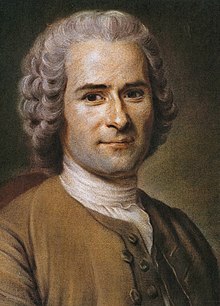
Jean-Jacques Rousseau


The thinking of Swiss philosopher Jean-Jacques Rousseau, who was born on June 28, 1712, influenced the French Revolution.  It also inspired Walter Scott’s friend Lord Byron.  Sir Walter Scott provides evidence, and his own opinions, in his biographical sketch of Lord Byron, which is published in “The Miscellaneous Works of Sir Walter Scott”.

‘…The next theme on which the poet [Byron] rushes, is the character of the enthusiastic, and as Lord Byron well terms him, "self-torturing sophist, wild Rousseau," a subject naturally suggested by the scenes in which that unhappy visionary dwelt, at war with all others, and by no means at peace with himself; an affected contemner of polished society, for whose applause he secretly panted, and a waster of eloquence in praise of the savage state in which his paradoxical reasoning, and studied, if not affected, declamation, would never have procured him an instant's notice. In the following stanza, his character and foibles are happily treated.

"His life was one long war with self-sought foes, Or friends by him self-banish'd; for his mind Had grown Suspicion's sanctuary, and chose For its own cruel sacrifice, the kind, 'Gainst whom he raged with fury strange and blind. But he was frenzied—wherefore, who may know? Since cause might be which skill could never find; But he was frenzied by disease or woe, To that worst pitch of all, which wears a reasoning show."

In another part of the poem, this subject is renewed, where the traveller visits the scenery of La Nouvelle Eloise.

"Clarens, sweet Clarens, birthplace of deep love,
Thine air is the young breath of passionate thought;
Thy trees take root in love; the snows above
The very Glaciers have his colours caught,
And sunset into rose-hues sees them wrought,
By rays which sleep there lovingly." 

There is much more of beautiful and animated description, from which it appears that the impassioned parts of Rousseau's romance have made a deep impression upon the feelings of the noble poet. The enthusiasm expressed by Lord Byron is no small tribute to the power possessed by Jean Jacques over the passions; and, to say truth, we needed some such evidence, for, though almost ashamed to avow the truth, which is probably very much to our own discredit, still, like the barber of Midas, we must speak or die, we have never been able to feel the interest, or discover the merit, of this far-famed performance. That there is much eloquence in the letters, we readily admit: there lay Rousseau's strength. But his lovers, the celebrated St Preux and Julie, have, from the earliest moment we have heard the tale (which we well remember) down to the present hour, totally failed to interest us. There might be some constitutional hardness of heart; but, like Lance's pebblehearted cur, Crab, we remained dry-eyed, while all wept around us. And still, on resuming the volume, even now, we can see little in the loves of these two tiresome pedants to interest our feelings for either of them; we are by no means flattered by the character of Lord Edward Bomston, produced as the representative of the English nation; and, upon the whole, consider the dulness of the story as the best apology for its exquisite immorality. To state our opinion in language much better than our own, we are unfortunate enough to regard this far-famed history of philosophical gallantry as an "unfashioned, indelicate, sour, gloomy, ferocious medley of pedantry and lewdness; of metaphysical speculations, blended with the coarsest sensuality." Neither does Rousseau claim a higher rank with us on account of that Pythian and frenetic inspiration which vented

"Those oracles which set the world in flame,
Nor ceased to burn till kingdoms were no more." 

We agree with Lord Byron that this frenzied sophist, reasoning upon false principles, or rather presenting that show of reasoning which is the worst pitch of madness, was a primary apostle of the French Revolution; nor do we differ greatly from his Lordship's conclusion, that good and evil were together overthrown in that volcanic explosion. But when Lord Byron assures us, that after the successive changes of government by which the French legislators have attempted to reach a theoretic perfection of constitution, mankind must and will begin the same work anew, in order to do it better and more effectually,—we devoutly hope the experiment, however hopeful, may not be renewed in our time, and that the " fixed passion" which Childe Harold describes as "holding his breath," and waiting the "atoning hour," will choke in his purpose ere that hour arrives. Surely the voice of dear-bought experience should now at length silence, even in France, the clamour of empirical philosophy. Who would listen a moment to the blundering mechanic who should say, " I have burned your house down ten times in the attempt, but let me once more disturb your old fashioned chimneys and vents, in order to make another trial, and I will pledge myself to succeed, in heating it upon the newest and most approved principle?"…’

Sunday, April 29, 2012

Works on Napoleon


Following yesterday’s post with a little more on Walter Scott’s friend Lord Byron, Scott enjoyed more initial success with his work on Napoleon, than Byron did with his “Ode to Napoleon Bonaparte”.  On April 29th, 1814, Byron responded to letter from publisher John Murray, offering effectively to relieve Murray from having to publish further of his poetry, after the failure of this ode.  Both Murray’s and Byron’s letters are found in Samuel Smiles’ “A Publisher and his Friends”

‘[Murry to Byron]…The "Ode to Napoleon Bonaparte," which appeared in April 1814, was on
the whole a failure. It was known to be Lord Byron's, and its
publication was seized upon by the press as the occasion for many bitter
criticisms, mingled with personalities against the writer's genius and
character. He was cut to the quick by these notices, and came to the
determination to buy back the whole of the copyrights of his works, and
suppress every line he had ever written. On April 29, 1814, he wrote to
Mr. Murray:

Lord Byron to John Murray.

April 29, 1814.

I enclose a draft for the money; when paid, send the copyrights. I
release you from the thousand pounds agreed on for "The Giaour" and
"Bride," and there's an end.... For all this, it might be well to assign
some reason. I have none to give, except my own caprice, and I do not
consider the circumstance of consequence enough to require
explanation.... It will give me great pleasure to preserve your
acquaintance, and to consider you as my friend. Believe me very truly,
and for much attention,

Yours, etc.,

BYRON…’

After further communication from Murray, Byron reconsidered.