Showing posts with label August 4. Show all posts

Saturday, August 4, 2012

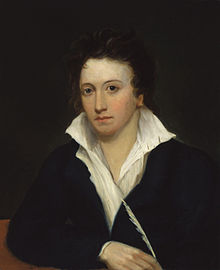
Percy Bysshe Shelley


August 4 is the birth-date of poet Percy Bysshe Shelley, who produced more in his twenty-nine years, than most of us do in longer life times.  Shelley was influential to many, but was also a source of controversy.  One of his earlier publications was titled “The Necessity of Athiesm”. 

Shelley had friends in common with Walter Scott, one of whom was Lord Byron, whose religious beliefs were also called into question through his writing.  In the entry from Scott’s Journal below, Scott distinguishes between the two.

February 4 [1828] --Wrote a little and was obliged to correct the Molière affair for R.P.G. I think his plan cannot go on much longer with so much
weakness at the helm. A clever fellow would make it take the field with
a vengeance, but poor G. will run in debt with the booksellers and let
all go to the devil. I sent a long letter to Lockhart, received from
Horace Smith, very gentlemanlike and well-written, complaining that Mr.
Leigh Hunt had mixed him up, in his Life of Byron, with Shelley as if he
had shared his irreligious opinions. Leigh Hunt afterwards at the
request of Smith published a swaggering contradiction of the inference
to be derived from the way in which he has named them together. Horatio
Smith seems not to have relied upon his disclamation, as he has
requested me to mention the thing to John Lockhart, and to some one
influential about Ebony, which I have done accordingly.

Thursday, August 4, 2011

Battle of Stanhope Park

August 4, 1327 saw the conclusion of a conflict between English and Scots forces at Stanhope Park.  The result was a victory for Scotland, led by James Douglas; the “Black Douglas”.  Walter Scott’s “The History of Scotland” provides some detail on the battle.

‘The king sent a herald to defy the Scots to a fair field of fight, according to the practice of chivalry : he offered either to withdraw his own troops from the northern hank, and permit the Scottish army to come over and form in array of battle; or, if the enemy preferred to retire from the southern bank, and allow the English to cross the river unmolested, he declared his willingness to make the attack. But Douglas and Randolph knew too well their own inferiority in numbers and appointments, and the great advantage of their present situation, to embrace either alternative. They returned for answer, that they had entered England without the consent of the king and his barons; that they would abide in the realm as long as they pleased : " if the king dislikes our presence," said they, " let him pass the river, and do his best to chastise us." Thus the two armies continued facing each other; the Scots on the south bank of the Wear, the English on the north; the former subsisting on the herds of cattle which they drove in from the country on all hands, the latter living poorly on such provisions as they brought with them : the former spending their night round immense fires, maintained in the greater profusion for the pleasure of wasting the English wood, and lodging in huts and lodges made of boughs; the English, who were on the depopulated and wasted side of the river, sleeping many of them in the open air, with their saddles for pillows, and holding their horses in their hands. They were annoyed by the Scottish bordermen winding their horns all night, and making a noise as if, says Froissart, " all the devils of hell had been there." Having thus faced each other for two or three days, the English, at dawn of the third or fourth morning, perceived the Scots' position was deserted and empty. They had decamped with much silence and celerity, and were soon found to have occupied a new position on the Wear, resembling the former in its general description, but even stronger, and masked by a wood, being part of an inclosed chase, called Stanhope Deer-park, the property of the bishop of Durham. Here the two hostile armies confronted each other as formerly; the English declining to attack on account of the strength of the Scottish position, the Scots refusing battle with an army superior to their own….
But the English did not remain long in the. neighbourhood of the Douglas in undisturbed slumbers. On the second night after their arrival in this new position, that enterprising leader left the Scottish camp with a select body of men at arms, crossed the Wear at a distance from the English encampment, and entered it, saying, as he passed the sleepy sentinels, in the manner and with the national exclamation of an English officer making the rounds: " Ha! Saint George! have we no ward here ?" He reached the king's tent without discovery, cut asunder the ropes, and cried his war cry of " Douglas ! Douglas !" The young king only escaped death or captivity by the fidelity of his chaplain and others of his household, who fell in his defence. Disappointed in his attempt on the king's person, which was his main object, Douglas cut his way through the English host, who were now gathering fast, broke from their encampment, and returned safe to the Scottish camp with fresh laurels in his helmet…’
Wednesday, August 4, 2010

Battle of Evesham

A part of the Second Barons' War, the Battle of Eesham took place on August 4, 1265.  The battle pitted Prince Edward - later Edward I of England - against Simon de Montfort, the Earl of Leicester. 

Leicester in 1265 was the most powerful person in England.  He had defeated King Henry III in 1264 at the Battle of Lewes, and held Henry and his sons Edward and Richard as captives.  Edward escaped in May 1265, with the aid of Gilbert de Clare, a former ally of Leicester's. 

Edward soon displayed some of the military prowess, and ruthlessness that marked his reign.  He gathered Royalist forces, and made a surprise attack on Kenilworth Castle, where Simon de Montfort's son Simon was in charge.

The elder Simon was en route to Kenilworth at the time, reaching Evesham on August 3rd.  The battle the following day was one-sided, with Edward having the advantage in terms of position and numbers.  Leicester and his son Henry were slaughtered on the field of battle, along with most of their forces.

Walter Scott set his novel "Kenilworth" in the historical Kenilworth Castle, with this description from the text:

'At length the princely Castle appeared, upon improving which, and the domains around, the Earl of Leicester had, it is said, expended sixty thousand pounds sterling, a sum equal to half a million of our present money.

The outer wall of this splendid and gigantic structure enclosed seven acres, a part of which was occupied by extensive stables, and by a pleasure garden, with its trim arbours and parterres, and the rest formed the large base-court or outer yard of the noble Castle. The lordly structure itself, which rose near the centre of this spacious enclosure, was composed of a huge pile of magnificent castellated buildings, apparently of different ages, surrounding an inner court, and bearing in the names attached to each portion of the magnificent mass, and in the armorial bearings which were there blazoned, the emblems of mighty chiefs who had long passed away, and whose history, could Ambition have lent ear to it, might have read a lesson to the haughty favourite who had now acquired and was augmenting the fair domain. A large and massive Keep, which formed the citadel of the Castle, was of uncertain though great antiquity. It bore the name of Caesar, perhaps from its resemblance to that in the Tower of London so called. Some antiquaries ascribe its foundation to the time of Kenelph, from whom the Castle had its name, a Saxon King of Mercia, and others to an early era after the Norman Conquest. On the exterior walls frowned the scutcheon of the Clintons, by whom they were founded in the reign of Henry I.; and of the yet more redoubted Simon de Montfort, by whom, during the Barons' wars, Kenilworth was long held out against Henry III...'