Showing posts with label April 3. Show all posts

Tuesday, April 3, 2012

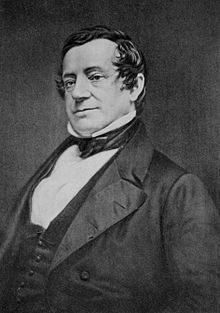
Washington Irving's Birth


Washington Irving was born on April 3rd, 1783, the son of Orcadian William Irving.  As noted previously in this blog, Sir Walter Scott helped Irving publish his “The Sketch Book of Geoffrey Crayon” in England.  The story is told in Samuel Smiles’ memoir of John Murray “A Publisher and his Friends”.

‘…A business in Liverpool, in which, with his brother, he [Irving] was a partner, proved a failure, and in 1818 he was engaged on his famous "Sketch Book," which he wrote in England, and sent to his brother Ebenezer in New York to be published there. The work appeared in three parts in the course of the year 1819. Several of the articles were copied in English periodicals and were read with great admiration. A writer in Blackwood
expressed surprise that Mr. Irving had thought fit to publish his
"Sketch Book" in America earlier than in Britain, and predicted a large
and eager demand for such a work. On this encouragement, Irving, who was
still in England, took the first three numbers, which had already
appeared in America, to Mr. Murray, and left them with him for
examination and approval. Murray excused himself on the ground that he
did not consider the work in question likely to form the basis of
"satisfactory accounts," and without this he had no "satisfaction" in
undertaking to publish.

Irving thereupon sought (but did not take) the advice of Sir W. Scott,
and entered into an arrangement with Miller of the Burlington Arcade,
and in February 1820 the first four numbers were published in a volume.
Miller shortly after became bankrupt, the sale of the book (of which one
thousand had been printed) was interrupted, and Irving's hopes of profit
were dashed to the ground. At this juncture, Walter Scott, who was then
in London, came to his help.


"I called to him for help as I was sticking in the mire, and, more
propitious than Hercules, he put his own shoulder to the wheel. Through
his favourable representations Murray was quickly induced to undertake
the future publication of the work which he had previously declined. A
further edition of the first volume was put to press, and from that time
Murray became my publisher, conducting himself in all his dealings with
that fair, open, and liberal spirit which had obtained for him the
well-merited appellation of the Prince of Booksellers." [Footnote:
Preface to the revised edition of "The Sketch Book."]

Irving, being greatly in want of money, offered to dispose of the work
entirely to the publisher, and Murray, though he had no legal protection
for his purchase, not only gave him £200 for it, but two months later
he wrote to Irving, stating that his volumes had succeeded so much
beyond his commercial estimate that he begged he would do him the favour
to draw on him at sixty-five days for one hundred guineas in addition to
the sum agreed upon. And again, eight months later, Murray made Irving a
second gratuitous contribution of a hundred pounds, to which the author
replied, "I never knew any one convey so much meaning in so concise and
agreeable a manner." The author's "Bracebridge Hall" and other works
were also published by Mr. Murray…’

Sunday, April 3, 2011

Edward the Confessor Crowned

'There remained betwixt Cedric and the determination which the lovers desired to come to, only two obstacles,— his own obstinacy, and his dislike of the Norman dynasty. The former feeling gradually gave way before the endearments of his ward, and the pride which he could not help nourishing in the fame of his son. Besides, he was not insensible to the honour of allying his own line to that of Alfred, when the superior claims of the descendant of Edward the Confessor were abandoned for ever. Cedric's aversion to the Norman race of kings was also much undermined,—first, by consideration of the impossibility of ridding England of the new dynasty, a feeling which goes far to create loyalty in the subject to the king de facto; and secondly, by the personal attention of King Richard, who delighted in the blunt humour of Cedric, and, to use the language of the Wardour Manuscript, so dealt with the noble Saxon, that, ere he had been a guest at court for seven days, he had given his consent to the marriage of his ward Rowena and his son Wilfred of Ivanhoe.'

The text above is from Walter Scott's "Ivanhoe".  Edward the Confessor was crowned king of England on April 3, 1043.  Upon his death, Harold Godwinson, the last Saxon king took power.  His rule lasted just long enough to run up against William the Conqueror, who ushered in the Norman era in England that, against the Saxons, forms the clash of culture in "Ivanhoe".

Saturday, April 3, 2010

Bonnymuir

On April 3, 1820, the ill-fated Radical War took its first real action, with a strike by artisans in central Scotland.  A militant group among the Radicals determined to seize weapons at the Carron Iron Works.  Proceeding from Glasgow toward the Carron Company, they were stopped at Bonnymuir by Perth-based troops; the 11th Hussars commanded by Lt. Ellis Hodgson.  Two of the Radical leaders, John Baird and Andrew Hardie, were later tried and executed for their roles in this uprising.

Walter Scott recorded these words concerning the executions of Hardie and Baird in the Edinburgh Annual Register (v. 13)

8th (September 1820).—Stirling.—Execution Of Hardie And Baird.—During last night the usual apparatus was erected in front of the stair leading to the Townhouse, and in the morning exhibited two decently ornamented coffins on the platform, with a dark-coloured wooden block.


About 12 o'clock two troops of the Dragoon Guards entered the esplanade before the Castle, and formed a wide semicircle in front of the drawbridge. Within this a party of the 13th foot drew up. The crowd collected on the esplanade was inconsiderable. At a quarter to one o'clock the Sheriff and Magistrates left the Townhall in procession, and walked to the Castle to receive the prisoners. Immediately on their arrival the gates of the Castle were thrown open, and Baird and Hardie appeared, attended by the authorities of the garrison and the established clergy men of the town. Baird looked pale and thoughtful; Hardie's countenance did not seem much altered. With astonishing calmness they bade an affectionate farewell to the officers of the corps in the Castle, and expressed warmly their gratitude for the indulgence they had experienced during their confinement. They both surveyed the ignominious preparation for their removal with dignity, and were kindly assisted to their seat on the hurdle by the clergymen. The headsman in the mask, who decapitated Wilson at Glasgow, took his seat on the hurdle opposite the two victims, with his hatchet resting on his thigh. As he entered, a slight expression of contempt marked the features of Hardie. Baird was busy with a Bible, and spoke a few words to the clergyman next him. The cavalcade began to move down the esplanade, and the prisoners united in singing a psalm till they reached the bottom of the scaffold. Hardie stepped out of the hurdle, and looked up to the drop without the slightest trace of discomposure. They walked into the court-room, each resting on the arm of a clergyman— With great apparent earnestness they joined in the religious devotions, which lasted till twenty-five minutes past two, when their arms were bound, and they walked with a firm step and elevated mien to the drop. They were followed by the civil authorities and the clergymen. Baird advanced to the railing, and bowed gracefully; a smile was on his countenance, and he expressed a wish to be heard. Silence being obtained, with a loud unfaltering voice, he recommended to the understandings and lives of his hearers the doctrines and precepts of Christianity. We caught, "Oh ! I entreat of you, notice your Bibles, and conduct yourselves soberly ; mind religion at all times; but be not regardless of justice and reason on every subject." He then maintained his strong attachment to the cause in which he had been merely imprudent, and declared himself pure, in his political purposes. He rejoiced in the. knowledge he had obtained of a Saviour, who had likewise Buffered innocently ; and spoke gratefully of the clerical aid he had enjoyed. During his address he gesticulated violently, turning round in all directions. Hardie, at the commencement of it, sat calmly down on the block, and in rising up paid his respects to an acquaintance whom he saw in the crowd. He then spoke with equal freedom, but less distinctness, and seemed less subdued in spirit. His political conduct appeared uppermost in his thoughts; and the crowd could only hear him say, " I die a martyr to the cause of liberty, truth, and justice." This seemed to operate like a charm on the hitherto sad multitude, and was greeted by three vehement cheers. He was interrupted by the cheering and a tap on the shoulder by the sheriff, to whom he turned round, and replied to whatever had been said to him. He then resumed his address, changing the subject to an expression of his religious feelings. The executioner having prepared Baird during the address of Hardie, they were soon both ready to be launched. Having both joined in the prayer of a clergyman behind them, Baird spoke something towards the spectators through his cap, and dropped the signal. They died almost without a struggle.


After hanging half an hour, Calder, the sheriffs officer, came forward and caught the bodies alternately, whilst the hangman cut them down. They then placed them on the scaffold, and Calder having bared the neck to the shoulders, cutting open the coat and vest, the decapitator came forward amid execrations, hisses, and shouts of "Murder!" One blow aimed at the first neck he engaged failed to sever the head; and a second, with mangling, scarcely effected it. He held it up; it seemed to be that of Hardie, swoln and livid, but placid. The blood trinkled down ; the usual proclamation was feebly pronounced, having to come through the crape, mask of the headsman. The cries of "Butchery ! Ruffian!" were general, but seemed to make no impression on the operator, who advanced to the next, and was equally unfortunate in his odious work. The mangling horrified the spectators; the head was proclaimed; and the decapitator quickly retreated, amid loudly expressed disapprobation.


To the credit of the humanity of the inhabitants of this place, very few attended the execution. The crowd seemed almost entirely composed of people from the country, this being the market-day. Females of any respectability there seemed none; and scarcely any spectators occupied the neighbouring windows.